
 Lesson 5.2
Lesson 5.2 · Space, Form & Feeling
Complexity, Order & Beauty
The brain seems to like neither a blank, monotonous wall nor a chaotic visual mess but something in between - a rich, ordered complexity, the kind of patterned intricacy we find in nature, in a good facade, in a well-made ornament - and the young science of neuroaesthetics is trying to understand why we find some things beautiful; there is genuine, interesting evidence here, but it is also a field thick with overclaim, so the honest task is to design for coherent, interesting, human richness while treating grand 'science of beauty' pronouncements with real skepticism
A blank wall bores us; a chaotic jumble tires us; but a richly ordered surface - a carved screen, a leafy canopy, a good facade - can hold the eye for a lifetime. Why?
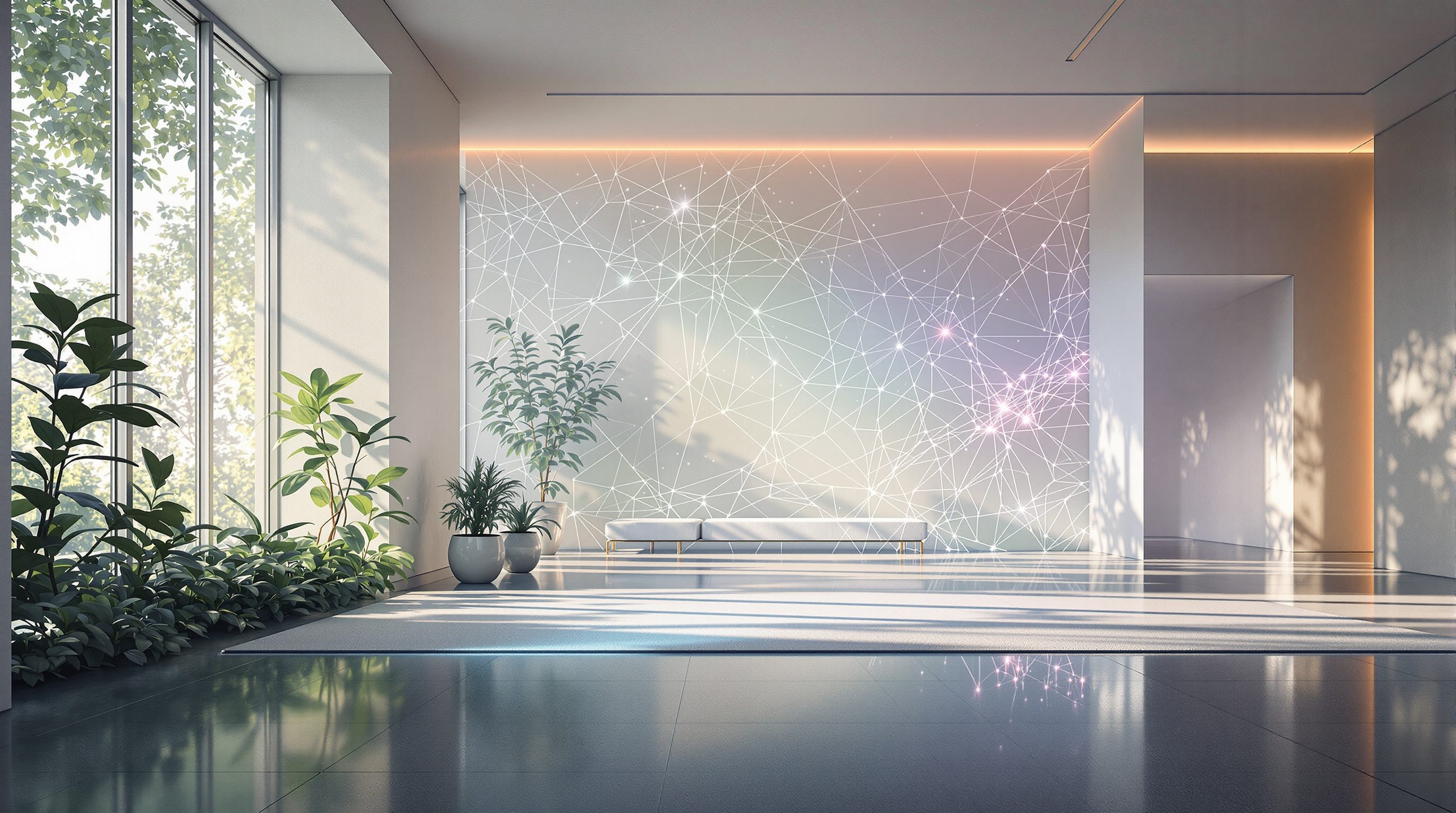
Stand in front of a completely blank, featureless wall and the eye slides off it, restless and unsatisfied - there is nothing to hold attention, and monotony has its own low fatigue. Stand in front of a chaotic visual mess - a cluttered, clashing, disordered surface with no pattern to grasp - and the eye is overwhelmed and tired in a different way, unable to settle. But stand in front of something in between - the intricate order of a carved jaali, the branching richness of a great tree, the patterned rhythm of a well-composed facade, the detail of a Persian carpet or a temple wall - and the eye is happily held, exploring, never bored and never overloaded. There seems to be a preferred middle: a balance of order and complexity, richness with underlying structure, that the human visual system finds deeply satisfying.
This is one of the more genuinely interesting frontiers of neuroarchitecture, and it connects to the young field of neuroaesthetics - the attempt to understand, with the tools of neuroscience and psychology, why we find some things beautiful. There is real and fascinating evidence here: people across many studies tend to prefer a middling level of visual complexity over both bareness and chaos; natural, fractal-like patterns are often found calming and pleasing; curved forms tend to be preferred over sharp, angular ones by many people. But this is also a field thick with overclaim, where a single brain scan gets spun into 'science proves this building is objectively beautiful' and where genuine, tentative findings are inflated into universal laws of beauty. So the stance of this lesson is genuine interest held with real skepticism: take seriously that the brain responds to complexity, order and pattern in describable ways, design for coherent human richness deliberately - and treat any grand pronouncement about the settled science of beauty with the caution it deserves.
Preference = inverted U. Blank -> starved. Chaos -> overwhelmed. Middle = ordered richness (coherence + detail). Nature's fractal patterns pleasing (biophilia bridge) - suggestive not settled. Neuroaesthetics: real broad tendencies BUT heavily overclaimed, no objective beauty. Interest + skepticism.
The preferred middle: complexity with order
A recurring finding across environmental psychology and aesthetics is that human preference for visual complexity tends to follow an inverted-U curve: too little complexity (a blank, monotonous, featureless surface or space) is under-stimulating and mildly unpleasant, too much (a chaotic, cluttered, disordered jumble) is overwhelming and stressful, and somewhere in the middle - rich but ordered, complex but coherent - sits a preferred zone where the eye is engaged without being taxed. The key word is coherent: what people seem to like is not raw complexity but complexity held together by an underlying order - a pattern, a rhythm, a structure the brain can grasp even as it enjoys the detail. A great carved screen, a patterned textile, a well-proportioned facade with rhythm and articulation, a leafy tree, a traditional street of related-but-varied buildings - all offer this marriage of richness and structure. The brain, it seems, is a pattern-seeking organ that delights in finding order within complexity, and is dissatisfied by both the emptiness that offers nothing to find and the chaos that defeats the finding.
This matters directly for design, because so much of modern building errs toward one extreme or the other. Vast blank walls, endless identical facades, flat monotonous surfaces and stripped-bare minimalism can leave the eye starved and the environment subtly draining - the visual equivalent of silence pushed to sensory deprivation. At the other extreme, visual chaos - clashing signage, cluttered uncoordinated surfaces, restless over-decoration with no order - overloads and tires. The design lesson is to aim for the ordered-richness middle: give surfaces and spaces enough interest, detail and pattern to engage and reward attention, but hold that richness within a clear order, rhythm and coherence so it reads as resolved rather than chaotic. This is deeply resonant with traditional architecture worldwide and especially in India, where ornament, pattern and detail were never gratuitous but organised by strong underlying geometry and rhythm - the jaali, the carved column, the patterned floor, all rich AND ordered. The honest caveat, held throughout: the inverted-U is a robust general pattern, but the location of the 'preferred' peak shifts with the person, their culture and their familiarity, so it is a guiding tendency, not a fixed setting.
Preference vs complexity = inverted U. Too bare -> boring/draining. Too chaotic -> overwhelming. Middle = RICH but ORDERED (coherent). Brain seeks order within complexity. Peak shifts by person/culture/familiarity. Aim for ordered richness (jaali, good facade, tree).
Nature's patterns and the pull of fractals
One of the most intriguing threads in this area is the appeal of fractal-like patterns - the self-similar, repeating-at-different-scales patterns found throughout nature, in the branching of trees, the edges of clouds and coastlines, the veins of a leaf, the ripple of water. Some research suggests that people find fractal patterns of a certain moderate complexity particularly pleasing and even calming, and that our visual system, evolved in a natural world saturated with such patterns, may be especially tuned to them - a possible bridge between this lesson and biophilia, the innate affinity for nature. If true, it would help explain why natural scenes and natural materials so reliably please and soothe, why patterned traditional ornament (often derived from natural forms) is satisfying, and why blank, hard-edged, patternless modern surfaces can feel subtly sterile. It is a genuinely interesting idea with some supporting evidence, and it offers designers a real cue: bring natural or nature-like pattern, texture and moderate fractal richness into surfaces, materials and views, rather than defaulting to flat blankness.
But this is exactly the kind of finding that gets overclaimed, so hold it carefully. The evidence that we prefer certain fractal dimensions is interesting but far from settled - studies are relatively few, effects vary, and the leap from 'people in a study rated these patterns pleasant' to 'the brain is hard-wired for a specific fractal dimension that architects must use' is a large one the evidence does not support. Treat fractal-preference as a suggestive, promising idea that reinforces the broader, better-evidenced value of natural pattern and complexity, not as a precise formula to be applied by number. The safe and honest translation is the general one: nature's patterns - branching, layered, self-similar, moderately complex - are a reliable source of the ordered richness people find satisfying, so drawing on natural pattern, texture and form (directly through greenery, materials and views, or indirectly through nature-derived ornament and geometry) is a sound design move. Just describe it as 'nature-inspired richness that people tend to find pleasing and calming', which the evidence broadly supports, rather than 'the scientifically optimal fractal dimension', which it does not.
Neuroaesthetics: the contested science of beauty
Behind all this sits neuroaesthetics - the young field trying to understand, using neuroscience and psychology, what happens in the brain when we find something beautiful, and why. It is a genuinely fascinating enterprise, and it has produced some interesting, tentative findings: that aesthetic experiences engage the brain's reward and emotion systems; that people on average tend to prefer curved over sharp-angled forms, moderate over extreme complexity, and coherent over chaotic compositions; that beauty is not purely arbitrary but has some sharable, describable regularities across people. Taken modestly, this is valuable - it suggests that some aesthetic responses are broadly human and can be designed for, and it dignifies the study of beauty as a real subject rather than pure whim. A brain-literate designer can draw genuine encouragement from it: the sense that a well-composed, coherent, richly-ordered, nature-inflected environment pleases people is not merely personal taste but has some grounding in how humans generally respond.
And yet neuroaesthetics is also one of the most overclaimed and misused areas in the whole field, and honesty demands equal emphasis here. The prestige of a brain scan is constantly used to launder aesthetic opinion into 'proof': a designer's or developer's preferred style is declared 'scientifically beautiful' or 'what the brain wants', a single small study is inflated into a universal law, and the deep truth that beauty is heavily shaped by culture, era, personal history and context is quietly dropped. The reality is that aesthetic preference varies enormously across cultures and individuals, that much neuroaesthetic evidence comes from small, artificial lab studies that generalise poorly, that 'the brain lights up' tells us far less than the confident language implies, and that there is no settled science that ranks buildings or styles by objective beauty. So the stance is genuine interest with firm skepticism: welcome the modest, real finding that humans share some broad aesthetic tendencies (toward coherence, moderate complexity, curves, natural pattern) and design for them thoughtfully, while flatly rejecting any claim that neuroscience has settled what is beautiful, proven one style objectively superior, or turned taste into a formula. When you meet 'neuroscience proves this is beautiful', ask the course's core question - what is the actual evidence, how strong, and does it apply here - and expect the grand version to fail it.
Neuroaesthetics: real, interesting - aesthetics engage reward/emotion; broad tendencies (curves > sharp, moderate complexity, coherence). BUT heavily overclaimed: brain scan laundering taste into 'proof', culture/person ignored, small lab studies. No settled science of objective beauty. Interest + skepticism.
Designing rich, ordered beauty - honestly
The practical distillation is confident about the design move and humble about the science. Aim for ordered richness: give the spaces and surfaces people live with enough complexity, detail, pattern and texture to engage and reward the eye over time, while holding that richness within a clear underlying order, rhythm and coherence so it reads as resolved, not chaotic. Avoid both failure modes - the blank, monotonous, under-stimulating surface that leaves the eye starved, and the cluttered, incoherent chaos that overwhelms it. Draw richness especially from nature and natural pattern - greenery, natural materials with their inherent texture and variation, views of natural scenes, and ornament and geometry derived from natural forms - since this is among the most reliable sources of the moderate, fractal-like, ordered complexity people find satisfying and calming. Use rhythm, proportion, articulation and pattern to organise detail rather than suppress it. This is, in effect, a re-legitimising of ornament, pattern and richness after a long era that often stripped them away - and a homecoming to traditions, strongly including India's, where rich, ordered pattern was always the norm.
Hold the honesty as firmly as the guidance. Describe your aesthetic decisions as skilled design judgement, informed by broad and tentative evidence about human preference, not as neuroscience-certified truth: 'people tend to find coherent, richly-ordered, nature-inflected environments engaging and calming, and there is some evidence for that' is honest; 'neuroscience proves this facade is objectively beautiful' is neuro-washing. Respect difference: the preferred level and kind of complexity varies across people, cultures and eras, so what reads as satisfying richness to one may read as too much or too little to another - which argues for coherence and quality over any single 'correct' style, and for cultural literacy over universal formulas (a good reason to learn from India's own rich traditions rather than importing a generic aesthetic). And keep the boundary clear: beauty and visual richness genuinely contribute to how a space feels and can support wellbeing, but this is aesthetics and design judgement, not a clinical intervention - no facade cures anything, and any health claim belongs to real evidence and qualified professionals. Design for rich, ordered, human beauty with conviction; talk about the science of it with humility.
Aim for the ordered-richness middle
Composing surfaces, facades and rooms
Avoid both blank monotony (starves the eye) and incoherent chaos (overwhelms it); give detail and pattern held within clear order and rhythm. The inverted-U is a general tendency, and its peak shifts by person and culture. Modules 5.2, 5.1.
Natural pattern as reliable richness
Sourcing complexity
Nature's moderate, fractal-like, layered patterns are a dependable source of satisfying, calming richness (a bridge to biophilia). Describe as 'nature-inspired richness people tend to find pleasing', not an optimal fractal number. Modules 5.2, 3.2.
Neuroaesthetics: interest, not proof
Reading a 'science of beauty' claim
Real broad tendencies exist (coherence, moderate complexity, curves), but there is no settled science ranking styles by objective beauty. A brain scan does not prove a design beautiful. Modules 5.2, 9.1.
Respect cultural and individual difference
Any universal aesthetic claim
Preferred complexity and beauty vary by culture, era and person; favour coherence and quality over one 'correct' style, and learn from India's rich, ordered traditions rather than importing a generic aesthetic. Modules 5.2, 9.3.
Workshop — find the preferred middle
This workshop trains your eye for the balance of complexity and order, and your honesty about the science of beauty. You will collect and rank images along the complexity spectrum, locate the preferred middle, and test how much it shifts between people.
8-10 images (found or photographed), one other participant for the comparison, and a notebook. No brain science required - this is about training your eye and your skepticism, not proving what is objectively beautiful.
Goal: to read and design ordered richness, honestly
Inputs: 8-10 images of surfaces or spaces ranging from very blank to very chaotic + one other person + a notebook
Time: ~50 minutes
- 1Collect 8-10 images of real surfaces or spaces spanning the full range: some blank and monotonous, some chaotic and cluttered, and several in between with varying richness and order.
- 2Order them yourself along a line from least to most visually complex, then mark where your own 'preferred middle' sits - the ones that engage without overwhelming - and note what gives the good ones their coherence (rhythm, pattern, underlying geometry).
- 3Ask another person, ideally from a different background, to do the same independently, and compare: how much does the preferred middle shift between you? Note this as direct evidence that the peak is not fixed.
- 4Pick your favourite 'ordered richness' example and analyse it: what is the source of its complexity (natural pattern, ornament, material texture) and what order holds it together? Note any nature-derived or fractal-like quality.
- 5Write a short honest reflection: what design move you take from this (aim for ordered richness, draw on natural pattern), which claims you can defend as broadly evidenced (inverted-U, natural-pattern appeal) versus overclaimed (objective beauty, ideal fractal number), and how much individual and cultural difference you observed.
You’ll walk away with
A short study: images ranked along the complexity spectrum with your and another person's preferred middle marked, one 'ordered richness' example analysed for its complexity and order, and an honest reflection separating broadly-evidenced claims from overclaimed ones - with any health or beauty-as-treatment claim left to evidence and qualified professionals.
Three altitudes on the same idea
Read the band that fits you — or all three.
People tend to prefer neither blank monotony nor visual chaos but ordered richness - complexity held within a clear underlying structure - so design facades, surfaces and spaces for engaged-but-not-overwhelmed eyes. Avoid the two failure modes that dominate modern building: vast blank, monotonous surfaces that starve the eye, and cluttered, incoherent chaos that tires it. Aim for the middle - detail, pattern, rhythm and articulation organised by strong order and proportion. Draw richness especially from nature and natural pattern (materials, greenery, views, nature-derived geometry), the most reliable source of the moderate, fractal-like complexity people find satisfying and calming, and a homecoming to India's own tradition of rich, ordered ornament. But stay skeptical of grand claims: neuroaesthetics offers real but modest, tentative findings (broad tendencies toward coherence, moderate complexity, curves, natural pattern), not a settled science of objective beauty. Present aesthetic decisions as skilled judgement informed by broad evidence, never as 'neuroscience proves this is beautiful', respect cultural and individual difference over universal formulas, and leave any health claim to real evidence and qualified professionals.
The interior is where ordered richness is most tangible - in materials, textures, pattern, layering and the composition of a room - and where you can most directly avoid both the starved blankness and the cluttered chaos that tire the eye. Give rooms enough visual interest to reward attention over time - texture in natural materials, pattern in textiles and screens, layered detail, the moderate complexity of plants and natural forms - while holding it all within a coherent order, palette and rhythm so it feels resolved and calm rather than busy. This is the honest, evidence-broadly-supported case for pattern, ornament and biophilic richness against sterile minimalism on one side and cluttered maximalism on the other. India's traditions - jaali, block-print, carved detail, patterned floors - are a masterclass in rich-yet-ordered. But be honest with clients: 'this pattern is scientifically calming' or 'neuroscience says this is beautiful' overclaims a young, contested field; effects are real but modest and vary by person and culture. Design rich, coherent, human interiors with conviction, describe the science humbly, and route any therapeutic or health claim to the standards and qualified professionals.
Complexity, order and beauty is a superb lesson in holding genuine interest and real skepticism at once - the mark of a brain-literate designer. Learn the core pattern: human preference for visual complexity tends to follow an inverted-U - too bare is under-stimulating, too chaotic is overwhelming, and the preferred zone is rich-but-ordered complexity, coherence the brain can grasp while the eye enjoys the detail. Learn the intriguing threads: nature's fractal-like patterns are often found pleasing and calming (a bridge to biophilia), and neuroaesthetics finds broad tendencies (curves over sharp angles, moderate complexity, coherence). Then learn the skepticism just as hard: the fractal-preference evidence is suggestive not settled, and neuroaesthetics is heavily overclaimed - brain scans used to launder taste into 'proof', small lab studies inflated into universal laws, and the huge role of culture and individual difference ignored. There is no settled science that ranks styles by objective beauty. Practise designing for ordered, natural richness while describing the science honestly - 'people tend to prefer this, with some evidence', never 'neuroscience proves this is beautiful'. That double stance is exactly what the field needs.
“Neuroaesthetics has become a real science of beauty - brain scans now show which shapes, patterns and proportions the brain finds objectively beautiful, even the ideal fractal dimension - so we can finally settle aesthetic arguments scientifically and prove which designs are the right ones.”
Do it yourself
No tools needed — reason it through.
- 1Describe the inverted-U relationship between visual complexity and preference, with an example of each failure mode.
- 2Why is 'ordered richness' preferred to raw complexity - what does the word 'order' add?
- 3Explain the appeal of fractal-like natural patterns, and state honestly how strong that evidence is.
- 4What genuine, modest findings does neuroaesthetics offer, and what grand claim should you reject?
- 5How would you describe an aesthetic decision to a client honestly, without laundering taste through 'neuroscience'?
The one line to carry out
Peer-reviewed journals & authoritative standards
- 01Neuroaesthetics — Wikipedia — Neuroaesthetics, 2026.
- 02Fractal — Wikipedia — Fractal, 2026.
- 03A Pattern Language — Wikipedia — A Pattern Language, 2026.
- 04Correlation does not imply causation — Wikipedia — Correlation does not imply causation, 2026.
If complexity and order concern how much the eye wants to see, the next lesson turns to the single most over-claimed variable in the whole field - colour - and asks what is actually known about colour and mood versus the pop-psychology myths.
The author
Amogh N P
Architect, interior designer, and creative polymath. Studio Matrx began in his notebooks — his vision of design made honest, useful, and open to everyone. Its Academy is written and taught in his memory, and free, forever.
More about Amogh →