
The property that survives every rotation
Your left hand and your right hand are the same shape. Same fingers, same proportions, same everything — and you cannot turn one into the other, no matter how you rotate it. That stubbornness has a name, handedness, and it is the single most useful idea in this area, because it is the one thing rotation leaves untouched and reflection always destroys.
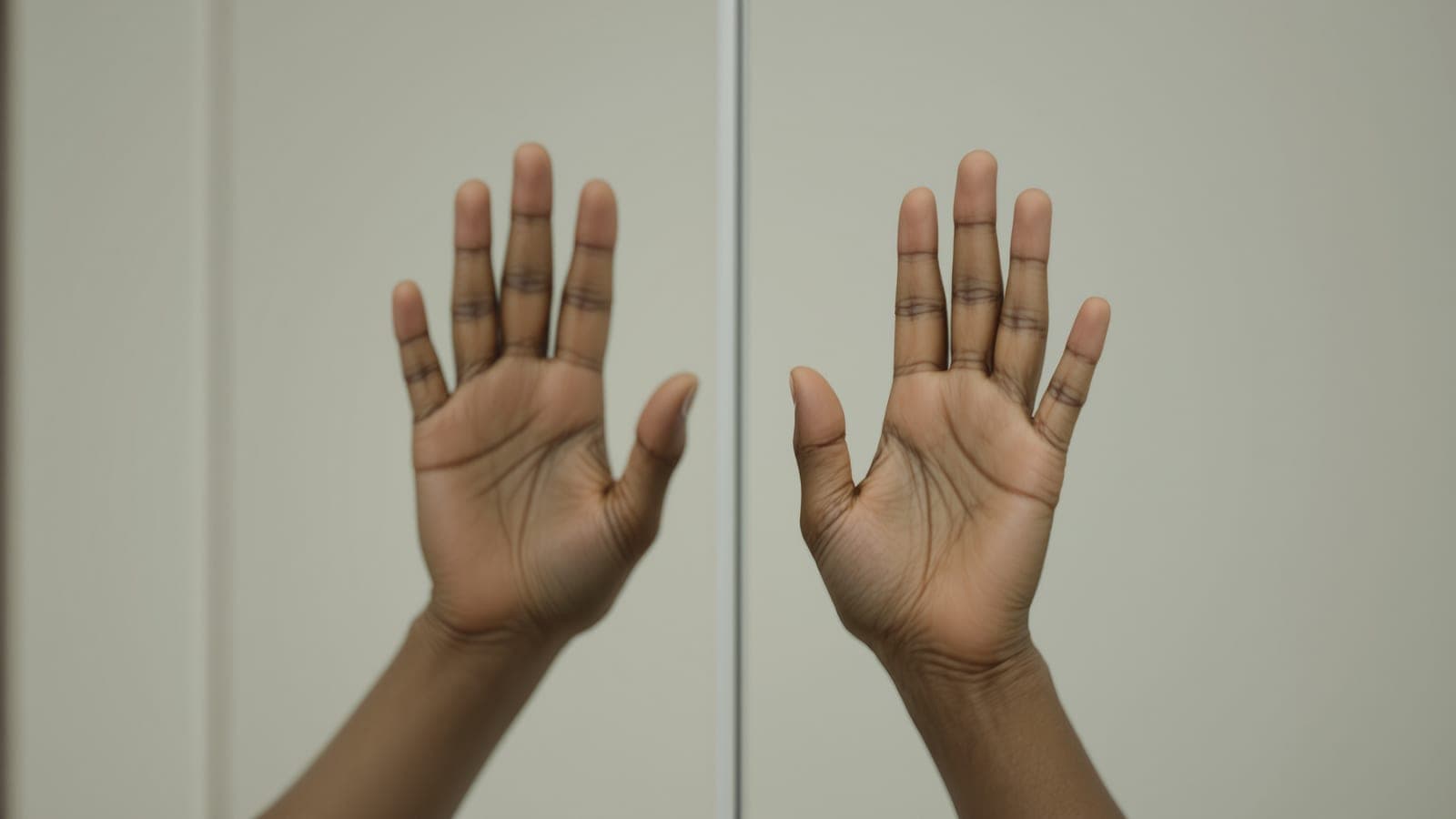
Two operations, and only one of them flips you
Everything in this area reduces to keeping two operations apart.
Rotation turns an object. It changes orientation and preserves handedness. A rotated left glove is still a left glove, at every angle, forever.
Reflection flips it through a plane. It preserves shape and reverses handedness. A reflected left glove is a right glove — which is why a mirror shows you someone who parts their hair on the wrong side.
And the composite rule that catches people: no sequence of rotations ever produces a reflection. You cannot get there. This is not a rule of thumb; it is a fact about three-dimensional space, and it holds however cleverly you rotate.
Which means: if a question asks for a rotation and offers you a mirrored option, that option is wrong. Not probably wrong. Wrong. You do not need to check it.
Finding the cue in two seconds
The technique is to find one chirality cue — any feature that reveals handedness — and read it. You are not comparing the figures; you are reading one property off each.
Good cues, roughly in order of reliability:
Order going clockwise. Take three distinguishable features and read them clockwise: circle, square, triangle. In a rotation that order is preserved. In a reflection it reverses to circle, triangle, square. This is the most robust cue there is and it works on almost any figure.
Direction of a spiral or curve. A clockwise spiral stays clockwise under rotation and becomes anticlockwise under reflection.
Which side a feature sits on relative to an axis. If the flag is on the right of the pole in the original and on the left in the option, and nothing else changed, it is a reflection.
The clockwise-order cue is the one to drill, because it needs no visualisation at all — you are just reading three labels round a circle, twice. That is genuinely two seconds, and it collapses most rotation questions to two options before you have done any spatial work.
Symmetry is the exception that trips everyone
Here is where confident candidates get caught, and it is worth being precise about it.
If a figure is symmetrical about a plane, its mirror image is identical to itself. A perfect capital A reflected left-to-right is still a perfect capital A. So for symmetrical figures, reflection and rotation can produce the same result, and the handedness cue tells you nothing — because there is no handedness to read.
This matters because it flips the difficulty. On an asymmetric figure, chirality is a free elimination. On a symmetric one, the shortcut is unavailable and you must do the actual spatial work.
So the very first thing to establish is: is this figure chiral at all? Look for a feature that breaks the symmetry. If you find one, you have a free cue. If you genuinely cannot, stop hunting for one and start rotating — the question has deliberately removed your shortcut, and question-setters know exactly which shortcut they are removing.
The rules behind this
Sourced to the official brochure rather than restated here, so there is one place to correct when the Council revises it.
Part B examines six named areas: Visual Reasoning, Logical Derivation, General Knowledge/Architecture and Design, Language Interpretation, Design Sensitivity and Thinking, and Numerical Ability.
Visual Reasoning — understanding and reconstructing 2D and 3D composition. Logical Derivation — decoding a situation or context and drawing conclusions. General Knowledge, Architecture and Design — current issues, important buildings, historical progression, innovation in materials and construction. Language Interpretation — meaning of words and sentences, English grammar. Design Sensitivity and Thinking — observing and analysing people, space, product, environment; semantics, metaphor, problem identification. Numerical Ability — basic mathematics and its association with creative thinking; unfolding space using geometry.
Source · verified 2026-07-16
What almost everyone believes
“If I rotate it enough ways, I can eventually match the mirrored option — mirror images are just rotations.”
No sequence of rotations ever produces a reflection. It is not difficult; it is impossible.
Because rotated and reflected figures look so similar, candidates treat the difference as a matter of finding the right angle, and burn most of their 108 seconds trying. Handedness is a property of the object that rotation preserves absolutely — a left glove is a left glove at every angle. Recognising this converts the single most common distractor in Visual Reasoning into a two-second free elimination, which is why the clockwise-order cue is worth drilling until it is automatic.
Depending on how long you have
Foundation
Understand the skill. Months out, or starting from zero.
Play with real mirrors and real objects. Hold up your hand, a letter, a spiral notebook. Notice which things change and which do not — symmetrical things look identical and asymmetrical things flip. Building this as physical intuition rather than a memorised rule means it will be there at speed under pressure.
Drill
The practice protocol. What to repeat, how often, how to score it.
Two habits on every Visual Reasoning question. First: is it chiral? Second: if yes, read three features clockwise in the stem and in each option. That single pass eliminates the mirrored distractors before any visualisation, and it is the cheapest technique in Part B.
Exam-Day
What to actually do under the constraint — 108 seconds, no instruments, one pass.
Chirality check first, always. If the figure is asymmetric, delete every option whose clockwise feature order is reversed. If the figure is symmetric, accept that the shortcut has been deliberately withheld and do the work — do not waste twenty seconds hunting for a cue that is not there.
Try it
Ten minutes. This builds the cue-reading habit until it costs you nothing.
- 01Draw a simple asymmetric figure: a circle, a square and a triangle arranged round a centre.
- 02Read them clockwise and write the order down. That is your chirality cue.
- 03Now draw the figure rotated 90, 180 and 270 degrees. Read clockwise each time — the order is unchanged.
- 04Now draw its mirror image. Read clockwise: the order has reversed. That reversal is the whole technique.
- 05Finally draw a symmetric figure and try the same thing. You cannot — there is no cue. Notice how it feels, because that is the exam telling you to do the real work.
The short version
Rotation preserves handedness; reflection reverses it; and no sequence of rotations ever produces a reflection. So on any asymmetric figure, reading three features clockwise in the stem and in each option eliminates the mirrored distractors in about two seconds with no visualisation at all. The exception is symmetry: a symmetric figure has no handedness to read, the shortcut is deliberately withheld, and you must do the spatial work.
Next: nets and folding — where a single counting rule answers most of the questions.
Questions people actually ask
- Can a mirror image be produced by rotating an object?
- No. Never. Rotation preserves handedness absolutely — a left glove stays a left glove at every angle — and reflection is the only operation that reverses it. This means any mirrored option in a rotation question is wrong without needing to be checked.
- What is the fastest way to spot a mirror image?
- Read three distinguishable features clockwise. Under rotation that order is preserved; under reflection it reverses. It requires no visualisation at all — you are reading three labels round a circle twice — and it takes about two seconds.
- Why do symmetrical figures make these questions harder?
- Because a figure symmetrical about a plane is identical to its own mirror image, so there is no handedness to read and the chirality shortcut is unavailable. Question-setters know exactly which shortcut they are removing. Establish whether the figure is chiral first: if it is not, stop hunting for a cue and start rotating.