
Mostly counting, dressed up as visualisation
Net questions look intimidating — a flat cross of squares, and you are asked what the folded cube looks like. Candidates fold it in their heads, get lost around the third face, and lose ninety seconds. Almost none of that is necessary. The great majority of these questions are answered by a counting rule that takes about five seconds and requires no folding at all.
The one-square rule
Here is the rule that does most of the work: along any straight run of a net, squares separated by exactly one square land on opposite faces of the cube.
That is it. Adjacent squares share an edge and end up adjacent. Squares with one between them end up opposite. You do not fold anything — you count gaps along a line.
This matters because most net questions are secretly about opposite faces. Which face is opposite the one with the dot? Can these two symbols appear on adjacent faces? Which of these dice is impossible? All of them fall to the same count.
And the corollary is just as useful: a cube has three pairs of opposites, and every face belongs to exactly one pair. Once you have identified the three pairs from the net, you know the entire cube. Two of them can usually be read straight off a straight run, and the third is whatever is left over. That is the whole solve, and it is arithmetic rather than imagination.
When you genuinely must fold, fold one corner
Some questions do need real visualisation — usually when orientation matters, not just adjacency. Which way does the arrow point on the folded cube? cannot be counted.
Even then, do not fold the whole net. Pick one corner where three faces meet and fold only those three. Three faces around a corner is the maximum most people can hold accurately, and it is almost always enough, because the question hinges on the relationship between two or three faces rather than all six.
Choose the corner that contains the faces the question asks about. Everything else in the net is decoration for that question, and folding it is work you are doing for no marks.
Paper folding and punching is a doubling problem
The other folding family looks different and is even more mechanical.
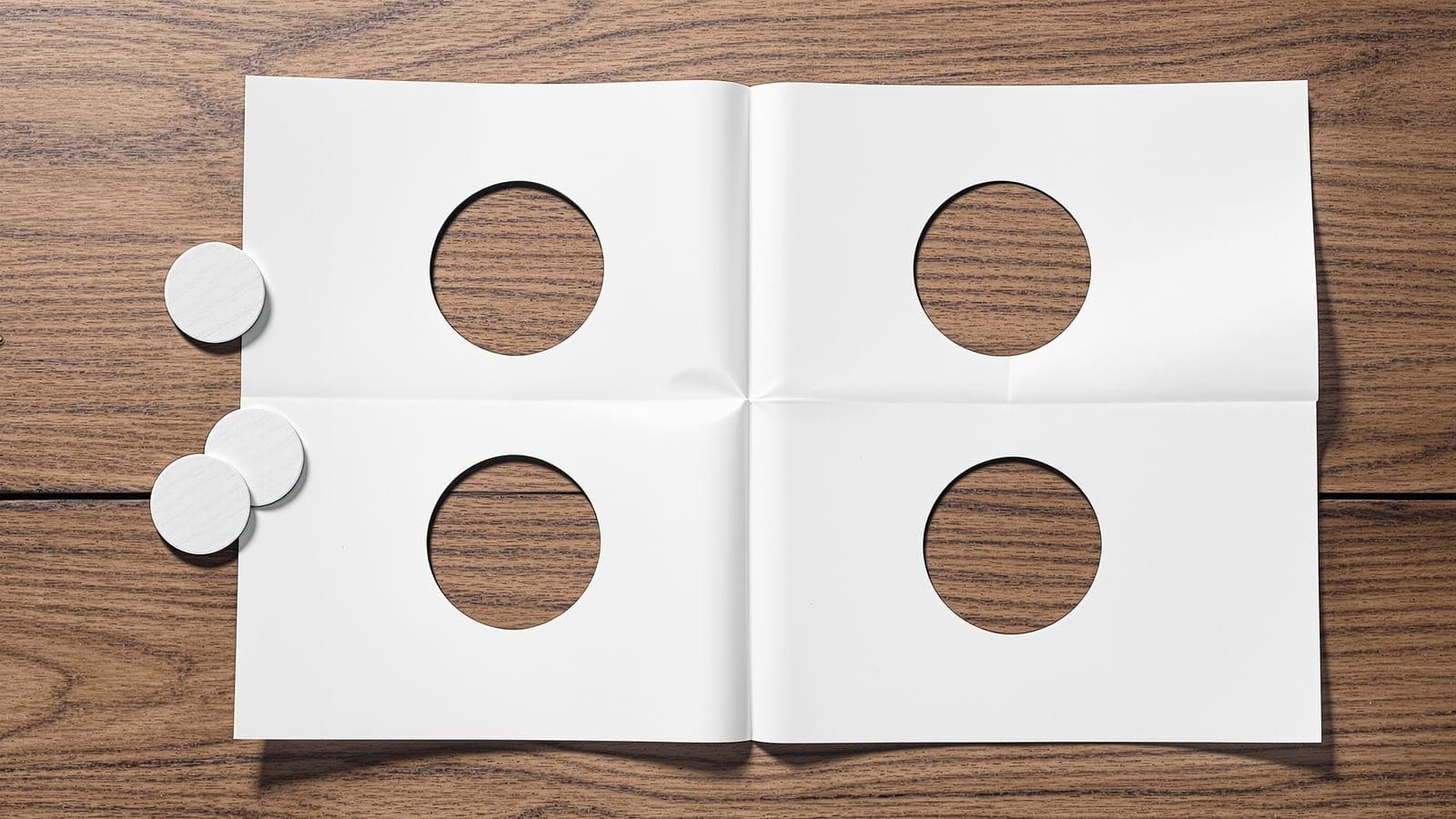
A sheet is folded some number of times, a hole is punched, and you are asked how many holes appear when it is unfolded. Each fold doubles the layers. One fold, two layers. Two folds, four. Three folds, eight. One punch through n folds gives 2^n holes.
Count the folds, not the punches. That gives you the number immediately, and it eliminates most options before you think about position at all.
Position is the second half, and it has its own rule: the holes are symmetrical about every fold line. Each fold line is a mirror, so the punched holes appear reflected across it. Work backwards — unfold once, mirror the holes across that line, unfold again, mirror across the next. You are not visualising a sheet of paper; you are applying reflections in sequence.
Which, satisfyingly, brings the previous lesson to bear: unfolding is reflection, and reflection reverses handedness. If the punch is asymmetric relative to the fold, its unfolded partner is its mirror image, not a copy.
The rules behind this
Sourced to the official brochure rather than restated here, so there is one place to correct when the Council revises it.
Part B examines six named areas: Visual Reasoning, Logical Derivation, General Knowledge/Architecture and Design, Language Interpretation, Design Sensitivity and Thinking, and Numerical Ability.
Visual Reasoning — understanding and reconstructing 2D and 3D composition. Logical Derivation — decoding a situation or context and drawing conclusions. General Knowledge, Architecture and Design — current issues, important buildings, historical progression, innovation in materials and construction. Language Interpretation — meaning of words and sentences, English grammar. Design Sensitivity and Thinking — observing and analysing people, space, product, environment; semantics, metaphor, problem identification. Numerical Ability — basic mathematics and its association with creative thinking; unfolding space using geometry.
Source · verified 2026-07-16
Part B allows 108 seconds per question, presented one after another, on an adaptive engine.
90 minutes across 50 questions. The adaptive structure dates to NATA 2025 per the President's foreword in V2.0, which states that NATA 2026 continues it.
Source · verified 2026-07-16
What almost everyone believes
“Net questions test whether I can fold the shape in my head, so I should practise folding faster.”
Most net questions are opposite-face questions, and opposite faces are found by counting gaps along a straight run — no folding required.
The questions are dressed as visualisation and are usually arithmetic. Candidates who practise folding faster are getting better at the expensive method: mentally folding a net takes most of the 108 seconds, loses track around the third face, and is unnecessary for any question about adjacency or opposition. Fold only when orientation is genuinely at stake, and then fold one corner, not six faces.
Depending on how long you have
Foundation
Understand the skill. Months out, or starting from zero.
Do this physically at least once, properly. Cut a net, mark the faces, fold it into a cube and see the one-square rule turn out true in your hands. Fold a sheet twice, punch it, unfold it, count. Ten minutes of real paper installs an intuition that reading cannot, and it will still be there in August.
Drill
The practice protocol. What to repeat, how often, how to score it.
Force the count. On any net question, resist folding: find the straight runs, identify the three opposite pairs, answer. Only fold if the question is about orientation rather than adjacency — and then fold exactly one corner, chosen to contain the faces you were asked about.
Exam-Day
What to actually do under the constraint — 108 seconds, no instruments, one pass.
Count gaps, do not fold. Three opposite pairs and the cube is solved. For punching, count folds and take 2^n — that eliminates most options before you consider position. If you catch yourself folding a whole net in your head, stop: you are doing ninety seconds of work for a five-second question.
Try it
Fifteen minutes, and you will need scissors. The physical version is the point.
- 01Draw a cross-shaped net of six squares. Number them 1 to 6.
- 02Before cutting, predict the three opposite pairs using the one-square rule: count gaps along each straight run.
- 03Now cut and fold it. Check your three pairs. They will be right, and the rule will stop feeling like a trick.
- 04Fold a fresh sheet twice, punch one hole near the folded corner, and predict the count before unfolding: 2^2 = 4.
- 05Unfold and check both the count and the positions. Notice the holes are mirrored about each fold line — reflection again.
The short version
Squares separated by exactly one square along a straight run of a net land on opposite faces, and a cube has exactly three opposite pairs — find them and the cube is solved without folding anything. Fold only when orientation matters, and then fold one corner containing the faces you were asked about. Punching is 2^n for n folds, with the holes mirrored about every fold line, which is reflection doing the work again.
Next: sections and plans — what a cut reveals, and why a plan hides the thing you most need.
Questions people actually ask
- How do I find opposite faces on a cube net quickly?
- Count gaps along a straight run: squares separated by exactly one square land on opposite faces. A cube has exactly three opposite pairs, and once you have identified them the cube is fully solved. No folding is needed for any question about adjacency or opposition.
- How many holes appear if I fold a paper three times and punch once?
- Eight. Each fold doubles the layers, so n folds give 2^n holes from a single punch. Count the folds, not the punches — that number alone eliminates most options before you think about where the holes sit.
- When do I actually need to fold the net mentally?
- Only when orientation matters — which way an arrow points, for instance — rather than adjacency. Even then, fold just one corner where three faces meet, chosen so it contains the faces the question asks about. Folding all six is work you are doing for no marks.