
Every material wants something
The syllabus phrase is _innovation in materials and construction technology_, and it sets two traps at once. The first is reading it as materials science, and trying to memorise properties. The second is reading _innovation_ as _new_, and going looking for carbon fibre and 3D printing. Both miss it. The materials worth knowing have a **grain** — a thing they are good at and a thing they fail at — and once you know the grain, the famous innovations stop being facts to memorise and become things you could have worked out yourself.
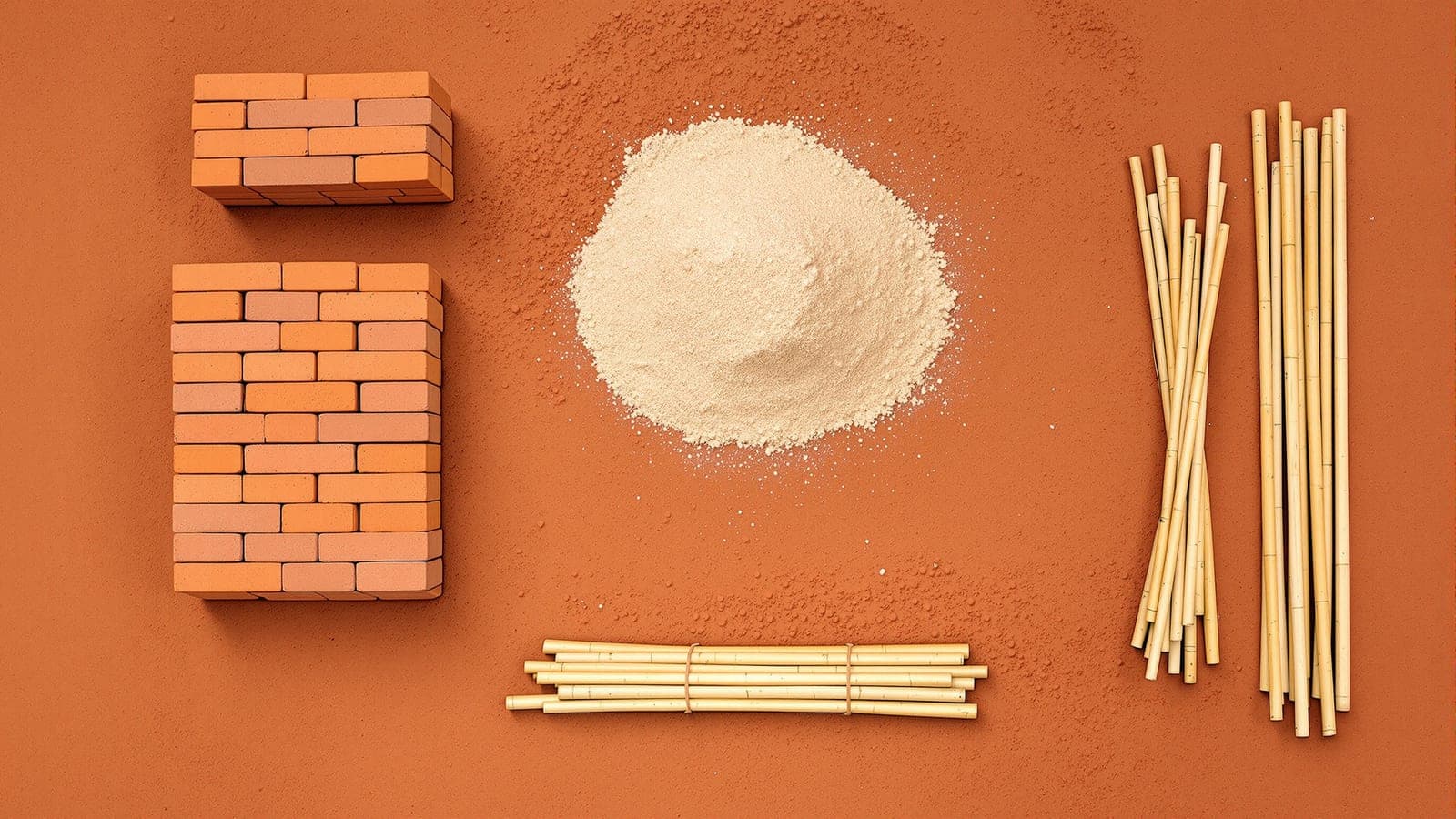
The grain of the four materials that matter
Almost everything reduces to one property: what happens in tension?
Masonry — brick, stone — is strong in compression and weak in tension. That single fact explains the arch, explains why the openings are small, explains why the walls are thick, and explains most buildings before 1850.
Timber works in both and is anisotropic — it has a literal grain, and it is much stronger along it than across it. It burns, and it moves with moisture.
Steel is strong in compression and tension, which is what made it revolutionary. Its weaknesses are elsewhere: it buckles when slender, it corrodes, and it loses strength in fire — which is why structural steel gets fireproofed and why that is not an optional extra.
Concrete is, structurally, a masonry that can be poured: strong in compression, weak in tension, and it will crack where you pull it. So you put steel where the tension is, and the composite does what neither does alone. That is the whole idea of reinforced concrete, and it is one sentence.
Four materials, four grains. Nearly every question about construction is a question about one of them, and none of it is a list.
Where the tension is — and why it decides everything
Get this one right and a surprising amount falls out of it for free.
Load a simple beam supported at both ends. It sags. The top gets shorter — that is compression. The bottom gets longer — that is tension. Between them is a layer doing neither, the neutral axis.
So in a reinforced concrete beam the steel goes at the bottom, where the tension is. And over a support — a continuous beam, a cantilever — the beam bends the other way, the tension moves to the top, and so does the steel. That is why reinforcement drawings look the way they do, and it is derived rather than remembered.
Now the consequence nobody points out, which is the most useful thing in this lesson: the concrete in the tension zone is not doing structural work. It has cracked, or it is about to; the steel is carrying that force. The concrete down there is mostly there to hold the steel in place and keep the weather off it. It is weight — weight the beam then has to carry, all the way down to the foundation.
Which is a problem sitting in plain sight, waiting for someone to notice.
Two Indian innovations you could have derived
Somebody noticed, and this is why Laurie Baker is on this syllabus rather than in a footnote.
The filler slab. If the concrete below the neutral axis is dead weight, take it out — and put something cheap, light and hollow in its place. Baker used Mangalore roof tiles. The slab gets lighter, so the beams and columns and foundations carrying it can all get smaller, so the whole building costs less; less cement is used, which cuts both cost and carbon; and the tiles leave a coffered ceiling that happens to be beautiful. It is not a trick. It is the direct consequence of one fact you already know, and if you understood the last section you could have invented it.
The rat-trap bond. Lay the bricks on edge rather than flat, in a bond that leaves a continuous cavity inside the wall. You use roughly a quarter fewer bricks and less mortar; the cavity is trapped air, so the wall insulates better in a hot climate; and the wall is thinner in material but not in performance. Again: not exotic. Just someone asking what the brick in the middle of a solid wall was actually for.
That is the pattern for the whole area, and it is why the memorisation approach fails here. The celebrated Indian innovations are mostly subtractive and mostly low-tech. They come from asking what a material is doing and removing what is not earning its place. Somebody who understands the tension zone can reconstruct the filler slab from first principles. Somebody who memorised the phrase 'filler slab' has one fact and cannot use it.
The current issue the syllabus is pointing at
Look at the syllabus phrase once more: current issues sits in the same line as innovation in materials and construction technology. That pairing is not accidental, and it tells you where to look.
Cement is one of the largest industrial sources of carbon dioxide on earth — most published estimates put it in the region of seven to eight percent of global emissions, and the number moves depending on who is counting and what they include, so treat the magnitude rather than the digit as the fact. The chemistry is the problem, not the fuel: making clinker drives CO2 out of limestone, so the emission is inherent to the reaction and does not disappear if you run the kiln on renewables.
That single fact reframes the whole area. Every material innovation that reduces cement is a climate innovation, whether or not it was invented for that reason. The filler slab uses less concrete. AAC blocks are lighter, so the structure carrying them shrinks. Fly ash substitutes clinker with a waste product. CSEB — compressed stabilised earth blocks — are literally the site's own soil, unfired, so they skip both the kiln and the truck. Bamboo is strong in tension, grows back in years rather than decades, and is the material most obviously misfiled as primitive. And the greenest building of all is usually the one already standing, which is why reuse and retrofit are architectural questions rather than sentimental ones.
So current issues and innovation in materials are the same question asked twice. If you can explain why cement is the problem and what reduces it, you have the useful half of both.
The rules behind this
Sourced to the official brochure rather than restated here, so there is one place to correct when the Council revises it.
Part B examines six named areas: Visual Reasoning, Logical Derivation, General Knowledge/Architecture and Design, Language Interpretation, Design Sensitivity and Thinking, and Numerical Ability.
Visual Reasoning — understanding and reconstructing 2D and 3D composition. Logical Derivation — decoding a situation or context and drawing conclusions. General Knowledge, Architecture and Design — current issues, important buildings, historical progression, innovation in materials and construction. Language Interpretation — meaning of words and sentences, English grammar. Design Sensitivity and Thinking — observing and analysing people, space, product, environment; semantics, metaphor, problem identification. Numerical Ability — basic mathematics and its association with creative thinking; unfolding space using geometry.
Source · verified 2026-07-16
No weighting is published for any of the six areas.
You cannot know how many of the 50 questions fall to each area. Any source giving you a percentage split is inventing it.
Source · verified 2026-07-16
What almost everyone believes
“Innovation in materials means new high-tech materials — carbon fibre, 3D printing, smart glass.”
The Indian innovations that matter most on this syllabus are subtractive and low-tech: the filler slab and the rat-trap bond both work by removing material that was not doing anything.
Both are derivable from one property rather than memorised. Concrete is weak in tension, so in a slab the concrete below the neutral axis has cracked and the steel is carrying that force — meaning the concrete down there is dead weight the building must carry to its foundations. Remove it, fill the gap with Mangalore tiles, and the slab gets lighter, the frame beneath gets smaller, the cost falls, the cement falls, and the ceiling ends up beautiful. The rat-trap bond does the same thing to a wall: lay the bricks on edge to leave a cavity, use around a quarter fewer bricks, and gain insulation from the trapped air. Neither needed new technology. Both needed someone to ask what the material in the middle was for. A candidate chasing carbon fibre is looking in the wrong direction entirely — and, more to the point, is memorising when they could be deriving.
Depending on how long you have
Foundation
Understand the skill. Months out, or starting from zero.
Learn the grain of four materials — masonry, timber, steel, concrete — through the single question of what happens in tension. That is a week's curiosity and it underpins everything else in construction. Then watch a building go up somewhere near you: the sequence makes sense once you know what each material is being asked to do.
Drill
The practice protocol. What to repeat, how often, how to score it.
When you meet an innovation, do not file it — derive it. Ask what it removed, what it substituted, and which property of the material made that possible. If you can reconstruct the filler slab from 'concrete is weak in tension', you understand the area. If you can only name it, you have a flashcard.
Exam-Day
What to actually do under the constraint — 108 seconds, no instruments, one pass.
Unfamiliar material or technique? Ask the only question that matters: what is it doing in tension, and what does it replace? Most options can be eliminated on the grain of the material alone, without knowing the specific product at all. That is usually enough to get from four options to two inside twenty seconds.
Try it
Fifteen minutes with a pencil. You are going to re-invent something famous.
- 01Draw a simple beam on two supports and load it. Mark where it gets shorter (compression) and where it gets longer (tension).
- 02Put the steel where the tension is. You have just designed a reinforced concrete beam.
- 03Now ask the awkward question: what is the concrete in the tension zone actually doing structurally? Answer honestly.
- 04It is holding the steel and keeping the rain off it. Otherwise it is weight. So take it out and put something light and cheap in the hole.
- 05You have just re-invented the filler slab. That is what 'innovation in materials' means here — and note you did not memorise anything.
The short version
Every material has a grain, and nearly all of it reduces to what happens in tension: masonry and concrete are strong in compression and weak in tension, steel takes both but buckles and burns, timber works along its grain. Put steel where the tension is and you have reinforced concrete in one sentence — bottom of a simple beam, top over a support. The consequence nobody states: concrete in the tension zone is dead weight, which is exactly why the filler slab works, and why you could have invented it. The rat-trap bond does the same to a wall. The celebrated Indian innovations are subtractive and low-tech, not high-tech. And since cement chemistry itself emits CO2 — on most estimates around seven to eight percent of the global total — every innovation that reduces cement is also the 'current issue' the same syllabus line is pointing at.
That completes the six areas. What remains is the craft of sitting the thing: 108 seconds, no way back, and a day with rules of its own.
Questions people actually ask
- What does 'innovation in materials and construction technology' mean in NATA?
- Not high-tech materials. The innovations worth knowing are mostly subtractive and derivable — the filler slab removes concrete from the tension zone where it was dead weight, and the rat-trap bond leaves a cavity in a brick wall, saving around a quarter of the bricks while insulating better. Learn what each material does in tension and you can reconstruct the innovations rather than memorise them.
- Why does a filler slab work?
- Because concrete is weak in tension. In a slab, the concrete below the neutral axis has cracked and the steel is carrying that force — so that concrete is mostly holding the steel in place and otherwise just adding weight the building must carry down to its foundations. Replace it with light, cheap Mangalore tiles and the slab gets lighter, the structure beneath gets smaller, cost and cement both fall, and the coffered ceiling is a bonus.
- Where does steel go in a reinforced concrete beam?
- Where the tension is. A simple beam on two supports sags, so the bottom stretches — steel goes at the bottom. Over a support, or in a cantilever, the beam bends the other way and the tension moves to the top, so the steel does too. It is derived from how the beam bends, not memorised from a drawing.
- Why is cement a problem for the climate?
- Because the chemistry emits carbon dioxide, not just the fuel. Making clinker drives CO2 out of limestone, so the emission is inherent to the reaction and does not vanish if the kiln runs on renewable energy. Most published estimates put cement at roughly seven to eight percent of global CO2, with the figure varying by method — so hold the magnitude rather than the digit.