
Democracy is the enemy of composition
Give a candidate six foam blocks and they will, nine times out of ten, arrange all six so that each gets a fair share of attention. It looks tidy. It looks considered. And it reads as nothing at all, because a composition where everything is equally important has told the eye nothing about where to go.
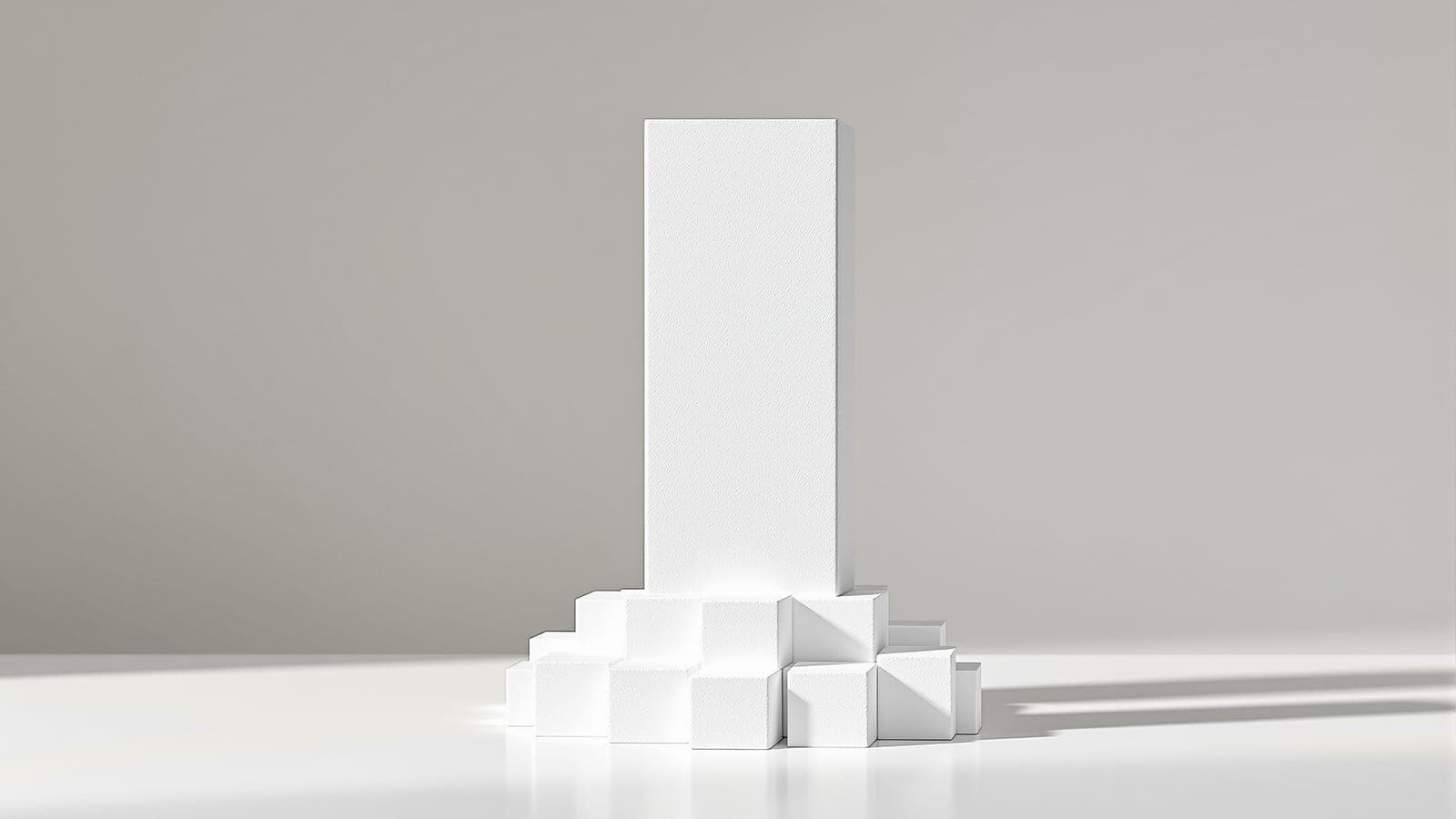
One thing dominates. Everything else answers to it.
The single decision that separates a strong A3 from a middling one is made in the first minute: which form is the protagonist?
Compositions read when there is a hierarchy — a dominant mass that the eye lands on, subordinate masses that support and qualify it, and incidental pieces that do detail work. Three tiers, roughly. Not six equal citizens.
Dominance is not only about size, which is why this survives a kit you did not choose. A form dominates by being the tallest, or by being isolated when others cluster, or by sitting where the base's axes cross, or by being the only one of its kind among a family of similar shapes. If your kit gives you five cubes and one cylinder, the cylinder is your protagonist whether you like it or not — it is the only thing that is different, and difference is what the eye finds.
So the first question at the desk is never what shall I build. It is which of these is the one.
The gaps are not leftovers
Here is the thing candidates almost never see, and once you see it you cannot unsee it: in a composition of solid blocks, the voids are also forms.
The space between two masses has a shape. It has proportion. It can be tight and charged, or slack and accidental. When you push two blocks close together you are not just placing blocks — you are making a slot, and that slot will read in the photograph as clearly as the blocks do.
This is why compositions built by placing objects tend to look worse than compositions built by shaping space. The difference in method is small and the difference in result is large. Place two forms. Now look at the gap you made, not at the forms. Is it a shape you chose, or a shape that happened? If it is 4mm, it reads as a mistake. If it is generous and deliberate, it reads as a decision. If they touch, that is a decision too — a different one.
Architecture is the discipline of shaping space with solids. A3, whether or not it announces it, is testing whether you already think that way.
Grouping, and why five things become two
The eye does not count to six. It groups.
Put three blocks in a tight cluster and one block apart, and the eye does not see four objects — it sees two things: a cluster and a solitary. That is composition doing work for you. You have taken six pieces you did not choose and reduced them to a relationship the eye can hold in one glance.
This is the practical answer to the anxiety about not knowing your kit. You will never control what is in the bag. You will always control how many things the eye ends up seeing, and that number should be small. Two or three relationships, not six items.
A good working test: describe your composition out loud in one sentence. If it takes a list, it is not composed yet. A tall mass with a low cluster gathered at its foot is a composition. A cube, a cylinder, a wedge, another cube, a small block and a prism is an inventory.
The rules behind this
Sourced to the official brochure rather than restated here, so there is one place to correct when the Council revises it.
The A3 foam kit is supplied at the centre. You do not bring one, and you cannot know its contents in advance.
The question paper carries a KIT CODE (D1, D2, D3...) and the invigilator issues the matching kit: a set of 3D forms made of foam plus a 15cm x 20cm foam base sheet. Glue is provided. The finished model is photographed at the centre in three views and uploaded.
Read this carefully: Consequence worth stating plainly: A3 cannot be rehearsed as an artefact, only as a capability. Anyone selling 'the NATA foam kit' is selling a proxy.
Source · verified 2026-07-16
What almost everyone believes
“A good 3D composition uses all the pieces, arranged so it looks balanced and neat.”
A good composition establishes a hierarchy. Using every piece equally is the most reliable way to make something that reads as nothing.
Balance is not sameness. Candidates hear composition and reach for symmetry and even distribution, which produces a tidy arrangement with no protagonist and no direction for the eye. Examiners are looking for spatial decisions, and treating six pieces as six equals is precisely the absence of a decision. Nothing requires you to use every form in the kit — and a composition that leaves one out because it weakened the hierarchy is a stronger answer than one that includes it out of duty.
Depending on how long you have
Foundation
Understand the skill. Months out, or starting from zero.
Train the eye before the hand. Look at buildings and ask what dominates and what subordinates — most good buildings answer instantly, and most bad ones cannot. Do it with photographs, with furniture in a room, with anything three-dimensional. You are building the reflex to see hierarchy, which is the actual examinable skill.
Drill
The practice protocol. What to repeat, how often, how to score it.
Practise with sets you did not choose — the constraint that matters most. Each attempt, name your protagonist before you touch anything, and afterwards check whether a stranger would name the same one. If they would not, the hierarchy is in your head rather than in the composition. Then describe it in one sentence: if you need a list, start again.
Exam-Day
What to actually do under the constraint — 108 seconds, no instruments, one pass.
Lay everything out. Find the odd one — the different size, the different family, the only cylinder — and make it your protagonist. Group the rest so the eye sees two or three things, not six. Watch the gaps you are making. Then commit, because an imperfect hierarchy resolved beats a perfect one you ran out of time to build.
Try it
Twenty-five minutes. Same 15 x 20 cm base as before, same rule: you do not choose the pieces.
- 01Have someone give you six primitive objects, including at least one that is clearly different from the rest.
- 02Before touching anything, say out loud which one is the protagonist and why.
- 03Build so the eye sees two or three things, not six. Group deliberately.
- 04Now photograph it and look only at the gaps between the masses. Circle any that look accidental rather than chosen.
- 05Rebuild once, fixing only the gaps. Most people find this second version is dramatically better, which is the whole lesson.
The short version
Composition is hierarchy: one dominant mass, subordinates that answer to it, and voids shaped as deliberately as the solids. The eye groups rather than counts, so reduce six pieces to two or three relationships it can hold at a glance. You cannot control what is in the kit; you can always control the odd one out, the grouping, and the gaps — and those are the marks.
Next: the base itself — the one constant in the whole question, and the thing most candidates treat as a shelf.
Questions people actually ask
- Do I have to use every piece in the NATA A3 kit?
- Nothing in the official material says so. The task is to create an interesting 3D composition using the provided kit. A composition that omits a form because it weakened the hierarchy is a stronger answer than one that includes everything out of duty — the marks are for spatial decisions, not for inventory management.
- What makes a 3D composition good?
- Hierarchy, primarily. A dominant mass the eye lands on, subordinate masses that support it, and voids shaped as deliberately as the solids. Compositions where every element is equally important read as arrangements rather than compositions, because they give the eye nowhere to go.
- How do I compose when I do not know what the kit contains?
- By training decisions rather than arrangements. Whatever is in the bag, you can find the odd one out and make it the protagonist, you can group the rest so the eye sees two or three things instead of six, and you can shape the gaps deliberately. Those moves work on any set of forms, which is exactly why they are worth practising.