
Nowhere to hide
A2 is Sketching and Composition (Black and White), 25 marks — and like A1, that title plus the marks is the entire published brief. But the parenthesis is doing something significant. Take the colour away and every crutch goes with it. No pleasant palette to make a weak arrangement look considered. No warm accent to fake a focal point. Just line and value, which is exactly the pair that was carrying the composition all along.
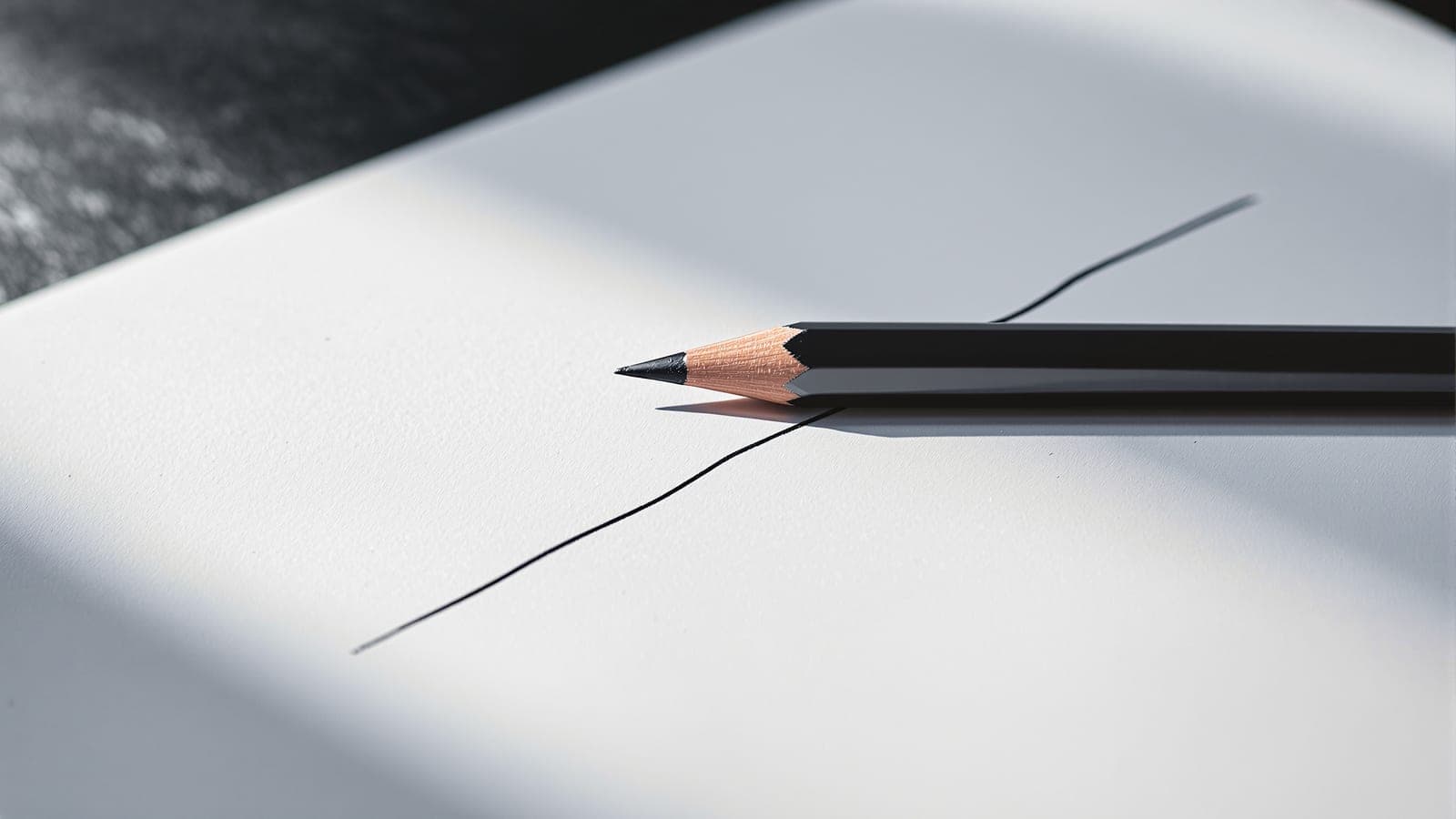
A2 is A1 with the disguise removed
It is tempting to treat these as two different questions. They are closer to the same question asked twice, once with a variable and once without.
Recall the argument from A1: value carries composition, hue carries mood, and the squint test works by throwing hue away to show you the value structure underneath. A2 is the squint test as a question. There is no hue to throw away. What you put on the page is already the thing that gets marked.
That is why candidates who are strong at A1 and weak at A2 usually have this diagnosis: their A1 was being carried by colour. Pleasant hues, competent handling, and underneath it an arrangement that never held. Colour was doing the work and hiding the absence. Remove it and the absence is all that is left.
The reverse is also true and worth knowing: if you can compose well in black and white, A1 becomes much easier, because you are then adding colour to a structure that already works rather than hoping colour will supply one.
Two tools, and they do different jobs
Black and white gives you exactly two instruments, and confusing them is the commonest technical failure in A2.
Line describes edges, direction and structure. It tells you where one thing stops and another begins. It is fast, it is precise, and it is how you get information onto a page quickly.
Value describes mass, light and depth. It tells you what is solid, what is in shadow, what is near. It is slow — you are covering area by abrasion again — and it is what makes a page read from across a room.
A drawing that is all line reads as a diagram: accurate, informative, flat, and unmarked by any decision about light. A drawing that is all value reads as a smudge: atmospheric and structureless. Almost every strong A2 is line for structure, value for mass, with a clear decision about which is carrying which part of the page.
And the word in the title is sketching, not rendering. That is a hint about register. A sketch is economical — it commits, it does not fuss, and it leaves things out on purpose.
What black and white actually rewards
No criteria are published, so this is inference from what the exam consistently does rather than a claim about a marking scheme. But the paper is remarkably consistent, and it points one way.
A2 rewards the same three things as everything else: hierarchy (something dominates), structure (the page divides deliberately), and resolution (it is finished and it holds together). What it removes is the ability to fake any of them.
So the preparation is not a new skill. It is the same composition practice with the safety net taken away — which is precisely why it is worth doing first. Work in black and white until compositions hold, and A1 arrives as a bonus rather than a problem.
If you are short of time before an exam and can only practise one of the two, practise A2. It is the harder one, it is worth the same 25 marks, and the skill runs uphill into A1 rather than the other way round.
The rules behind this
Sourced to the official brochure rather than restated here, so there is one place to correct when the Council revises it.
Part A is three questions: A1 Composition and Colour (25), A2 Sketching and Composition in Black and White (25), A3 3D Composition (30).
Eighty marks across three questions means each is worth roughly 13% of the whole exam. There is no salvaging a bad question by volume, the way a 50-question paper allows.
Source · verified 2026-07-16
No official NATA mock test or sample paper exists. COA has published none.
Neither nata.in nor coa.gov.in hosts one, and neither brochure version mentions mocks or sample papers. Every 'NATA sample paper' in circulation is reconstructed by a coaching institute. Official papers are unlikely ever to be released: §12.0 Weeding Out Rules preserves the examination record for only 90 days after results.
Read this carefully: Claims that "COA releases the NATA mock test on nata.in" appear only on coaching sites and could not be verified on either official domain.
Source · verified 2026-07-16
No instruments are permitted — no compass, no set squares — and no calculators, phones, or wet media.
Appendix-II states "Don't bring any instruments". Also barred: Bluetooth devices, slide rules, log tables, electronic watches with calculators, and any textual material. Numerical Ability is examined without a calculator.
Source · verified 2026-07-16
What almost everyone believes
“A2 is the easier question because there is less to think about without colour.”
It is the harder one. Colour is a crutch, and A2 removes it — everything that was propping up a weak arrangement is gone.
Candidates read fewer variables as less difficulty, but colour is what lets a page look considered while the composition underneath is doing nothing. Take it away and the arrangement is fully exposed. This is also why A2 is the better use of limited practice time: it is worth the same 25 marks, it is where weakness shows, and the skill runs uphill into A1 — if you can compose in black and white, colour becomes something you add to a structure that already works rather than something you hope will supply one.
Depending on how long you have
Foundation
Understand the skill. Months out, or starting from zero.
Work in pencil only for a long time — months, not weeks. It is the single most efficient thing in this whole course, and almost nobody does it because it feels like a detour. You are building the value sense that both A1 and A2 depend on, and you cannot get it while hue is available to distract you.
Drill
The practice protocol. What to repeat, how often, how to score it.
Alternate: one A1 attempt, one A2 attempt, same prompt. Compare them. If the A1 is markedly better, colour is carrying you and the underlying composition is weaker than you think — which is a diagnosis worth having now rather than in the exam hall.
Exam-Day
What to actually do under the constraint — 108 seconds, no instruments, one pass.
Line for structure, value for mass, and decide which is carrying which before you start. Remember the word is sketching, not rendering: commit, do not fuss, and leave things out deliberately. Everything you learned about hierarchy in A1 applies here with more force, because there is nothing else to lean on.
Try it
Fifty minutes. This is the diagnostic that tells you which question you actually need to practise.
- 01Pick one prompt. Do it twice: once in full colour (25 min), once in pencil only (25 min).
- 02Pin both up and walk to the far side of the room.
- 03Ask which one holds you from six metres. Be honest — this is the whole exercise.
- 04If the colour version is much stronger, your composition is weaker than you think and colour has been hiding it.
- 05If the pencil version holds, you are in good shape: add colour to that structure and A1 takes care of itself.
The short version
A2 is Sketching and Composition in black and white, 25 marks, and that plus the title is the whole official brief. It is A1 with the disguise removed — the squint test asked as a question. Line describes structure, value describes mass, and the word is sketching rather than rendering, so commit and leave things out. It is the harder of the two and the better use of scarce practice time, because the skill runs uphill into A1 and never the other way.
Next: line weight — how a single varied line does the work that most candidates try to do with twenty.
Questions people actually ask
- What does NATA A2 ask?
- Officially: A2 - Sketching and Composition (Black and White) - 25 Marks. That title and the marks are the entire published brief; no prompt, format or criteria is released, and no official past papers exist. What is known is that it is on paper, without instruments, in one of three questions across a 90-minute Part A.
- Is NATA A2 easier than A1 because there is no colour?
- It is generally harder. Colour lets a weak composition look considered; black and white exposes the arrangement completely. That is also why it is the better use of limited practice time — it is worth the same 25 marks, and the skill transfers upward into A1.
- Should I practise A1 or A2 first?
- A2, if you have to choose. Composing in black and white builds the value sense both questions depend on, and once a composition holds without colour, A1 becomes a matter of adding colour to a structure that already works rather than hoping colour will supply one.