
 Lesson 0.2
Lesson 0.2 · Why Mass Timber Now
What Mass Timber Is (and Isn't)
Mass timber is not one product but a family - large, solid, engineered elements that act as a building's primary structure - and drawing the line clearly, against light framing and against ordinary sheet goods, is the first real skill of the course
Mass timber is not a product you can point at - it is a family, defined by size, solidity and structural role, not by being made of wood.
Ask ten people what mass timber is and you will get ten answers - a tall wooden building, cross-laminated timber, engineered wood, "the new plywood." All of them touch it and none of them nails it, and that vagueness is a problem, because the word carries a specific structural meaning that you need to hold precisely to design, specify or even talk about it well. Getting the definition right is not pedantry; it is the difference between understanding a genuinely new class of structure and lumping it in with the plywood in a kitchen cabinet.
The clearest way to define mass timber is by three things it always is - large, solid and structural - and by the things it is often confused with but is not: the light timber framing of an ordinary house, and the everyday sheet goods like plywood, OSB and MDF. This lesson draws those lines carefully, introduces the product families you will meet again and again across the course, and gives you a reliable test for what counts. Get this straight now and every later module - the products, the structures, the fire and moisture behaviour - will sit on solid ground.
Engineered wood is the umbrella. Mass timber = the large + solid + structural part. Members vs panels.
The definition: large, solid, engineered structural elements
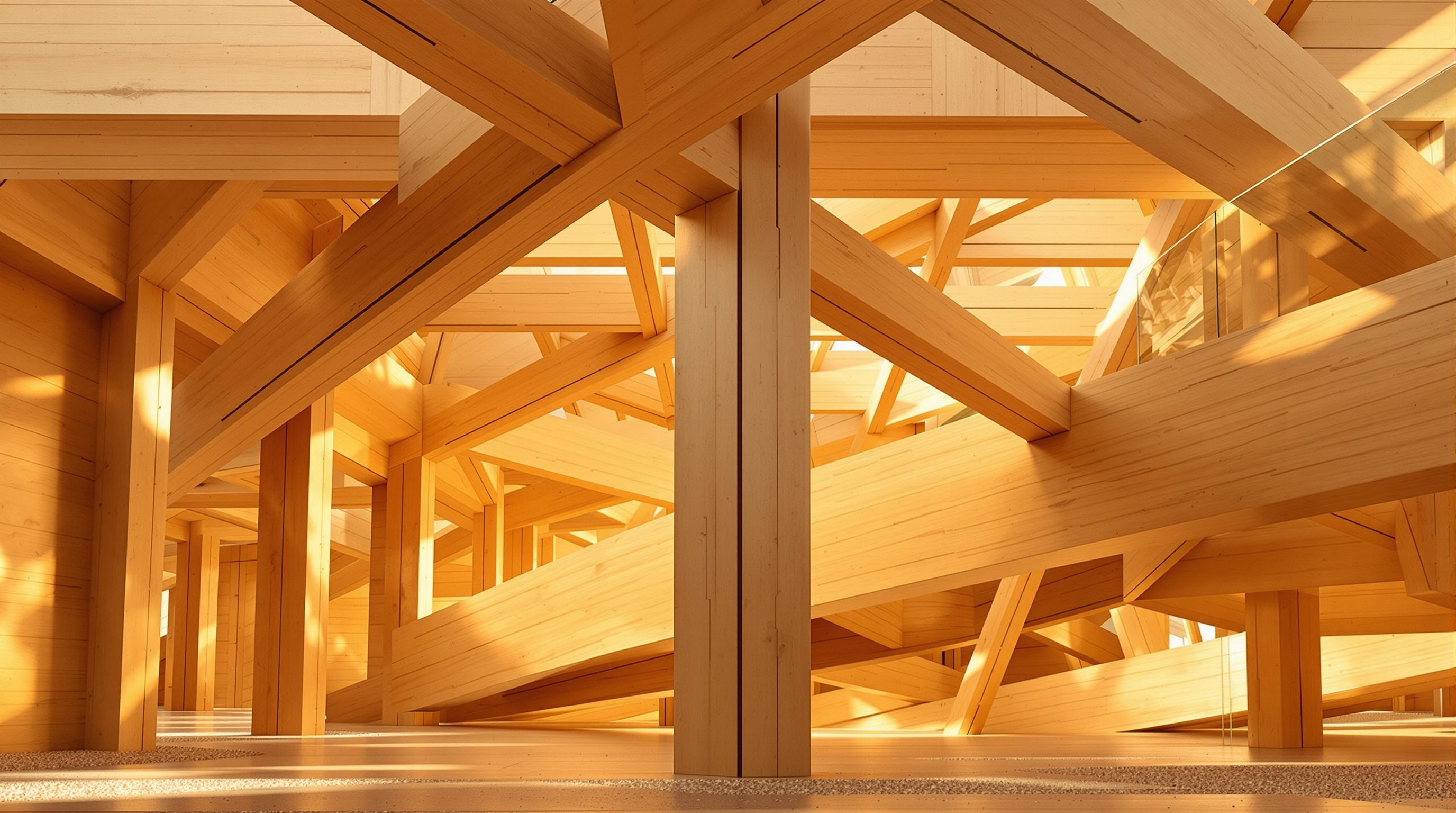
Mass timber is best defined as a family of engineered-wood products made by bonding or fastening many smaller pieces of graded wood into large, solid elements that serve as a building's primary structure - its floors, walls, beams and columns. Three words carry the definition, and it is worth holding all three at once.
Large. Mass timber elements are made far bigger than any single log allows - a CLT panel can be the full width of a room and many metres long, a glulam beam can span a hall. This large format is what lets timber take on the jobs of a concrete slab or a steel frame, and it is what makes prefabrication and fast site assembly possible: you erect a building from a modest number of big pieces, not thousands of small ones.
Solid. The 'mass' in mass timber refers to a genuinely massive, solid cross-section. Unlike a framed wall full of cavities, a mass-timber element is a continuous block of wood. That solidity is not incidental - it is central to how the material performs in fire (a solid section chars slowly on the surface while the core stays cool and strong) and to its heft, feel and acoustic behaviour. When you picture mass timber, picture a thick, solid panel or a deep, solid beam, not a lattice of studs.
Engineered. The wood is not used as it comes off the saw. Smaller boards, veneers or strands are dried, graded, arranged and bonded (or nailed or dowelled) in controlled factory conditions, which disperses natural defects, averages out variability, and lets the maker place strength where the design needs it. The result is a product that is stronger, more uniform, more dimensionally stable and more predictable than the sawn timber it is built from.
And underlying all three: structural. Mass timber is primary structure - it holds the building up. That is the through-line of this course, and it is what separates mass timber from the many other things wood does in a building. Hold the test in your head: large, solid, engineered, structural. If any one is missing, you are probably looking at something else.
Large + Solid + Engineered + Structural. Miss one and it is probably not mass timber.
Mass timber vs light framing vs plain sawn lumber
The quickest way to feel what mass timber is is to set it beside its two nearest relatives, because all three are 'building with wood' and yet they are profoundly different structural ideas.
Plain sawn lumber is a board cut straight from a log and used more or less as it is - a rafter, a joist, a stud, a plank. It is wood in its simplest structural form. Its virtues are obvious (cheap, simple, everywhere), but so are its limits: a board can only be as big as the tree, it varies knot-to-knot and piece-to-piece, it is much weaker across the grain than along it, and it moves as its moisture changes. Sawn lumber is the raw ingredient, not the engineered product.
Light timber framing - the 'stick-built' or platform framing of a typical house - takes many of those small sawn members, spaces them close together (studs at regular centres, joists across a floor), and sheathes them with boards to make walls and floors. Its genius is repetition: no single piece does much, but the assembly, working together and braced by its sheathing, makes a sound small building. It is superb for houses and light commercial work, but it is limited in scale, and the walls and floors it makes are hollow, cavity-filled assemblies rather than solid ones.
Mass timber inverts the logic. Instead of many small members working together, it uses a few large, solid elements, each of which carries serious load in its own right - the timber equivalent of a concrete slab or a steel beam. This is why mass timber can build tall and span far where light framing cannot, why it behaves so differently in fire (solid char versus exposed cavities and connections), and why it is erected as a prefabricated kit rather than assembled stick by stick on site. The three are a family, but do not confuse them: sawn lumber is the ingredient, light framing is many small pieces sharing the load, and mass timber is few big pieces each doing a big job.
The main product families at a glance
Mass timber is an umbrella over several product families, and while Module 2 studies each in depth, you should meet them now so the names stop being a fog. They divide naturally by how the small pieces are put together.
Glulam (glued-laminated timber) is the elder of the family: many boards (laminations) glued together in parallel layers to make a large, strong member. Because the laminations run the same way, glulam excels as a linear element - beams and columns - and it can be curved or cambered in the factory. Think of glulam wherever you need a big beam or a tall column.
Cross-laminated timber (CLT) is the product that lit the revival: boards glued in layers that alternate direction at ninety degrees, like a giant structural plywood. Crossing the grain makes the panel strong in both directions and dimensionally stable, which is exactly what a floor, wall or roof panel needs. CLT is the great plate-maker of mass timber.
The veneer and strand products - LVL, PSL and LSL - are built not from boards but from thin veneers (LVL) or strands (PSL, LSL) of wood, bonded under pressure. Dispersing the wood this finely makes very strong, very uniform members, used for heavily loaded beams, headers, rims and columns where you need strength in a slim section.
NLT and DLT (nail-laminated and dowel-laminated timber) stand boards on edge and hold them together with nails or hardwood dowels rather than glue - an older, glue-free way to make a solid panel, valued where adhesives are unwanted or for its exposed, ribbed underside.
There are others at the edges - glulam variants, box and cassette elements, and hybrids - but these are the workhorses. A simple way to keep them straight: glulam and the veneer/strand family make linear members (beams, columns); CLT, NLT and DLT make panels (floors, walls, roofs). That single distinction - members versus panels - will carry you a long way into the structural modules to come.
Glulam + LVL/PSL/LSL = linear members. CLT + NLT/DLT = panels. Learn the split first.
What does NOT count as mass timber
Defining mass timber by what it is not is just as useful, because the confusions are common and they matter. The key idea is a nesting of categories: engineered wood is a big umbrella that includes many products, and mass timber is only the subset that is large, solid and used as primary structure. Plenty of engineered wood is not mass timber at all.
Sheet goods - plywood, OSB, MDF, particleboard - are engineered wood, but they are thin sheets, not massive structural elements. Plywood and OSB do vital structural work as sheathing and webs, but as a skin over a frame, not as a solid element carrying a building; MDF and particleboard are non-structural, for furniture and finishes. They belong to the engineered-wood family, but calling them mass timber misses the whole point of solidity and scale.
Light-frame studs and joists are not mass timber either, even though they are structural and made of wood - they are small, spaced sawn members, the light-framing idea from the previous section, not large solid elements.
Timber finishes and joinery - timber flooring, cladding, panelling, decorative veneer, doors, furniture - are wood in the building, sometimes beautifully so, but they are finish and fit-out, not primary structure. A room lined in warm timber boards is not a mass-timber building; a room whose exposed CLT ceiling is holding up the floor above is.
Why be strict about this? Because the confusions lead to real errors: assuming a 'timber building' has mass timber's carbon story when it is a concrete frame with timber cladding; expecting sheet goods to behave like a solid element in fire; or specifying a 'timber floor' and meaning three completely different things. The reliable test is the one from the definition - large, solid, engineered and acting as primary structure. Run any wooden thing in a building through it: a CLT floor plate passes; a plywood cabinet, an OSB sheathing board, a timber skirting and a stud wall all, correctly, do not.
Product identification (glulam, CLT, LVL, PSL, LSL, NLT, DLT)
What each product is, how it is made, and its typical role
Principles and identification are covered here and in Module 2; grades, strengths and sizes come from the manufacturer's technical data and your structural/timber engineer.
Product standards & approvals (illustrative)
How mass-timber products are specified and approved
Products are made and specified to standards and approvals (for example manufacturer certifications, and where used Eurocode 5 and product approvals). Cited illustratively - verify the current governing documents with the engineer and supplier.
Structural role (engineer + code)
Whether an element is primary structure and how it is sized
Deciding an element's structural duty and its dimensions is the licensed engineer's work, to the current code (NBC 2016 and the relevant IS standards in India). Modules 3, 4.
Workshop — sort the timber in a building into structure, framing and finish
The skill this lesson builds is seeing clearly which wood in a building is which. In this workshop you will take a real building - one you know, a case study, or a project photo set - and classify every piece of timber you can find, using this lesson's tests.
A timber building or a good set of photos, and this lesson. No calculation - this is about correct identification, which underpins everything that follows.
Goal: reliably tell mass timber from framing and from finish
Inputs: a timber-rich building (real, photo set or case study) + this lesson
Time: ~35 minutes
- 1Find the timber: list every use of wood you can identify in the building - floors, walls, beams, columns, ceilings, cladding, joinery, flooring, furniture.
- 2Apply the four-word test to each: is it large, solid, engineered AND acting as primary structure? Mark each item as mass timber, light framing, or finish/joinery.
- 3For anything you marked mass timber, name the likely family (glulam, CLT, LVL/PSL/LSL, NLT/DLT) and say whether it is a member (beam/column) or a panel (floor/wall/roof).
- 4Catch the confusions: flag anything you were tempted to miscall - timber cladding on a concrete frame, plywood sheathing, a stud wall, a timber floor finish - and note why it does NOT count as mass timber.
- 5Write a one-paragraph summary: is this genuinely a mass-timber building, a light-framed one, or a non-timber structure merely finished in wood - and how could you tell?
You’ll walk away with
A short classified list of the building's timber, each item tagged structure / framing / finish, with the mass-timber items named by family and member-or-panel, plus a one-line verdict on what kind of timber building it really is.
Three altitudes on the same idea
Read the band that fits you — or all three.
Precision with the term is a professional habit worth forming early. When you say 'timber building' in a brief, a planning statement or a carbon claim, be clear whether you mean a mass-timber primary structure, a light-framed building, or a concrete or steel frame merely finished in wood - the three have entirely different carbon, fire, cost and programme stories. Learn the members-versus-panels split (glulam and the veneer family for beams and columns; CLT, NLT and DLT for plates) because it maps directly onto how you will lay out a timber grid. And know that the choice of product family is a design decision you make with your structural engineer, who owns the sizing and the binding values.
The distinction between structure and finish is the one to hold tightly. Exposed CLT and glulam are primary structure you are allowed to see and celebrate - which means what you can and cannot do to them (drilling, fixing, cutting, coating) is governed by structural and fire rules, not finish rules. Timber cladding, panelling, flooring and joinery, by contrast, are yours to specify freely as finishes. Knowing which timber in a room is holding the building up and which is lining it changes how you detail, fix and protect it - and stops you treating a structural panel as if it were a decorative board.
Memorise the four-word test - large, solid, engineered, structural - and the members-versus-panels split, and you will be ahead of most people talking about mass timber. A common exam-and-interview trap is to call plywood or a stud wall 'mass timber'; you now know why they are not. Spend time getting comfortable with the family names (glulam, CLT, LVL, PSL, LSL, NLT, DLT) and what each is made from, because they recur in every later module. You do not yet need to size anything - you need to be able to identify, correctly, what you are looking at.
“Mass timber is basically just cross-laminated timber (CLT) - or, worse, it is just fancy plywood - so once you have seen a CLT panel you have seen mass timber.”
Do it yourself
No tools needed - reason it through.
- 1State the four-word test for mass timber and explain why each word matters.
- 2Distinguish plain sawn lumber, light timber framing and mass timber as three different structural ideas.
- 3Explain the members-versus-panels split and place glulam, CLT, LVL and NLT on the correct side.
- 4Why are plywood, OSB and MDF engineered wood but not mass timber?
- 5A concrete building is clad and lined in timber. Is it a mass-timber building? Justify your answer.
The one line to carry out
Peer-reviewed journals & authoritative standards
- 01Mass timber — Wikipedia — Mass timber, 2026.
- 02Engineered wood — Wikipedia — Engineered wood, 2026.
- 03Cross-laminated timber — Wikipedia — Cross-laminated timber, 2026.
- 04Glued laminated timber — Wikipedia — Glued laminated timber, 2026.
- 05Lumber — Wikipedia — Lumber, 2026.
We now have a clear definition and the product names - but why has this suddenly become one of the most talked-about ideas in construction, when wood is the oldest building material of all? Next we trace the long retreat and the recent return.
The author
Amogh N P
Architect, interior designer, and creative polymath. Studio Matrx began in his notebooks — his vision of design made honest, useful, and open to everyone. Its Academy is written and taught in his memory, and free, forever.
More about Amogh →