
 Lesson 10.4
Lesson 10.4 · Mass Timber in Practice & the Future
The Future of Mass Timber
New products, deeper hybrids, taller and wider buildings and a maturing India all point the same way - toward wider adoption of a renewable, carbon-storing structural material - and this final lesson gathers the whole course into a single, hopeful, grounded idea: we can build well with a material that grows back
The most exciting thing about mass timber is not what it has already built - it is where an ancient material, freshly engineered, is only just beginning to go.
Every powerful technology has a moment when it stops being a novelty and becomes a normal choice, and mass timber is somewhere on that curve - past the proof, not yet at the plateau. The towers that made headlines a decade ago as daring experiments are now precedents; the products have matured; the carbon argument has moved from the fringe to the centre of how the profession thinks about building. What comes next is less a single breakthrough than a broadening: more products, deeper hybrids, taller and wider buildings, and adoption spreading into markets - India among them - that are only now beginning their timber story.
This is the last lesson of the course, and it does two things. First, it looks honestly forward - not with prophecy, but with a grounded read of the directions the field is genuinely moving, and the forces (supply, cost, code, sustainability) that will set the pace. Second, and more importantly, it gathers everything you have learned across ten modules into a single coherent idea, and closes on it. Because the point of the course was never to make you a timber enthusiast; it was to make you a clear-eyed designer who understands a remarkable material well enough to use it wisely, honestly and beautifully - and, in doing so, to help build the low-carbon buildings this century asks for. Let us look ahead, and then look back at the whole journey, and end where the material itself begins: in a forest that grows back.
Better products, hybrids, taller, wider, India rising. Keep judgement, defer values, source honestly. Build with what grows back.
New products, deeper hybrids, taller and wider
The near-term future of mass timber is, in large part, more and better of what the course has already introduced. The product family keeps growing: the established members - glulam, CLT, LVL and the veneer and panel products (Module 2) - are being refined with better adhesives, higher performance, larger and longer elements, and new variants engineered for particular jobs, while research explores products that use more of the tree, faster-growing species, and even agricultural residues. Alongside better products come better ways of making them - deeper digital fabrication, automation, and tighter integration between the model and the machine (Module 8) - which lower cost, raise precision and shorten lead times, all of which widen where timber makes sense.
Hybrids are one of the clearest directions of travel, and one of the most sensible. Rather than an ideological all-timber-or-nothing, the maturing field increasingly uses each material where it is best: timber for the low-carbon, fast, light superstructure; concrete or steel where their particular strengths - mass for acoustics, a stiff core for stability, a transfer structure - genuinely earn their carbon (Module 3.3). Intelligent hybridisation lets timber into buildings and situations that pure timber could not yet reach, and it is likely to be how much of the near future's timber gets built, especially in emerging markets learning the material.
And the buildings keep going taller and wider. The tall-timber high-rise, the 'plyscraper' (Module 3.4), has moved from a handful of record-setting experiments toward a genuine building type, as codes, fire engineering and confidence catch up; each new tower extends what is permitted and proven, and the ceiling keeps rising. Long-span timber - halls, arenas, industrial and civic buildings - continues to grow too, playing to the beauty and efficiency of glulam and large panels. None of this changes the discipline the course has taught: every one of these advances still defers its binding values to the structural engineer, the fire engineer and the code, and still depends on genuinely sustainable sourcing to keep its carbon promise true. The frontier moves; the principles hold.
More/better products. Smart hybrids. Taller, wider. Frontier moves - principles (engineer, code, sourcing) hold.
Wider adoption - and India's real potential
Beyond the products and the height records, the deeper story of mass timber's future is adoption spreading - from the mature markets where it began into the many places, India prominent among them, that are only now starting. This broadening matters more for the climate than any single tower, because the carbon benefit scales with how ordinary timber becomes, not with how spectacular. The forces driving it are strong and aligned: the intensifying pressure to cut the embodied carbon of construction (Module 7), the growing body of proof that timber buildings perform and sell and let well, the maturing supply chains and falling relative costs, and a generation of architects, engineers and clients who want to build differently.
India's potential is genuine, and worth stating clearly and honestly, as the previous lessons did. The country builds at vast scale, and that construction carries an enormous, rising carbon footprint - which is precisely the problem mass timber exists to help solve. India has strengthening sustainability drivers and a maturing green-building movement; deep, living traditions of building in wood across its regions to build cultural confidence on; and forestry and agricultural-residue resources that, sustainably managed and honestly certified, could over time support a domestic engineered-wood industry rather than reliance on imports. The honest caveats remain - today the supply is nascent, the code path bespoke, the expertise base small, and the cost often high - but maturity gaps close, and usually faster than expected once flagship projects and domestic supply begin to reinforce each other.
The realistic and hopeful picture, then, is not that India will suddenly fill with timber towers, but that the field will grow steadily and meaningfully here over the coming years - starting with interiors, engineered wood, hybrids and the right pilot projects, and broadening as the ecosystem matures. The designers who understand mass timber now, honestly and without overclaiming, are exactly the ones who will lead that growth - who can spot the projects where timber already works, who can guide clients and authorities through an unfamiliar path, and who can help build the domestic knowledge that a maturing market needs. That is a genuinely exciting place for an Indian architect, interior designer or student to stand: at the honest beginning of a field with real potential, equipped to help write its early chapters well.
The whole course, in one idea
Step back now, at the end, and see the shape of the whole journey - because everything you have learned resolves into a single, coherent idea. The course began (Module 0) by reframing the oldest building material as the low-carbon structural frontier: timber is grown by sunlight and stores carbon, where concrete and steel are mined and fired at huge up-front carbon cost, and mass timber engineers ordinary wood into large, strong, fire-safe elements that can build at real scale. To use it well, you first had to understand the material itself (Module 1) - how wood works, its strength, grain and lifelong relationship with moisture, and the journey from log to engineered product. Then you met the products (Module 2) - glulam, CLT, LVL and the panels - and the structural systems they make possible (Module 3), from post-and-beam to panel systems to hybrids to the tall-timber high-rise.
With the material and systems in hand, you learned to design with them (Module 4) - grids and spans tuned to the product, connections as the heart of the structure, lateral stability - and then to respect the two disciplines that most decide whether a timber building is safe and pleasant: fire and life safety (Module 5), where large timber chars predictably and can be engineered to be genuinely fire-safe, and building physics (Module 6) - acoustics, moisture, thermal performance and vibration - where timber's real challenges are met by early, careful design. You then reached the heart of why any of this matters (Module 7) - the carbon story, sustainable forestry, life-cycle and circularity - and saw how the promise depends entirely on honest, certified sourcing. Finally you learned how timber buildings are actually delivered (Module 8) - DfMA, digital fabrication, assembly and logistics - and how they become architecture (Module 9) - connection detailing, the exposed aesthetic, integrated services, finishes and ageing - before this last module made it real: cost, procurement and the team, codes and India, the common mistakes, and now the future.
Across all of it, one through-line held without exception. You keep the design judgement - the material choice, the architecture, the carbon ambition, the strategy - and you defer every binding value to the licensed structural or timber engineer, the fire engineer and the current code; and the carbon win is only real if the sourcing is genuinely sustainable and certified. That is the whole discipline of designing with mass timber, and you now carry it.
Understand wood -> products -> systems -> design -> fire -> physics -> carbon -> deliver -> detail -> practice. Keep judgement, defer values, source honestly.
Building with a material that grows back
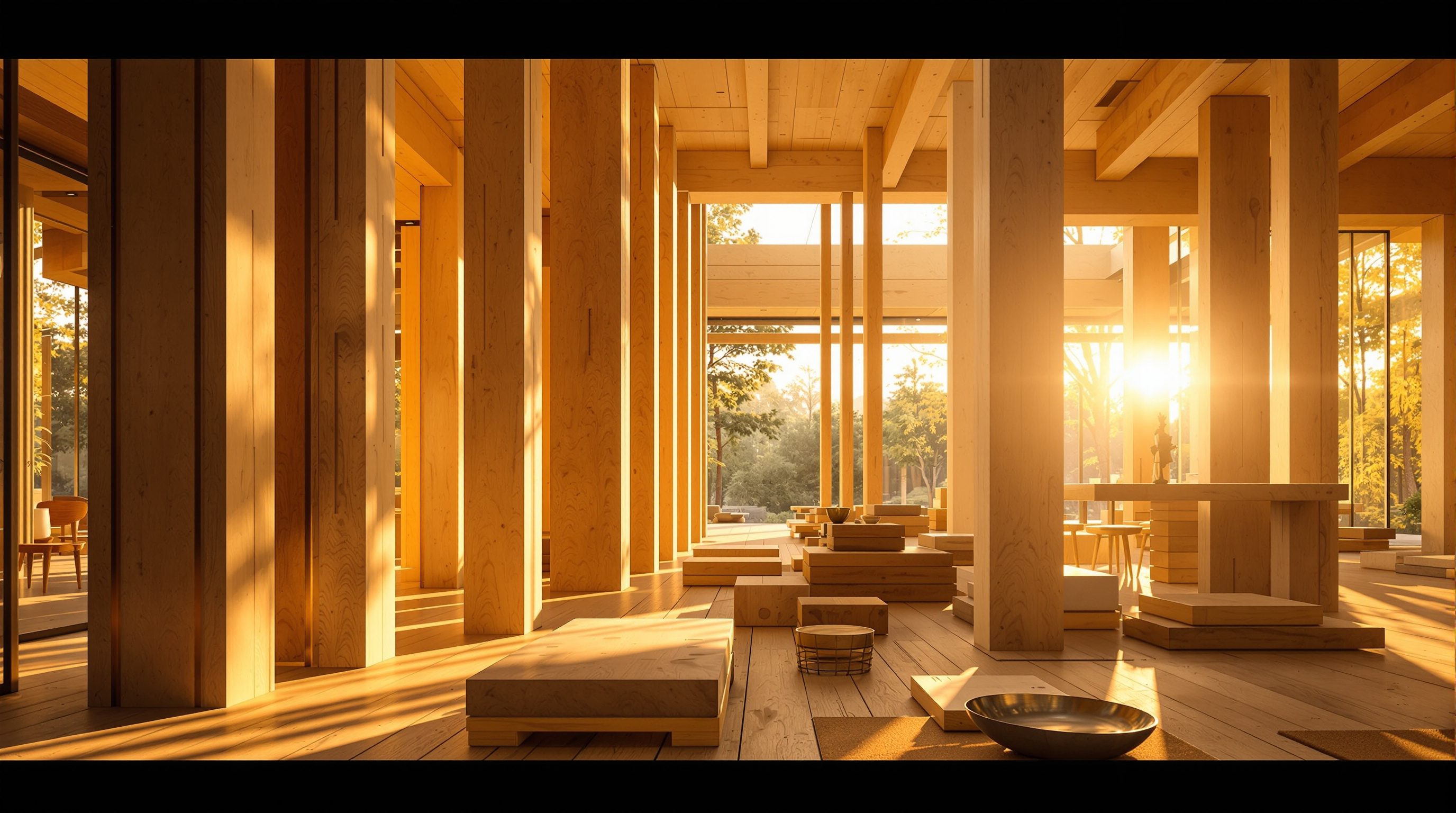
We opened this course with an image, and it is the right one to close on. Concrete and steel are dug from the ground and burned into existence, releasing their carbon the moment they are made. Timber is the opposite: it is grown - by sunlight, water and carbon pulled from the air - and it locks that carbon away in its fibres as it stands. For most of history the catch was scale: natural timber could only span and stack so far. Mass timber removed that catch, engineering the humble log into massive, precise, reliable, fire-safe elements that can build the tall and long-span buildings a modern city needs. And so the oldest building material became the most hopeful new one - because it offers something concrete and steel cannot: a genuinely renewable, carbon-storing way to build at real scale.
That is a profound thing to be able to say about a structural material in a century defined by the climate. It does not make timber a miracle - this course has been honest throughout about the real cautions: fire must be designed for, moisture is timber's enemy, acoustics and cost and code and supply all demand care, and the carbon claim is only true if the forests are genuinely well managed and replanted. Mass timber is a powerful option, not a magic one. But used in the right project, designed properly, sourced responsibly and delivered by a team engaged early, it is transformative - faster, lighter, lower-carbon and more beautiful, a building that is, in effect, a store of carbon a forest captured and a place people love to be inside.
You began this course knowing timber as an old, familiar material. You leave it understanding mass timber as one of the most important tools available to a designer who wants to build well in a carbon-constrained world - and, just as importantly, understanding its limits and how to defer them wisely to the engineers and the code. That balance of ambition and humility is the whole point. In India, where the field is only beginning, that understanding is especially valuable; you can help write its early chapters. So go and use it well: choose it wisely, design it knowingly, respect fire and moisture, source it honestly, work as one team, and defer the binding numbers to those who own them. And take pleasure in the deepest fact of all - that, done right, you are building the shelter and cities of the future out of a material that, when this building's long life is over, the forest simply grows back.
Structural & fire design (engineer + code)
Every binding value, however advanced the product or tall the building
New products, hybrids and heights do not change the rule: member sizes, connections, stability, fire-resistance and charring come from the licensed engineers and the current code, verified as of the day you design.
Certified sustainable sourcing
The condition on which the whole carbon promise depends
The future's carbon benefit is only real if the wood is genuinely well-managed, replanted and certified. Specify and verify chain of custody - the frontier does not relax this.
Current codes & standards (verify)
NBC/IS in India; international standards as reference where used
As tall-timber provisions and standards evolve, verify the current edition for your jurisdiction; a field that is maturing is a field whose codes keep changing.
Workshop - your mass-timber manifesto and first move
This is the final workshop of the course, and it is about you. Rather than analyse a building, you will synthesise everything you have learned into a short personal statement of how you intend to use mass timber - and name the concrete first step you will actually take.
The whole course and a notebook. No calculation - this is synthesis and intent; the binding values, as always, belong to the engineers and the code.
Goal: a personal synthesis of the course into intent and a first action
Inputs: the whole course, your own context and ambitions, a notebook
Time: ~45 minutes
- 1Write the through-line in your own words: in two or three sentences, capture what mass timber is, why it matters in a carbon-constrained century, and the discipline of keeping design judgement while deferring binding values to the engineers and the code.
- 2Name where it fits for you: given your context (your market, including India's realities; your kind of work as architect, interior designer or student), where could mass timber, engineered wood or hybrids genuinely work for you in the next few years - and where not yet?
- 3State your honesty commitments: write the non-negotiables you will hold - certified sustainable sourcing, early team engagement, keeping timber dry, designing fire and acoustics in, and deferring the binding numbers.
- 4Read the future you care about: note which of the directions in this lesson (new products, hybrids, taller/wider, wider adoption, India's growth) most excites you and why - and what you would watch or learn to be ready for it.
- 5Choose one concrete first move: a real, small, specific next step - a timber building to visit, a case study to study, a course project to attempt in timber, a specialist to talk to, or a client conversation to open.
- 6Write your one-paragraph manifesto: combine the above into a short statement of how you intend to build well with a material that grows back - ambitious about the potential, honest about the cautions, and clear about your first step.
You’ll walk away with
A one-page mass-timber manifesto: your synthesis of the course, where timber fits for you, your honesty commitments, the future you are watching, and one concrete first move. Keep it where you will see it - it is the bridge from finishing this course to actually building with the material.
Three altitudes on the same idea
Read the band that fits you — or all three.
You now hold mass timber as a serious option in your structural palette, and the future will only widen where it fits. Watch the directions that matter - better and larger products, intelligent hybrids, taller and longer-span buildings, and maturing supply and codes - and read them as expanding opportunity rather than hype. Your enduring role is unchanged: own the material choice, the architecture, the carbon ambition and the early integrated team, and defer every binding value to the structural engineer, the fire engineer and the current code. In an emerging market like India, the architect who understands timber honestly can spot the projects where it already works, guide clients and authorities through an unfamiliar path, and help build the domestic knowledge a maturing field needs. Build well, and build the future.
The future is full of exposed, warm, biophilic timber interiors - and you are the one who makes them sing. As adoption widens and products improve, more buildings will offer honest, structural timber to work with, and the interior qualities people most love - warmth, calm, natural texture, wellbeing - are exactly what exposed mass timber delivers. Keep learning how timber is finished, protected, integrated with services and left to age gracefully, and keep coordinating early with the structural and fire engineers where your interiors meet the timber. The material's future is bright partly because people simply want to be inside it - and turning that raw structural honesty into beautiful, comfortable, lasting spaces is your contribution to it.
You are entering the profession at exactly the right moment to make mass timber part of your career. The field is past the proof and broadening fast, the carbon imperative that drives it is only intensifying, and in India it is at its honest beginning - which means the designers who understand it now will help lead its growth. Carry forward the whole course: understand wood, know the products and systems, design for the material, respect fire and moisture, hold the carbon story honestly, source responsibly, and always keep the design judgement while deferring the binding values to the engineers and the code. This is a hopeful, fast-growing area to bring into your studies, your portfolio and your working life - and a genuine chance to help build a lower-carbon world with a material that grows back.
“Mass timber is a passing green fad - concrete and steel will always dominate, and timber towers are just publicity stunts that won't change how we really build.”
Do it yourself
No tools needed - reflect and synthesise.
- 1Describe three genuine directions in which mass timber is heading, and the forces (supply, cost, code, sustainability) that will set the pace.
- 2Why does intelligent hybridisation make sense, and why is it likely to be how much of the near-term future's timber gets built - especially in emerging markets?
- 3Make the honest, specific case for India's mass-timber potential, holding both the real opportunity and the real caveats.
- 4In a few sentences, synthesise the whole course: what is the through-line that connects understanding wood to designing, delivering and detailing a timber building?
- 5Restate the course's central discipline: what design judgement do you keep, what binding values do you defer, and on what condition does the carbon benefit depend?
The one line to carry out
Peer-reviewed journals & authoritative standards
- 01Mass timber — Wikipedia — Mass timber, 2026.
- 02Plyscraper — Wikipedia — Plyscraper, 2026.
- 03Carbon sequestration — Wikipedia — Carbon sequestration, 2026.
- 04Circular economy — Wikipedia — Circular economy, 2026.
- 05Sustainable design — Wikipedia — Sustainable design, 2026.
This is the end of the course - but the beginning of your work with the material. Take the manifesto you wrote, make your first move, and go build well with a material that grows back.
The author
Amogh N P
Architect, interior designer, and creative polymath. Studio Matrx began in his notebooks — his vision of design made honest, useful, and open to everyone. Its Academy is written and taught in his memory, and free, forever.
More about Amogh →