
What Accessories Do
The finishing layer that completes a room
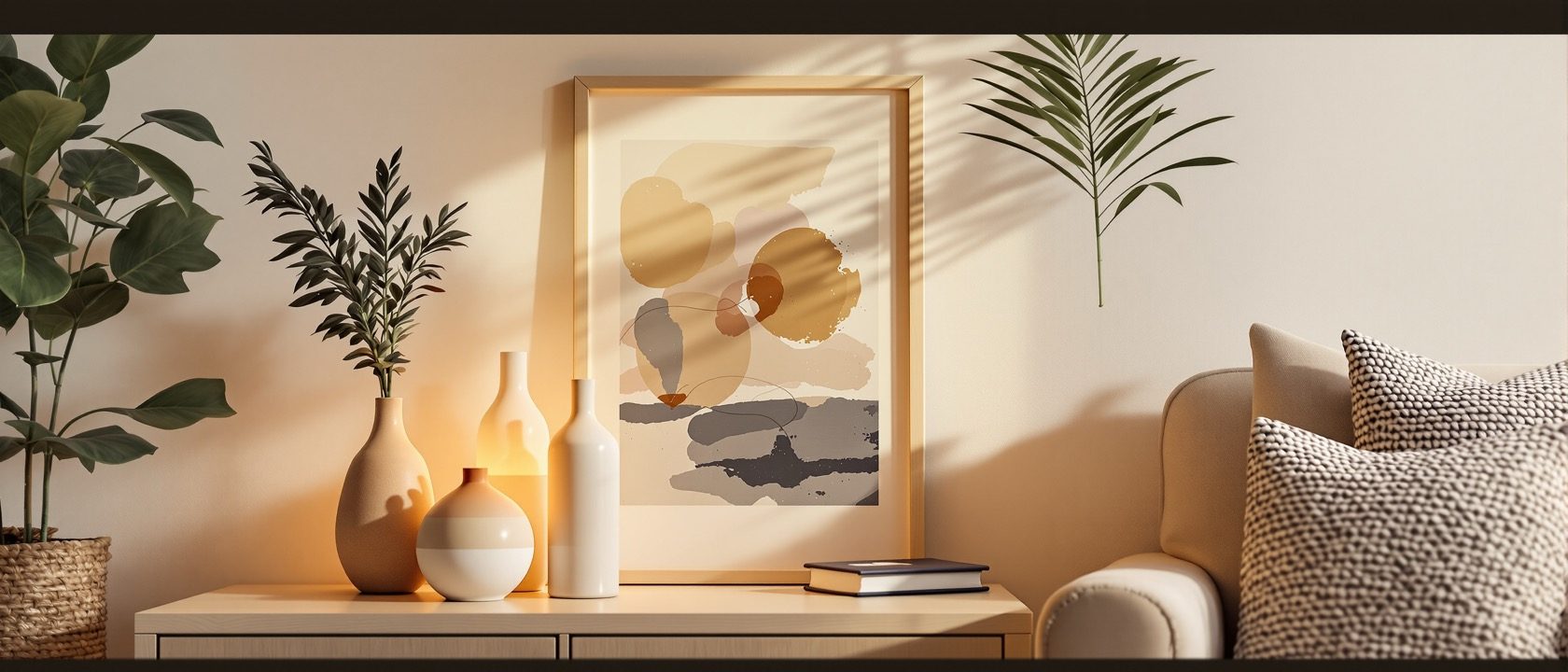
Accessories are the finishing layer of interior design — the lamps, mirrors, vases, cushions and art added once the architecture and furniture are done, where a room stops being a shell and becomes a home. ‘Accessories are just decoration, an afterthought’ is a myth: they carry both a room’s function and its character. They divide into functional (lamp, clock, mirror, vase) and decorative (art, objet) families; an accessory lives in relationship with its space, and scale is its first test. Trends should be read, not obeyed.
Learning objectives
By the end of this lesson, you will be able to — mapped to the course outcomes for Lifestyle Accessories Design:
Explain accessories as the finishing layer that completes a room's function and character.
Distinguish functional and decorative accessories, and their relationship to a space.
Read accessory trends and market demand against timeless, personal choice.
The finishing layer
Accessories are the finishing layer — where a room becomes a home. ‘Just decoration, an afterthought’ is a myth: they carry function and character. They fall into two families, functional (lamp, clock, mirror, vase, cushion) and decorative (art, sculpture, objet), and the best blur the line.[1, 2]
Where a room comes alive
Accessories are the FINISHING LAYER of interior design — the lamps, mirrors, vases, cushions, art and objects added once the architecture, furniture and finishes are done. They are where a room stops being a shell and becomes a HOME: warm, complete, personal. 'Accessories are just decoration, an afterthought' is a MYTH — a beautifully built but bare room feels unfinished, and accessories carry both a room's FUNCTION (light, time, comfort, reflection) and its CHARACTER and story. They are designed and chosen with intent, not scattered on when the budget is left over.[1, 2]
Accessory decoder · the vocabulary of lifestyle accessories
Principles, materials, lighting and styling — graded VERIFIED, NUANCED or MYTH.
The finishing layer
Accessories complete a room
Means: Accessories are the final layer of interior design — the lamps, textiles, art and objects added once the architecture, furniture and finishes are in place — that make a room feel complete, warm and personal.
Honestly · A beautifully built but bare room feels unfinished. Accessories are where a space becomes human and individual — not a leftover step, but the layer that brings it to life.
'Just decoration'
Not an afterthought
Means: The belief that accessories are an afterthought — mere decoration, added if there is money or space left over.
Honestly · A MYTH: accessories carry a room's function (light, time, warmth, comfort) AND its character and story. They are designed and chosen with intent, not scattered on at the end.
Functional vs decorative
Two families of accessory
Means: FUNCTIONAL accessories do a job — a lamp, a clock, a mirror, a vase, a cushion, tableware; DECORATIVE accessories are chosen for beauty and meaning — art, sculpture, objets.
Honestly · The line blurs, happily: the best functional accessory is beautiful too, and the best decorative one feels considered. Knowing the two families helps you balance use and delight in a scheme.
'More is more'
Edit and let it breathe
Means: The belief that more accessories, filling every surface, reads as richer or more luxurious.
Honestly · A MYTH: good accessorising is EDITING. Fewer, better pieces with NEGATIVE SPACE around them read as considered and calm; a crowded surface reads as clutter. Restraint is the luxury.
Rule of odd numbers
Group in threes, at varied heights
Means: The styling heuristic that objects grouped in ODD numbers (three, five) at VARIED heights, forming a loose triangle, look more natural and balanced than even, level rows.
Honestly · NUANCED: a useful guideline, not a law. Odd groupings and varied height help the eye, but symmetry has its own power, and a single strong object can be perfect. Use it, don't obey it.
Scale & proportion
Sized to its space
Means: Choosing an accessory whose SIZE suits its place — a mirror or artwork sized to its wall, a vase to its table, a pendant to its room — so it neither shouts nor disappears.
Honestly · The commonest accessory mistake is the wrong scale: a too-small picture marooned on a big wall, a giant lamp on a slim table. Scale is judged against the space, not the object alone.
Material & feel
Chosen for its property
Means: Choosing an accessory's material for its real property and feel — wood's warmth, metal's strength and shine, glass's transparency, ceramic's fired solidity, textile's softness.
Honestly · Material is a functional and sensory choice, not just a look. Mixing a few honest materials — brass, wood, linen, glass — gives a room depth; a room of one material feels flat.
'Sustainable looks cheap'
Recycled & natural can be beautiful
Means: The belief that sustainable, recycled or natural materials look cheap or unrefined.
Honestly · A MYTH: recycled glass, reclaimed wood, natural fibre and low-impact metal can be the most beautiful and characterful of all. And DURABILITY is sustainability — a well-made object kept for decades beats a throwaway.
'Handmade is inferior'
Artisan-made, not lesser
Means: The belief that handmade or artisan-crafted accessories are lower quality or inconsistent, next to machine-made goods.
Honestly · A MYTH: fine craft is a mark of quality, not a flaw, and the small variation of the handmade is its value. India's artisan accessories — brass, pottery, handloom, lacquerware — are world-class design.
Glass & ceramic
Blown, cast, fired
Means: Glassware (blown, cast or pressed) and ceramics (thrown, moulded, glazed and fired) — two of the oldest accessory crafts, giving vases, tableware, lamps and objets.
Honestly · Each has real technique behind it: a hand-blown vase or a wheel-thrown bowl carries the maker's skill. Understanding the making helps a designer specify and value the object honestly.
Textiles & soft furnishing
Warmth, texture, sound
Means: Cushions, throws, rugs, curtains and upholstery — the soft accessories that add colour, texture, warmth and acoustic softness to a room.
Honestly · Textiles do quiet, powerful work: they warm a hard room, soften its sound, and are the cheapest, fastest way to change its mood and season. Handloom and natural fibres bring craft and character.
Layered lighting
Ambient, task, accent
Means: Good lighting is LAYERED: AMBIENT (general light for the whole room), TASK (focused light for reading, cooking, work) and ACCENT (directed light to highlight art or texture), plus decorative fittings.
Honestly · One central light flattens a room. Layering the three — and putting them on separate switches or dimmers — lets one space shift from bright and working to soft and intimate. It is the biggest single upgrade to a room.
Colour temperature
Warm vs cool light
Means: The 'warmth' or 'coolness' of white light, measured in KELVIN — warm (about 2700K) is cosy and yellowish, neutral (about 4000K), cool (5000K and up) is crisp and bluish, like daylight.
Honestly · Colour temperature sets mood: warm light for living and bedrooms, cooler for kitchens and workspaces. And higher kelvin is NOT brighter (that is lumens) — a 2700K and a 5000K lamp can give identical brightness. Mixing temperatures carelessly in one room looks jarring — choose deliberately.
Colour rendering (CRI)
How true colours look
Means: The Colour Rendering Index (CRI, 0-100) measures how truly a light source shows an object's colours against natural light; a high CRI (90+) renders skin, fabric and finishes faithfully.
Honestly · A cheap, low-CRI lamp makes fabrics, food and skin look dull or 'off', however bright it is — a real problem for accessories chosen for their colour. For a room where colour matters, specify high CRI.
Decorative lighting
The fitting is an object
Means: A luminaire — a table lamp, pendant or chandelier — that is chosen as a decorative OBJECT as well as a light source, seen and admired even when switched off.
Honestly · NUANCED: a beautiful fitting is a real accessory, but it must still light well. A gorgeous lamp that glares or barely lights has failed half its job — form and light function must both be right.
Mirrors
Light and apparent space
Means: A mirror bounces light around a room and can make a space feel larger and brighter by reflecting a view, a window or the depth beyond.
Honestly · NUANCED, not magic: placement decides it. A mirror reflecting a window or a good view opens a room; one reflecting a blank wall or clutter just doubles the mess. Place it to reflect light and something worth seeing.
Room by room
Accessories suit the use
Means: Choosing accessories for the ROOM and its use — restful and soft in a bedroom, practical and wipeable in a kitchen, sociable and layered in a living room.
Honestly · An accessory that is right in one room is wrong in another. The use, the wear, the light and the mood of each room set what belongs there — design for the room, not just the object.
Cultural references
Rooted, not borrowed
Means: Grounding accessories in cultural and historical reference — India's brass and bronze, terracotta, blue pottery, Channapatna lacquerware, Dhokra casting and handloom textiles among them.
Honestly · Cultural reference gives an accessory depth and story, and supports living crafts. Done with knowledge and respect it is rich and rooted; done as a shallow motif it is cliche — know the source.
Trend vs timeless
Follow, or endure?
Means: The tension between the current TREND (of the moment, of the market) and TIMELESS, personal choices that endure beyond a season.
Honestly · NUANCED: knowing trends and the market matters, but a room built entirely on this year's trend dates fast. The best schemes mix a few timeless, personal, well-made pieces with a light touch of the current.
An accessory is a small, honest object that completes a room and serves the life lived in it.
History, and the accessory in its space
Decorative and useful objects are as old as the home, running from ancient craft through the Arts and Crafts movement (William Morris) to today. And an accessory lives in relationship with its space: scale, sized to its wall or table, is the first test — the commonest accessory mistake is the wrong scale.[2, 3]
The evolution of accessories
Decorative and useful objects are as old as the home — pottery, lamps, textiles and mirrors run through every culture and century. The story runs from ancient hand-craft, through the ornament of past eras, to the ARTS AND CRAFTS movement (William Morris and others, later 19th century) that prized honest materials and fine making against shoddy machine goods — Morris's famous rule was to 'have nothing in your houses that you do not know to be useful, or believe to be beautiful' — and on to modern and contemporary design. Knowing this evolution is knowing that accessories have always carried both use and meaning.[1, 3]
Trends and why accessories matter
Accessories are a fast market, and reading trends is part of the discipline — but a room built entirely on this year’s trend dates fast. Mix a few timeless, personal pieces with a light touch of the current. Small as they are, accessories are the fastest, most personal way to change a room.[1, 4]
Read them, don't obey them
Accessories are a fast-moving MARKET, and knowing current TRENDS and demand is part of the discipline — colours, materials and styles shift each season, and a designer should read them. But 'you must follow the latest trend' is a NUANCED half-truth: a room built entirely on this year's trend dates fast and feels impersonal. The strongest schemes mix a few TIMELESS, personal, well-made pieces — that will still please in ten years — with a light, changeable touch of the current. Trends are seasoning, not the meal.[2, 4]
At a glance
| Aspect | The fact | The folklore |
|---|---|---|
| Accessories are | The finishing layer that completes a room | An afterthought, mere decoration |
| They carry | A room's function AND its character | Only surface prettiness |
| The two families | Functional (lamp, clock, mirror) and decorative (art, objet) | All the same thing |
| The first test of an accessory | SCALE — sized to its space | Just whether it's pretty |
| Trends | Read them, but mix with timeless, personal pieces | Follow the latest, always |
| Their effect | Larger than their size — fast, personal, memorable | Minor, optional |
Key terms
A finishing object in an interior — lamp, mirror, clock, vase, cushion, art, objet — that completes a room's function and character; the final layer of design.
The last layer of interior design, added after architecture, furniture and finishes, that makes a room feel complete, warm and personal — not an afterthought.
Functional accessories do a job (lamp, clock, mirror, vase); decorative ones are chosen for beauty and meaning (art, sculpture, objet) — the best blur the line.
An accessory's size judged against its space — a mirror to its wall, a vase to its table — so it neither shouts nor disappears; the commonest accessory mistake is wrong scale.
The later-19th-century movement prizing honest materials and fine making over shoddy machine goods — 'have nothing in your houses that you do not know to be useful, or believe to be beautiful'.
The market's current fashion versus enduring, personal choices — the best schemes mix a few timeless pieces with a light touch of the current, not this year's trend alone.
Study task
Choose one room you know and audit its accessories. List them and sort each into functional or decorative (noting the ones that are both). For three pieces, judge the scale against the space — is anything too small for its wall, or too big for its table? Then ask which pieces are timeless and personal and which are just of-the-moment. Finally, name one accessory you would add or remove to make the room feel more complete, and say why. Use the accessory decoder to check your vocabulary and grade a claim or two you hold about accessories. The goal is to see the finishing layer as a designed, deliberate thing.
Self-assessment
1. What are lifestyle accessories, in interior design?
2. What are the two families of accessory?
3. What is the first test of an accessory in a space?
4. How should a designer treat accessory trends?
Recap
References & further reading
- [1]Decorative accessories in interior design — the finishing layer, and the history of decorative objects (Treena Crochet & David Vleck, Designer's Guide to Decorative Accessories). https://www.pearson.com/
- [2]Accessorising and styling interiors — functional and decorative accessories, scale and arrangement (interior-styling and decoration references; Francis D.K. Ching, Interior Design Illustrated). https://www.wiley.com/
- [3]Arts and Crafts movement and William Morris — honest materials and craft; 'have nothing in your houses that you do not know to be useful, or believe to be beautiful' (Morris, The Beauty of Life, 1880). https://www.vam.ac.uk/
- [4]Trends and the market in lifestyle and home accessories (design and market references; International Design Yearbook). https://www.rotovision.com/
Further reading
- Treena Crochet & David Vleck, Designer's Guide to Decorative Accessories.
- Laura Slack, What is Product Design?
- William Lidwell, Kritina Holden & Jill Butler, Universal Principles of Design.
Sources gathered and fact-checked June 2026. Published values vary by source, sample and method — treat as indicative and confirm against the cited standard before structural use.
The author
Amogh N P
Architect, interior designer, and creative polymath. Studio Matrx began in his notebooks — his vision of design made honest, useful, and open to everyone. Its Academy is written and taught in his memory, and free, forever.
More about Amogh →