
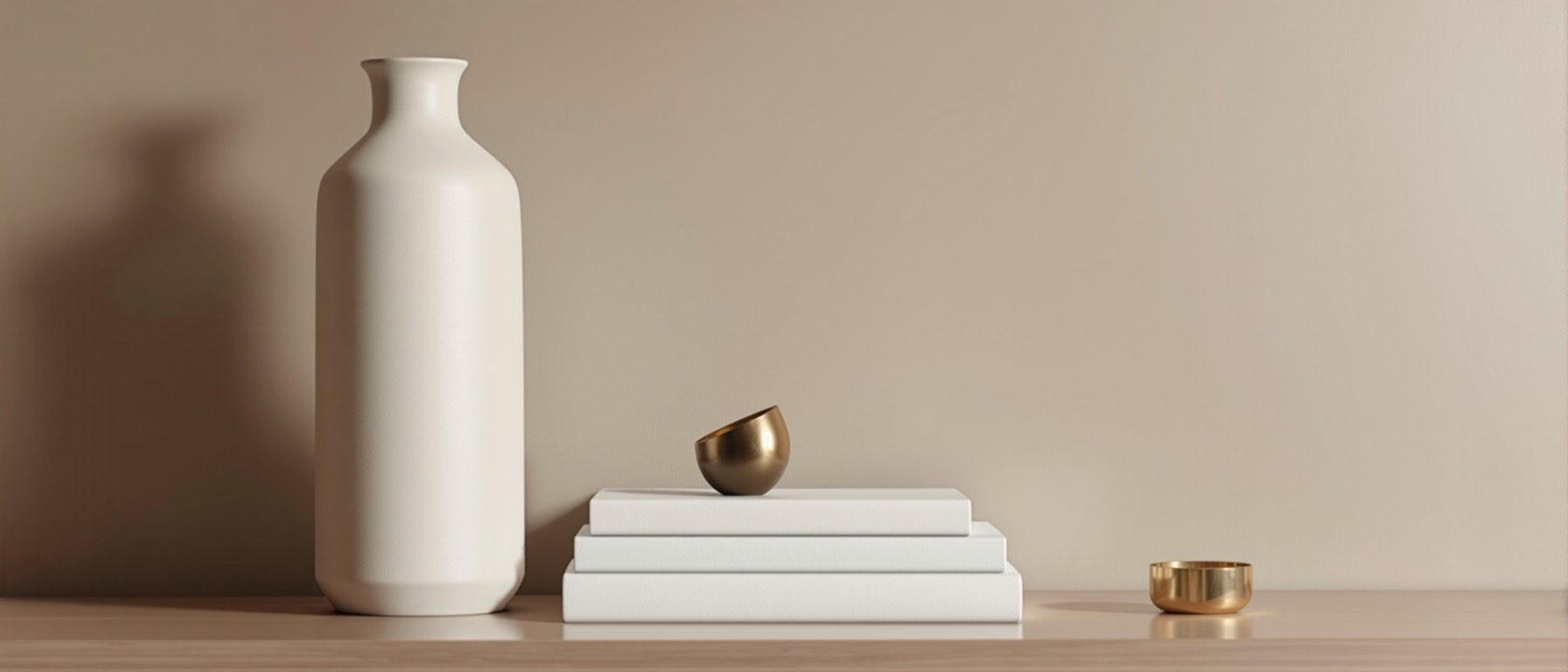
The Design Approach
For the room, the theme and the culture — edited to balance
Accessories are chosen for the room and its use — sociable in a living room, soft in a bedroom, durable in a kitchen — and must suit its theme and aesthetic. Grounding them in cultural reference (India’s brass, terracotta, blue pottery, handloom) gives depth, done with knowledge and respect. And placing them well is composition: scale, odd numbers and varied height — but the key skill is editing, because more is not more, and negative space is part of the design.
Learning objectives
By the end of this lesson, you will be able to — mapped to the course outcomes for Lifestyle Accessories Design:
Choose accessories for different rooms according to their use, wear and mood.
Adapt accessories to a theme and aesthetic, and to cultural and historical reference.
Compose a group by scale, odd numbers and negative space — editing for balance.
Room, theme and aesthetic
Accessories are chosen for the room and its use, wear, light and mood — right in one room, wrong in another. And they must suit the room’s theme and aesthetic: the accessory is where a scheme’s style is most strongly voiced, and a jarring one breaks the mood a whole room built.[1, 2]
Accessories suit the use
Accessories are chosen for the ROOM and its use. A LIVING room is sociable and layered — lamps, art, cushions, objects that invite. A BEDROOM is restful and soft — low warm light, textiles, personal pieces, calm. A KITCHEN and dining space is practical — durable, wipeable, useful-beautiful things that take heat, water and wear. An accessory right in one room is wrong in another: the use, the wear, the light and the mood of each room set what belongs there. Design for the room, not just for the object in isolation.[1]
Cultural reference and case studies
Accessories carry cultural and historical reference — India’s brass, terracotta, Jaipur blue pottery, Channapatna lacquer, Dhokra casting, handloom. Done with knowledge and respect it is rich and rooted; as a shallow motif it is cliche. Study real case studies to build judgement.[2, 3]
Rooted, not borrowed
Accessories carry CULTURAL and HISTORICAL reference, and this is a source of depth. India's own vocabulary is vast — brass and bronze, terracotta, Jaipur blue pottery, Channapatna lacquerware, Dhokra casting, block-print and handloom textiles, jaali and folk motifs. Grounding an accessory in real reference gives it story and supports living crafts. But reference must be done with KNOWLEDGE and RESPECT: drawn on with understanding it is rich and rooted; used as a shallow, decontextualised motif it is cliche, or worse, disrespectful. Know the source, and honour it.[2, 3]
Composing and editing
Placing accessories well is composition: judge scale, group in odd numbers at varied height (a helpful heuristic, not a law), and connect pieces by a shared thread. But the key skill is editing — ‘more is more’ is a myth; fewer, better pieces with negative space read as considered.[1, 2]
Scale, odds, and the triangle
Placing accessories well is COMPOSITION. A few working tools: judge SCALE against the space; group in ODD NUMBERS (three, five) rather than even rows; vary HEIGHT so a group forms a loose TRIANGLE the eye reads as balanced; and connect pieces by a shared colour, material or theme so a group feels intended. The 'rule of odd numbers' is a helpful HEURISTIC, not a law — symmetry has its own power and a single strong object can be perfect — but for a casual, natural-feeling group it genuinely helps. Try the vignette composer below.[1]
Vignette composer · group, vary height, and leave space
3 objects · good
Three objects of varied height, in a loose triangle, is the classic balanced group — the 'rule of odd numbers'. Enough variety to feel natural, few enough to breathe.
Odd groups at varied heights feel natural — but the rule of odd numbers is a guideline, not a law, and editing to leave negative space matters more than the count.
At a glance
| Aspect | The fact | The folklore |
|---|---|---|
| Accessories are chosen for | The ROOM and its use, wear, light and mood | The object in isolation |
| They must suit | The room's theme and aesthetic | Any style, interchangeably |
| Cultural reference is | Depth, done with knowledge and respect | A shallow motif to copy |
| A good group uses | Scale, ODD numbers, varied height, a shared thread | Even rows, all one height |
| The 'rule of odds' | A helpful HEURISTIC, not a law | An unbreakable rule |
| Good accessorising is | EDITING — negative space, fewer better pieces | Filling every surface |
Key terms
Choosing accessories for a room's use, wear, light and mood — sociable and layered in a living room, soft and restful in a bedroom, durable in a kitchen; right in one room, wrong in another.
The style language a room speaks — minimal, traditional, eclectic — which its accessories must suit, since an accessory is where a scheme's style is most strongly voiced.
Grounding an accessory in cultural and historical source — India's brass, terracotta, blue pottery, lacquerware, handloom — with knowledge and respect, not as a shallow motif.
The styling heuristic of grouping objects in odd numbers at varied heights, forming a loose triangle — a helpful guideline for natural-feeling groups, not a law.
The empty space left around and between accessories, which reads as considered and calm — part of the composition; a crowded surface reads as clutter.
The discipline of placing, stepping back and removing until what remains can breathe and each piece earns its place — a designer's eye shows in what they leave out.
Study task
Style one surface — a console, shelf or mantel — as a designer. First choose accessories that suit the room and its theme, including at least one grounded in a cultural reference you understand. Then compose them: judge each against the space’s scale, group in odd numbers at varied heights into a loose triangle, and connect them by a shared colour or material. Use the vignette composer to test how different counts feel. Finally — and most importantly — edit: step back and remove until what remains can breathe. Photograph the before and after, and note what leaving negative space did. The goal is a composed, edited group, not a crowded surface.
Self-assessment
1. How are accessories chosen for a room?
2. How should cultural references be used in accessories?
3. Is the 'rule of odd numbers' a law?
4. What is the most important accessorising skill?
Recap
References & further reading
- [1]The design approach for accessories — room by room, theme, composition, and editing (Treena Crochet & David Vleck, Designer's Guide to Decorative Accessories; interior-styling references). https://www.pearson.com/
- [2]Adapting design to themes and aesthetics, and principles of composition (William Lidwell, Kritina Holden & Jill Butler, Universal Principles of Design). https://www.rockpub.com/
- [3]Cultural and historical references in Indian accessories and crafts — brass, terracotta, blue pottery, lacquerware, handloom. https://www.indianculture.gov.in/
Further reading
- Treena Crochet & David Vleck, Designer's Guide to Decorative Accessories.
- William Lidwell, Kritina Holden & Jill Butler, Universal Principles of Design.
- Francis D.K. Ching, Interior Design Illustrated.
Sources gathered and fact-checked June 2026. Published values vary by source, sample and method — treat as indicative and confirm against the cited standard before structural use.
The author
Amogh N P
Architect, interior designer, and creative polymath. Studio Matrx began in his notebooks — his vision of design made honest, useful, and open to everyone. Its Academy is written and taught in his memory, and free, forever.
More about Amogh →