
The History & Craft of Set Design
Who designs the world — and how it is really built
Three roles are constantly confused. The production designer designs a film’s whole visual world — a title created for William Cameron Menzies on Gone with the Wind (1939); the art director executes it; the set decorator dresses the set, so ‘the designer just picks the furniture’ is a myth. A stage has forms — proscenium, thrust, arena, black box — each dictating what scenery is possible; Appia and Craig made light and form into scenery; and sets are facades and forced perspective, not real buildings, while CGI has joined physical sets, not replaced them.
Learning objectives
By the end of this lesson, you will be able to — mapped to the course outcomes for Set Design:
Distinguish the production designer, art director and set decorator and what each does.
Identify the stage forms and scenic machinery, and the reformers Appia and Craig.
Explain how sets are really built — facades, forced perspective, hybrid with CGI.
Who designs a production
The production designer designs the whole visual world and leads the art department; the art director executes it; the set decorator dresses the built set. The title was created by producer David O. Selznick for Menzies on Gone with the Wind (1939).[1, 2]
Designer, director, decorator
Three roles are confused and shouldn't be. The PRODUCTION DESIGNER designs the film's whole VISUAL WORLD — sets, locations, colour, texture, the look that tells the story — and leads the art department. The ART DIRECTOR executes that vision, running the department, drawings, construction and budget. The SET DECORATOR DRESSES the built set — furniture, drapes, props, the lived-in detail. 'The designer just picks the furniture' is a MYTH: that is one craft, the decorator's; designing the world is the production designer's. In theatre the designer of the world is the scenographer / scenic designer.[1, 2]
Set-design decoder · the vocabulary of scenic design
Film roles, stage forms, scenic craft and exhibit graphics — graded VERIFIED, NUANCED or MYTH.
Production designer
Designs the whole visual world
Means: The lead who designs a film's entire visual world — sets, locations, colour, texture and overall look — so it tells the story. The title was given to William Cameron Menzies on Gone with the Wind (1939).
Honestly · Not a decorator: the production designer designs the whole look and leads the art department. In theatre the equivalent is the scenographer / scenic designer.
Art director
Runs the art department
Means: The person who executes the production designer's vision — managing the art department, drawings, construction and budget so the design gets built.
Honestly · Confusingly, the film Oscar was called 'Best Art Direction' until it was renamed 'Best Production Design' in 2012 — the roles are distinct: the PD designs, the AD delivers.
Set decorator
Dresses the built set
Means: The person who DRESSES a built set — furniture, drapes, props, the lived-in detail — under the production designer's scheme.
Honestly · 'The designer just picks the furniture' is a MYTH: dressing is the decorator's craft, one part of a whole. The design of the world — its architecture, colour and mood — is the production designer's.
Film as cultural text
Read it for meaning
Means: Treating a film as a text that can be READ — for whose story it tells, what values and society it shows, and how it both reflects and shapes its culture.
Honestly · 'Film is just escapism' is a myth: even entertainment carries values, identity and politics. Reading film critically is the first skill of designing for it — you design the world a story argues for.
Scenography
The whole stage picture
Means: The design of the whole stage experience — space, scenery, light, costume and their relationship — not just painted backdrops (Pamela Howard, 'What is Scenography?').
Honestly · Broader than 'set design': modern scenography treats space, performer, light and audience as one designed experience. 'Scenery is a painted backdrop' is the old, narrow view.
Proscenium stage
Audience on one side
Means: The familiar 'picture-frame' stage: the audience sits on ONE side, looking through a proscenium arch at the stage, with scenery and machinery hidden behind and above.
Honestly · Great for illusion and elaborate scenery (the fly system, painted vistas), but the most distant from the audience. It is one of several forms, not the only kind of stage.
Thrust stage
Audience on three sides
Means: A stage that projects into the audience, who sit on THREE sides — intimate and close, with scenery mostly at the back so sightlines stay open.
Honestly · You cannot use a full painted 'wall' of scenery — the audience would not see past it. The form changes what scenery is possible; it is a design constraint, not a detail.
Arena / in-the-round
Audience on all sides
Means: A stage surrounded on ALL sides by the audience (theatre-in-the-round) — the most intimate form, with only low scenery, floor and furniture, and entrances through the seating.
Honestly · Almost no vertical scenery is possible; the design lives in the floor, the furniture, the light and the actors. The staging form dictates the whole scenic approach.
Black box
A flexible empty room
Means: A plain black room whose stage-audience relationship is reconfigured for each production — the most flexible, experimental space.
Honestly · The 'empty space' (Peter Brook) is a starting point, not a lack of design: the designer chooses the arrangement, the light and the few telling elements each time.
The fourth wall
The invisible watched plane
Means: The imaginary 'wall' at the front of a proscenium set through which the audience watches, as if looking into a room with one side removed.
Honestly · 'Breaking the fourth wall' means a performer acknowledging the audience. It is a convention of illusionistic staging, not a physical thing — and other stage forms barely have one.
Flats & the fly system
The machinery of scenery
Means: FLATS are lightweight framed scenery panels; the FLY SYSTEM is the rigging above the stage that flies scenery, borders and a cyclorama in and out of view.
Honestly · Stage scenery is built to be light, movable and changed fast — the opposite of real construction. Knowing the machinery (flats, battens, the cyclorama, wings) is knowing what scenery can do.
Forced perspective
Making shallow look deep
Means: Building a set with parts made smaller and tapered toward the 'distance' so a shallow set reads as deep — a deliberate trick of the eye, used from painted-set cinema to Peter Jackson's hobbit-sized illusions.
Honestly · The camera or the fixed audience viewpoint makes it work; move, and the trick breaks. Set design exploits how we see, rather than reproducing reality at full size.
The white model
Study form before colour
Means: A plain white scale model of a set, built to study its form, space and sightlines before any colour or texture is decided.
Honestly · The white model is a thinking tool: it separates the question of FORM and SPACE from surface, so the designer resolves the harder problem first. Colour comes in the colour model, later.
'Sets are real buildings'
Facades, not architecture
Means: The belief that film and stage sets are complete, solid buildings.
Honestly · A MYTH: sets are facades with nothing behind, partial rooms, wild (removable) walls to fit the camera, and breakaway props. They are built for the shot or the sightline, not to stand up as architecture.
'CGI killed physical sets'
Hybrid, not replaced
Means: The idea that green screen and computer imagery have made built sets obsolete.
Honestly · NUANCED: virtual production and LED volumes (as on The Mandalorian) are powerful, but physical sets remain central — actors and light need something real. The future is hybrid, not either-or.
Wayfinding
Helping people find the way
Means: Designing how people navigate a space — paths, landmarks, decision points and the signs at each — so a visitor can find the way without a map (Lynch; Arthur & Passini).
Honestly · Signage is only part of it: layout, sightlines and landmarks do much of the work. Good wayfinding is designed into the space, not stuck on afterward.
Environmental graphic design
Graphics in built space
Means: Graphics designed INTO a built environment — signage, wayfinding, super-graphics, exhibits and place-making — the field represented by SEGD (experiential graphic design).
Honestly · It joins graphic design, architecture and interiors: the graphics are part of the space, sized and placed for how people move and see, not a poster hung on a wall.
Sign legibility
Height, contrast, distance
Means: The rule that a sign's readability depends on letter HEIGHT relative to viewing DISTANCE, on tonal CONTRAST, and on clear type — bigger and higher-contrast for farther reading.
Honestly · A common rule of thumb is roughly 25 mm of letter height per 3 m of viewing distance (confirm for the job). Legibility is measurable — a beautiful sign no one can read has failed.
A set is designed storytelling — an honest illusion built for a viewpoint, that serves the story.
The forms and machinery of the stage
A stage’s form — proscenium, thrust, arena or black box — sets the actor-audience relationship and dictates what scenery is possible. Its machinery — flats, the fly system, the cyclorama, the raked floor — is built light and movable, and the fourth wall is the invisible plane the audience watches through.[3]
Where the audience sits
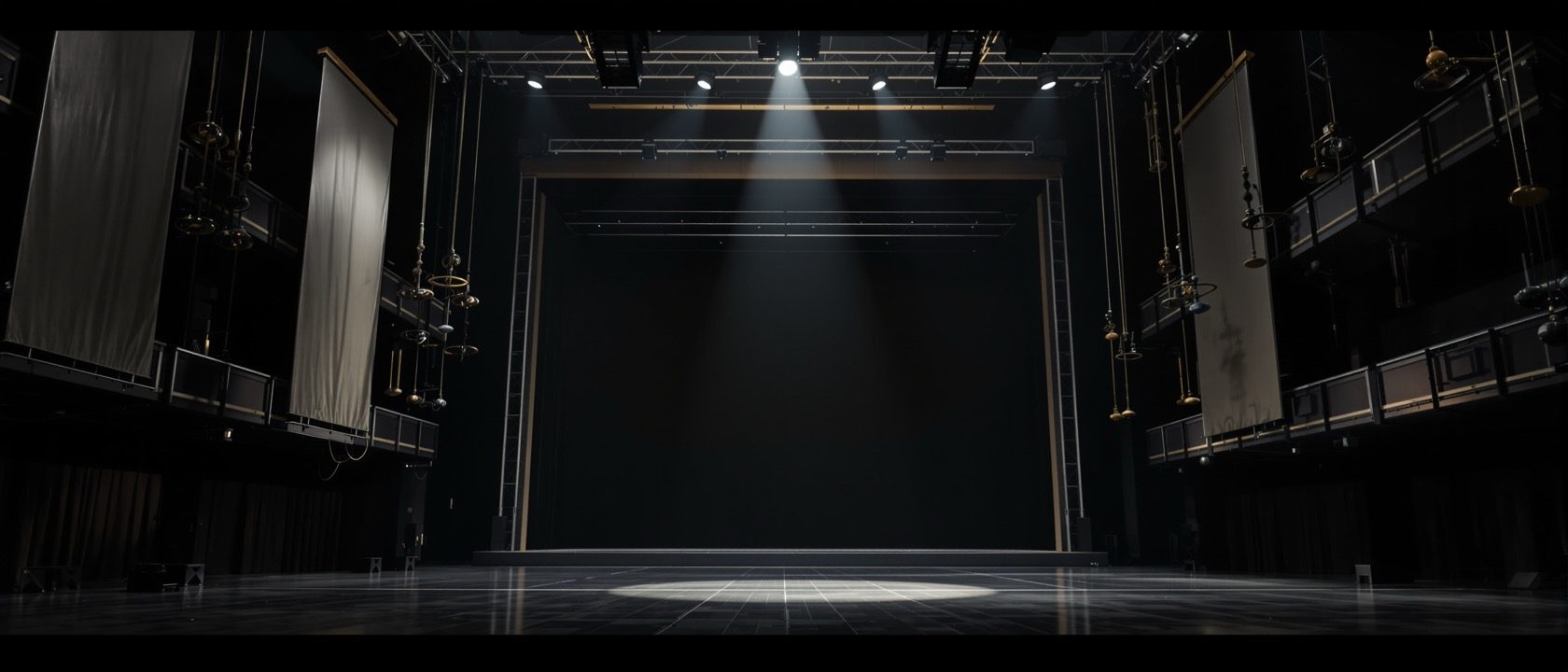
A stage has FORMS, each a different actor-audience relationship. The PROSCENIUM ('picture frame') has the audience on ONE side, through an arch, with scenery and machinery hidden behind — best for grand illusion. The THRUST projects into the audience on THREE sides — intimate, with scenery kept at the back. The ARENA (in-the-round) is surrounded on ALL sides — the most intimate, with only low scenery and floor. The BLACK BOX is a flexible empty room, arranged fresh each time. The form DICTATES what scenery is possible — it is a design decision, not a technicality. Try the stage-form explorer below.[3]
Reform, and how sets are really built
Around 1900 Appia and Craig replaced the painted backdrop with light and three-dimensional form. And ‘sets are real buildings’ is a myth: they are facades, partial builds, wild walls and forced perspective, built for the shot — while CGI and virtual production have joined physical sets in a hybrid craft.[4, 5]
Beyond the painted backdrop
Around 1900, two reformers changed scene design. Adolphe APPIA and Edward Gordon CRAIG rejected the flat PAINTED BACKDROP and made LIGHT and three-dimensional FORM the scenery — abstract steps, planes and pillars shaped by light, so the stage picture had depth, mood and unity with the actor. 'Scenery is a painted picture behind the actors' is the old, narrow view they overturned. Modern SCENOGRAPHY — designing space, light and scenery as one experience (Pamela Howard) — descends from them: the set is an environment, not a decorated wall.[4]
At a glance
| Aspect | The fact | The folklore |
|---|---|---|
| The production designer | Designs the whole visual world; leads the art dept | Just picks furniture |
| The set decorator | Dresses the built set — props, drapes, detail | Designs the film's look |
| The stage form | Dictates what scenery is possible (proscenium/thrust/arena/black box) | A technical footnote |
| Appia & Craig made scenery from | LIGHT and three-dimensional form | Better painted backdrops |
| Film sets are | Facades, partial builds, forced perspective — built for the shot | Complete real buildings |
| CGI and physical sets | Hybrid — virtual production joined sets, didn't replace them | CGI made sets obsolete |
Key terms
The lead who designs a film's entire visual world — sets, colour, texture, look — and leads the art department; the title was given to William Cameron Menzies on Gone with the Wind (1939).
The person who executes the production designer's vision — running the art department, drawings, construction and budget so the design gets built.
The person who dresses a built set with furniture, drapes and props under the designer's scheme — not the designer of the world.
The four stage forms — audience on one side through an arch; on three sides; on all sides (in-the-round); or in a flexible reconfigured room — each setting a different actor-audience relationship.
A flat is a framed scenery panel; the fly system is the overhead rigging that flies pieces in and out; a cyclorama is a curved back cloth — the light, movable machinery of scenery.
The invisible plane at the front of a proscenium set through which the audience watches; 'breaking' it means a performer addressing the audience directly.
Building a set with parts made smaller and tapered toward the distance so a shallow set reads as deep — a trick of the eye that works from a fixed viewpoint.
Filming actors against huge LED screens showing a real-time digital environment (as on The Mandalorian) — a hybrid of physical set and CGI, not a replacement for sets.
Study task
Take one memorable film or stage production and credit the design honestly. Find who the production designer (or scenographer) was, and distinguish their work from the art director’s and the set decorator’s. Then look at how the world was actually built: can you spot facades, partial sets, wild walls or forced perspective? For a stage production, identify the staging form and explain how it shaped what scenery was possible. Use the set-design decoder to check your vocabulary and grade three claims you hear about the film as VERIFIED, NUANCED or MYTH. The goal is to see the craft behind the illusion — and to name it correctly.
Self-assessment
1. What does the production designer do?
2. How does a stage's FORM affect scenery?
3. What did Appia and Craig change about scene design?
4. Are film sets complete real buildings?
5. Has CGI made physical sets obsolete?
Recap
References & further reading
- [1]Production design roles — production designer, art director and set decorator (Art Directors Guild; production-design texts; Vincent LoBrutto, By Design / The Filmmaker's Guide to Production Design). https://adg.org/
- [2]William Cameron Menzies and the origin of the 'production designer' title on Gone with the Wind (1939); the renaming of the Academy Award from Art Direction to Production Design. https://www.oscars.org/
- [3]Stage forms and scenic technology — proscenium, thrust, arena and black box; flats, fly systems, cycloramas (J. Michael Gillette, Theatrical Design and Production). https://www.mheducation.com/
- [4]Adolphe Appia and Edward Gordon Craig — light and three-dimensional form as scenery; modern scenography (Pamela Howard, What is Scenography?; Darwin Reid Payne, The Scenographic Imagination). https://www.routledge.com/
- [5]How sets are built — facades, forced perspective and virtual production / LED volumes (ILM StageCraft on The Mandalorian); Indian art direction (Nitin Chandrakant Desai). https://www.ilm.com/
Further reading
- J. Michael Gillette, Theatrical Design and Production.
- Pamela Howard, What is Scenography?
- Vincent LoBrutto, The Filmmaker's Guide to Production Design.
- Darwin Reid Payne, The Scenographic Imagination.
Sources gathered and fact-checked June 2026. Published values vary by source, sample and method — treat as indicative and confirm against the cited standard before structural use.
The author
Amogh N P
Architect, interior designer, and creative polymath. Studio Matrx began in his notebooks — his vision of design made honest, useful, and open to everyone. Its Academy is written and taught in his memory, and free, forever.
More about Amogh →