
AC Systems & Cooling Load
A 'ton' is a rate, not a weight — and bigger is not better
Two pieces of AC folklore cost real money. The first: a ‘ton’ of air conditioning is not a weight — it is a rate of heat removal, about 3.5 kW, the rate that would melt a ton of ice in a day. The second: a bigger AC is not a better one. Oversize it and it chills the air fast, hits the thermostat and stops — short-cycling so it never runs long enough to pull the humidity out, leaving the room cold and clammy. This unit covers the system types, and how correct size comes from the cooling load — sun, glazing, occupants, equipment — not floor area.
Learning objectives
By the end of this lesson, you will be able to — mapped to the course outcomes for Interior Services II:
Describe the main AC system types and match them to building types and needs.
Explain that a 'ton' is a rate of heat removal and estimate a cooling load from its real drivers.
Explain why an oversized AC fails (short-cycling, no dehumidification) and read BEE star / inverter efficiency.
AC system types
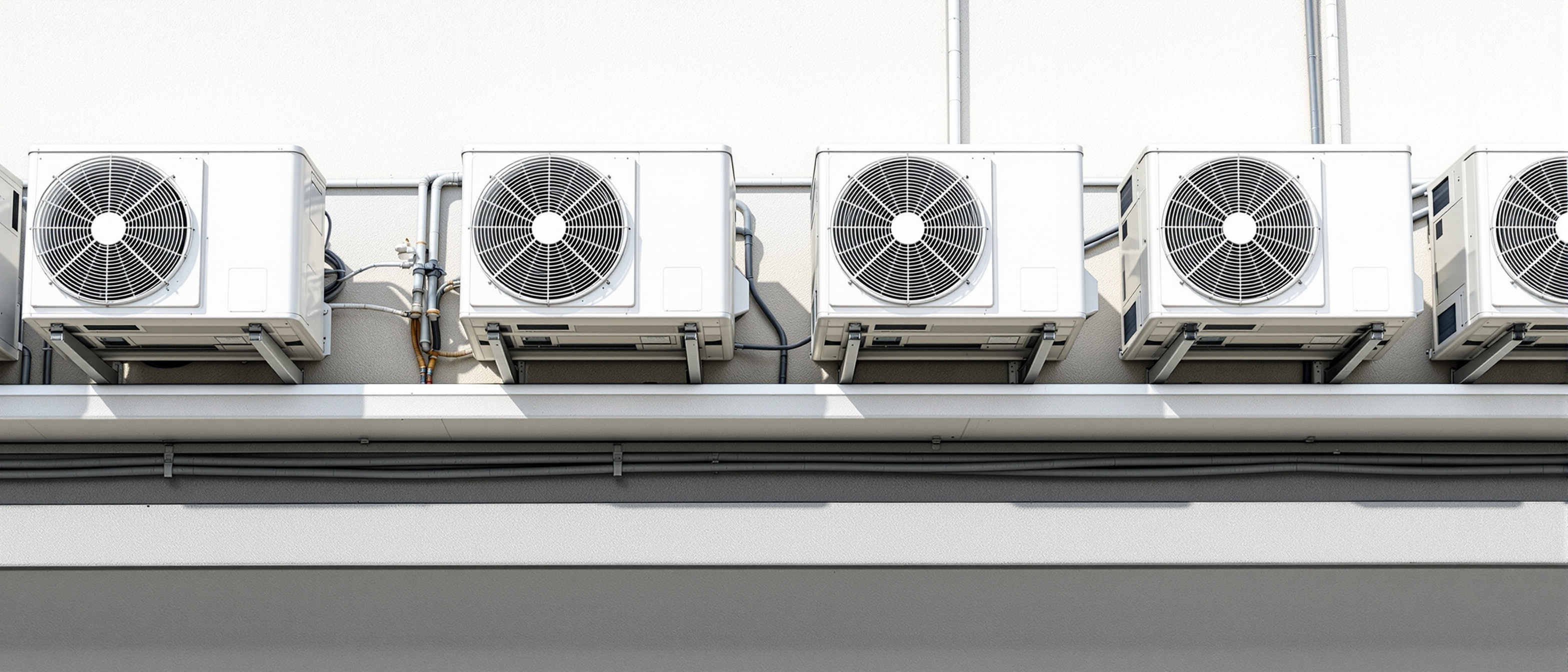
From the window and split units of homes, through VRF for zoned offices and packaged units for shops, to a central chilled-water plant feeding fan-coils in big buildings — the system follows the building, and its routes must be planned early.[1]
Window, split, VRF
For rooms and small buildings: the WINDOW unit (everything in one box through a wall), the SPLIT (indoor evaporator + outdoor condenser, quieter, the Indian default), the CASSETTE (ceiling split), and VRF/VRV (variable refrigerant flow — many indoor units on one outdoor unit, each separately controlled, for offices and hotels). PACKAGED units serve a whole floor or shop from one larger machine.[1]
Try it — the AC-sizing explorer
Pick a room’s factors and see an illustrative cooling load in tons — a rate of heat removal (~3.5 kW each), not a weight. Notice how sun, occupants and equipment change the answer far more than area alone, and why rounding up ‘to be safe’ backfires.
AC sizing & ‘ton’ explorer · a ton is a rate, not a weight
~1.0 ton
≈ 3.5 kW of heat removal
A ‘ton’ is a RATE of heat removal — about 3.5 kW, the rate that melts a ton of ice in a day — not the weight of the unit. Load depends on sun, occupants and equipment, not floor area alone.
Honest caveat · This is an ILLUSTRATIVE rule of thumb, not a real load calculation (which adds up glazing, orientation, infiltration and more). And do NOT round UP ‘to be safe’ — an oversized AC short-cycles and never dehumidifies, leaving the room cold and clammy.
Cooling load & sizing
A ‘ton’ is a rate (~3.5 kW); the cooling load is driven by sun, glazing, occupants and equipment, not floor area alone; and an oversized AC short-cycles and never dehumidifies. Right size, plus an inverter compressor, gives comfort and efficiency.[2, 3]
Not a weight
'A 1.5-ton AC weighs 1.5 tons' is a MYTH. A TON of refrigeration is a RATE of heat removal — exactly 12,000 BTU per hour, about 3.5 kW — named because it equals the rate that would melt one ton of ice in 24 hours. So a '1.5-ton' AC removes heat at about 5.3 kW. It says nothing about the unit's weight; it is a cooling POWER. Try the sizing tool below.[2]
At a glance
| Aspect | The fact | The folklore |
|---|---|---|
| A 'ton' of AC | A rate of heat removal (~3.5 kW), not a weight | The weight of the unit |
| Cooling load | Driven by sun, glazing, occupants and equipment | Just floor area |
| An oversized AC | Short-cycles and never dehumidifies (cold + clammy) | Cools faster and better |
| Comfort | Right size + inverter modulation | The biggest unit you can afford |
| VRF vs chilled water | Refrigerant-based zoning vs water-based central | The same thing |
| Services routes | Planned early (ducts, outdoor units, voids) | Squeezed in at the end |
Key terms
A RATE of heat removal, not a weight — exactly 12,000 BTU/h (~3.517 kW), the rate that melts a ton of ice in a day. A 1.5-ton AC removes heat at ~5.3 kW.
The total rate of heat a space gains — from sun and glazing, occupants, equipment, lights, infiltration and fresh air — that the AC must remove; it depends on far more than floor area.
Split = indoor + outdoor unit (the Indian default); VRF = many indoor units on one outdoor, zoned; chilled-water = a central chiller feeding fan-coils/AHUs in big buildings.
An oversized AC switching on and off rapidly — it cools the air but never runs long enough to remove humidity, leaving a cold, clammy room and wearing the compressor.
Removing moisture from the air, which happens only when the cooling coil runs long enough — the reason a right-sized (or inverter) AC feels more comfortable than an oversized one.
India's Bureau of Energy Efficiency star label (higher stars = more efficient, measured by ISEER); an inverter compressor modulates its speed instead of switching on/off, saving energy.
Study task
Take one real room and estimate its cooling load with the explorer, then write the honest note that must go with any number: this is a rule of thumb, not a real load calculation (which adds up glazing, orientation, infiltration, occupants and equipment). Convert your tonnage to kilowatts (tons × 3.5) to prove to yourself that a ‘ton’ is a rate of heat removal, not a weight. Then explain, in your own words, exactly why choosing the next size up ‘to be safe’ would make the room less comfortable — the short-cycling and humidity problem — and what an inverter unit does differently.
Self-assessment
1. What is a 'ton' of air conditioning?
2. What really determines a room's cooling load?
3. Why does an oversized AC fail to give comfort?
4. What gives both comfort and efficiency in sizing?
5. Which AC system suits an office with many small zones?
Recap
References & further reading
- [1]AC system types — window, split, cassette, VRF, packaged, central chilled-water and fan-coil systems, ductwork (Lulla, Air Conditioning; ASHRAE Systems). https://www.ashrae.org/
- [2]Ton of refrigeration (12,000 BTU/h = 3.517 kW) and cooling-load drivers — a rate not a weight; sun, occupants and equipment. https://en.wikipedia.org/wiki/Ton_of_refrigeration
- [3]AC sizing, oversizing and dehumidification; inverter compressors and BEE star ratings / ISEER (Bureau of Energy Efficiency). https://beeindia.gov.in/
Further reading
- M.H. Lulla, Air Conditioning — systems and load.
- ASHRAE Handbook — HVAC Systems and Equipment.
- Bureau of Energy Efficiency (BEE) — star-rating and ISEER references.
Sources gathered and fact-checked June 2026. Published values vary by source, sample and method — treat as indicative and confirm against the cited standard before structural use.
The author
Amogh N P
Architect, interior designer, and creative polymath. Studio Matrx began in his notebooks — his vision of design made honest, useful, and open to everyone. Its Academy is written and taught in his memory, and free, forever.
More about Amogh →