
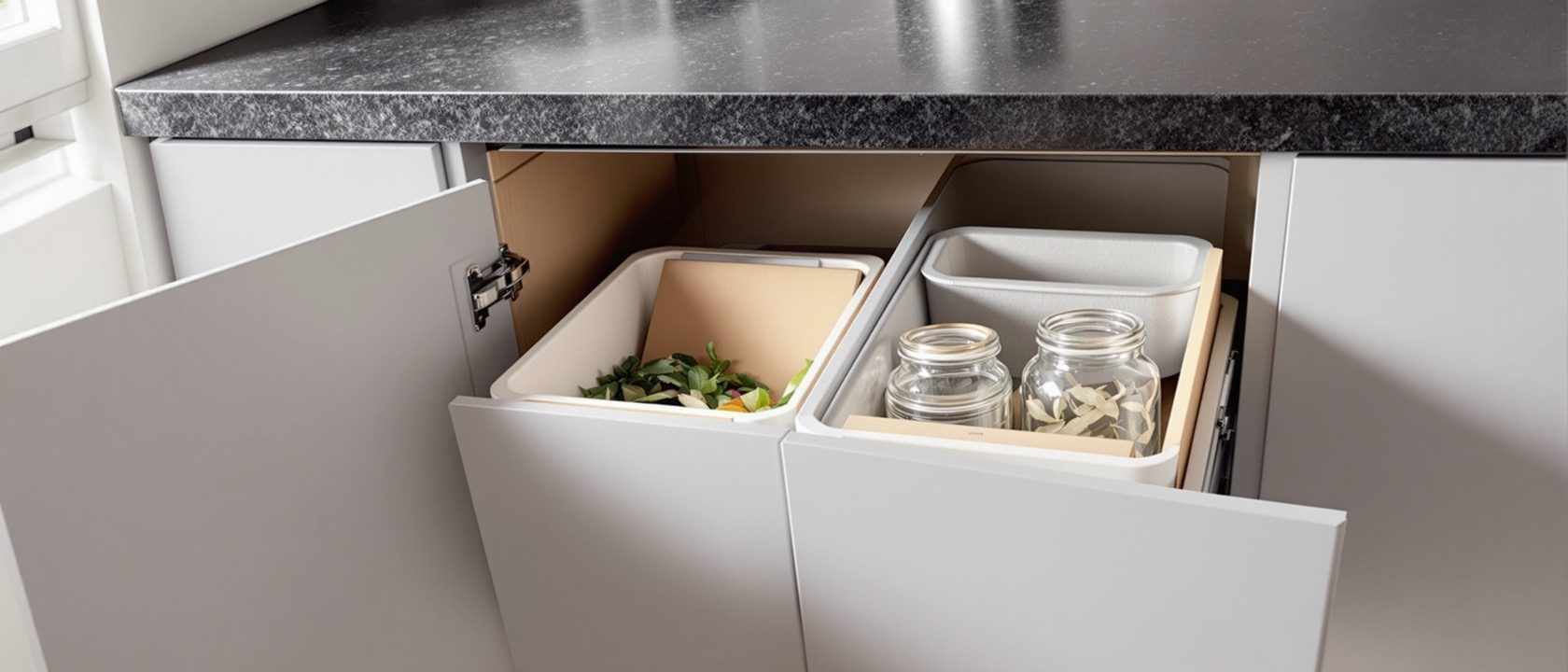
Solid Waste Disposal
Four streams, a two-bin market, and the designer's actual lever
Solid waste sits inside a plumbing course because the National Building Code itself files it there — Part 9 is titled Plumbing Services (Including Solid Waste Management). But this unit comes with an unusual warning, and it is not about the subject. It is about the syllabus. The law this unit was written to describe was superseded on 1 April 2026. India moved from three waste streams to four, and almost every textbook, lecture note and site practice in the country is still describing the old regime. So this unit teaches the change as well as the rule — and then asks the question the change creates, which no code currently answers.
Learning objectives
By the end of this lesson, you will be able to — mapped to the course outcomes for Interior Services I:
Explain solid waste collection and removal from buildings, and why the NBC files it under plumbing.
Distinguish aerobic from anaerobic decomposition, and explain why odour is a symptom rather than a property.
State the four streams required from 1 April 2026, and the thresholds that make a building a bulk waste generator.
Assess on-site processing options honestly against what they deliver, including the curing space nobody budgets for.
Design segregation into a kitchen, and defend a layered strategy against a naive four-equal-bins answer.
Identify where the codes contradict each other, and reason about the gap rather than looking up an answer.
Oxygen decides everything
One variable drives the whole comparison — and once you see it, the design implications fall out on their own. One process needs air; the other needs sealing.[4, 5]
Aerobic and anaerobic, and everything that follows
One variable drives the whole comparison: oxygen. With it, decomposition is aerobic — it releases a lot of energy, so the pile self-heats into the thermophilic range of 55 to 65 °C, it works fast, and the carbon leaves as carbon dioxide, giving you compost. Without oxygen it is anaerobic — low energy, near ambient temperature, slow, and the products are methane and carbon dioxide, which is to say biogas. In a biomethanation plant the gas is the entire point, so you SEAL the vessel. In a composting system the gas is a failure, so you AERATE. That single fork explains why one design needs turning access and ventilation while the other needs sealing and a gas offtake.[4]
The designer’s actual lever
Here is where this stops being a compliance topic and becomes a design one.[1, 2, 3]
Four streams, from 1 April 2026
The Solid Waste Management Rules, 2026 superseded the 2016 Rules and came into force on 1 April 2026. Rule 5(1)(b) requires every generator to segregate and store waste in FOUR separate streams at source: wet waste, dry waste, sanitary waste and special care waste. That last category is defined expansively — discarded paint drums, pesticide cans, CFLs and tube lights, expired medicines, broken mercury thermometers, waste batteries, used needles and syringes, contaminated gauze. The three-stream regime your older textbooks describe is gone. Note one nuance most summaries get wrong: on-site processing was never unconditionally mandatory for ordinary societies — both 2016 and 2026 use the phrase “as far as possible”. The hard obligation lands on bulk waste generators, through a new Extended Bulk Waste Generator Responsibility mechanism.[1, 2]
The gap between the law and the shelf
This is not a case of “we could not find one”. The evidence is structural, and it is worth seeing laid out, because it is the clearest example in this whole course of a designer being handed a problem that no lookup can solve:
- Häfele India’s own catalogue exposes a number of bins filter with counts — one bin, five products; two bins, six; three bins, one. There is no four-bin filter, because there is no four-bin product.
- EBCO’s full catalogues contain zero three-bin products. Its range tops out at two, and every one is framed “wet and dry”.
- Blum India publishes no waste category at all. Hettich India is one or two bins only — its three-bin units are catalogued in Australia.
- The two three-way products that do exist here are instructive. One holds 30 litres in a 300 mm cabinet. The other — special order, not stock — holds 36 litres, which is less than its own two-bin sibling’s 42. The third compartment costs capacity.
The four-stream vocabulary appears in the law and in the news. It does not appear in hardware marketing. As of 1 April 2026, no single cabinet SKU sold in India can satisfy the rule you are designing to — and that gap is now your problem to solve.
At a glance
| Aspect | One side | The other |
|---|---|---|
| Segregation streams | SWM Rules 2026 (from 1 Apr 2026): FOUR — wet, dry, sanitary, special care | SWM Rules 2016 (superseded): three — biodegradable, non-biodegradable, domestic hazardous |
| Bulk waste generator | 2026: any ONE of 20,000 m² floor area, 40,000 L/day water, or 100 kg/day waste | 2016: 100 kg/day ONLY. The 5,000 m² figure was a DIFFERENT rule (gated communities) |
| C:N ratio | FEEDSTOCK: 25–30:1 to start the pile | FINISHED PRODUCT: under 20:1 per the Schedule. Carbon leaves as CO₂; nitrogen stays |
| Moisture | PROCESS: 50–60 percent during composting | FINISHED PRODUCT: 15–25 percent per the Schedule. Two different quantities |
| Odour | A SYMPTOM of anaerobic conditions — too wet, too compacted, or C:N below 25:1 | MYTH: an inherent property of composting |
| Bin colours | A duty on the LOCAL AUTHORITY / for public bins (2016 Rule 15(h)) | MYTH: a duty on the household. The Rules never tell a flat-owner to buy a green bin |
| Four-way kitchen pull-out | Required in effect by the four-stream law | Does not exist in the Indian market. Häfele's own filter has no four-bin option |
| Refuse chute | NBC 2016 still specifies it approvingly — min 300 mm dia, buildings over 5 storeys | A single chute RE-MIXES the four streams the law requires separated |
Key terms
Organic waste including kitchen, food, vegetable, meat, fruit and flower waste and similar biodegradable waste (SWM Rules 2026, cl. 3(zzl)).
Waste other than wet, sanitary and special care waste; includes recyclable and non-recyclable waste (SWM Rules 2026, cl. 3(s)).
Used diapers, sanitary towels or napkins, tampons, condoms, incontinence sheets and similar waste (SWM Rules 2016, cl. 3(1)(41)).
Paint drums, pesticide cans, CFLs and tube lights, expired medicines, mercury thermometers, batteries, needles and syringes, contaminated gauze — at household level (SWM Rules 2026, cl. 3(zx)).
Under the 2026 Rules, a building satisfying at least ONE of: floor area 20,000 m² or above; water consumption 40,000 litres/day; waste 100 kg/day. Under the 2016 Rules it was 100 kg/day ONLY.
Extended Bulk Waste Generator Responsibility — a new 2026 mechanism. A BWG unable to process wet waste on site may seek exemption but must then procure certificates for an equivalent quantity.
A controlled process involving microbial decomposition of organic matter in the presence of oxygen (SWM Rules 2026, cl. 3(a)). Self-heats to 55–65 °C.
A process of using earthworms for conversion of biodegradable wastes into compost (NBC 2016 Part 9 Section 3, cl. 2.21).
A compartment at the lower end of a refuse chute for collecting and housing refuse between two successive cleanings (NBC cl. 2.24).
A receptacle fitting for receiving refuse from each floor and dropping it into the chute (NBC cl. 2.53).
The 55–65 °C stage of aerobic composting where pathogens die. Above roughly 65 °C it becomes counterproductive — you kill the microbes doing the work.
Study task
Design the waste strategy for a 2BHK flat that must comply with the four-stream rule, and draw it — a kitchen elevation and a plan at 1:20, plus a note. You will not find a product that does this, so you must reason instead. Ask yourself what each stream actually is: how many litres a day, arriving how often, and needing to travel how far. Wet waste is litres a day. Special care waste is grams a month. Sanitary waste is not generated in the kitchen at all. Then justify your layering in writing, and be explicit about the one thing a naive answer gets wrong: four equal bins under the sink would be designing for the rule rather than for how waste arrives. Finally, mark on your plan where the building-level collection point goes — and cite the town-planning provision that makes that space a drawing-stage obligation rather than a courtesy.
Self-assessment
1. Under the Solid Waste Management Rules, 2026, into how many streams must every waste generator segregate at source?
2. The optimal C:N ratio to START a compost pile is about 25–30:1, but the Indian compost standard specifies under 20. Why the difference?
3. Per NBC 2016, a refuse chute is described as suitable for buildings of what height, and what is the minimum internal diameter?
4. You are specifying a kitchen for a four-stream-compliant flat. What is the most defensible strategy?
Recap
References & further reading
- [1]Solid Waste Management Rules, 2026. S.O. 388(E), notified 27 January 2026, published 28 January 2026, Gazette of India Extraordinary Part II Section 3(ii) No. 360; in force 1 April 2026, in supersession of the Solid Waste Management Rules, 2016. Ministry of Environment, Forest and Climate Change.
- [2]Solid Waste Management Rules, 2016. S.O. 1357(E), 8 April 2016 (as amended). Ministry of Environment, Forest and Climate Change. Superseded 1 April 2026 but the source of the three-stream regime in most current teaching material. https://cdnbbsr.s3waas.gov.in/s30f46c64b74a6c964c674853a89796c8e/uploads/2024/07/20240710555191345.pdf
- [3]National Building Code of India 2016, Part 9 (Plumbing Services, Including Solid Waste Management), Section 3: Solid Waste Management. Bureau of Indian Standards. (Clause numbers to be confirmed against a licensed BIS copy. ⚠️ WITHDRAWN. BIS's own standards catalogue lists SP 7:2016 (National Building Code of India 2016, Vol I and II), committee CED 46, with status “withdrawn”, superseded by SP 7:2026 — NATIONAL BUILDING CONSTRUCTION STANDARDS 2026 (Volume 1 & 2), same committee, status “Active” (verified against BIS's catalogue, July 2026). The provision cited here is from the WITHDRAWN 2016 edition, which is what current Indian teaching and site practice still quote. Whether the provision survives unchanged into SP 7:2026, and how the Parts are renumbered, has NOT been verified — check SP 7:2026 before relying on this.
- [4]CPHEEO — Manual on Municipal Solid Waste Management (2016), Part II: Engineering and Financial Aspects. Ministry of Housing and Urban Affairs, Government of India.
- [5]FAO — On-farm Composting Methods. Land and Water Discussion Paper 2, Food and Agriculture Organization of the United Nations, Rome. https://www.fao.org/4/y5104e/y5104e05.htm
- [6]NIUA / MoHUA — Swachh Bharat Mission Solid Waste Management Field Visit Manual (2018). National Institute of Urban Affairs with the Ministry of Housing and Urban Affairs. https://niua.in/intranet/sites/default/files/2128.pdf
- [7]IS/ISO 17088:2021, Plastics — Organic Recycling — Specifications for Compostable Plastics (Second Revision). Bureau of Indian Standards, PCD 12. Its scope states it is NOT applicable to biological treatment undertaken in small installations by householders.
- [8]Central Pollution Control Board — Annual Report on Implementation of Solid Waste Management Rules (2022-23). CPCB, Delhi. https://cpcb.gov.in/uploads/MSW/MSW_AnnualReport_2022-23.pdf
- [9]Coffey, D. et al. (2017). Understanding open defecation in rural India: untouchability, pollution, and latrine pits. Economic & Political Weekly, 52(1).
- [10]Narayan, A. et al. (2026). Sanitation and solid waste in Indian cities. PLOS Water, 5(6), e0000571. https://doi.org/10.1371/journal.pwat.0000571
- [11]Patil, S. et al. (2022). Water–energy nexus in Indian urban waste management. Water-Energy Nexus, 5, 1–7. https://doi.org/10.1016/j.wen.2021.12.001
Further reading
- CPHEEO — Manual on Municipal Solid Waste Management (2016), Parts I, II and III. Ministry of Housing and Urban Affairs.
- Tchobanoglous, G., Theisen, H. & Vigil, S. — Integrated Solid Waste Management: Engineering Principles and Management Issues. McGraw-Hill.
- Bhide, A. D. & Sundaresan, B. B. — Solid Waste Management in Developing Countries. NEERI / INSDOC.
- Eawag / Sandec — Compendium of Sanitation Systems and Technologies (Second Revised Edition, 2014). Swiss Federal Institute of Aquatic Science and Technology.
- WHO — Guidelines on Sanitation and Health (2018). World Health Organization, Geneva.
- Garg, S. K. — Sewage Disposal and Air Pollution Engineering. Khanna Publishers, Delhi.
Sources gathered and fact-checked June 2026. Published values vary by source, sample and method — treat as indicative and confirm against the cited standard before structural use.
The author
Amogh N P
Architect, interior designer, and creative polymath. Studio Matrx began in his notebooks — his vision of design made honest, useful, and open to everyone. Its Academy is written and taught in his memory, and free, forever.
More about Amogh →