
 Lesson 3.1
Lesson 3.1 · A Design Vocabulary
Point, Line, Plane, Volume: The Elements of Form
The visual alphabet every interior is spelled in - from a single point to an enclosed volume
Four marks build every room you have ever stood in
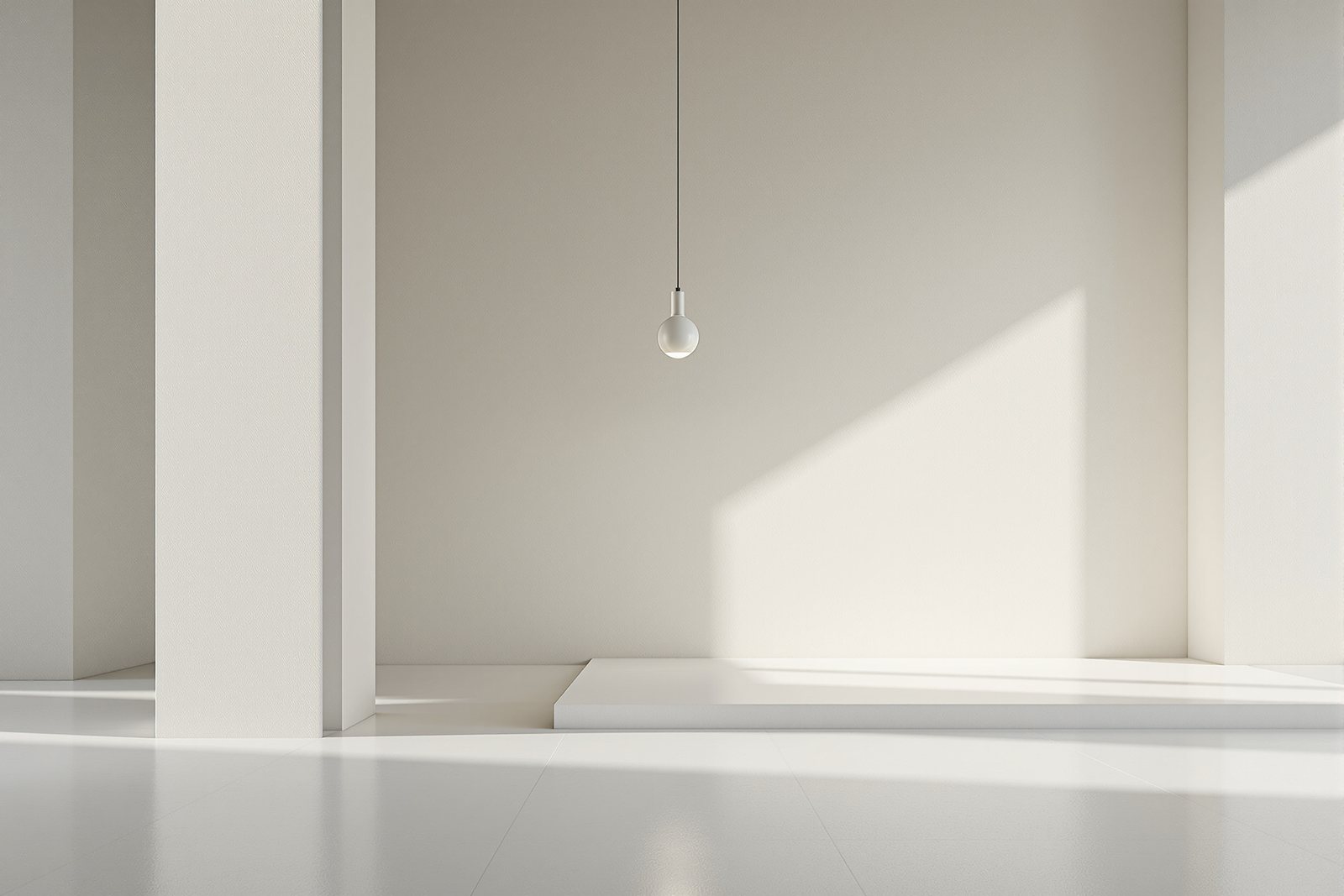
A single brass lamp hanging in a stairwell. The slim line of a teak beam overhead. The broad plane of a lime-washed wall. The cool volume of the room itself, holding the morning. Four elements - and once you can name them, you cannot stop seeing them.
A point is just a dot that hasn't decided to go anywhere yet.
It starts with a point
Stand in any room of your home and look for the thing that says here. A point marks a position in space and nothing more - it has no length, no width, no direction. It simply anchors the eye.
In an Indian home, points are everywhere once you tune to them. A single pendant light dropped over the dining table. One brass diya glowing in a wall niche. The deity in the corner of the pooja room, sitting at the exact centre of attention. A lone cane chair pulled into the middle of an otherwise empty terrace becomes a point, because it claims a spot and asks you to notice that spot.
A point has quiet power. Place one object at the centre of a room and the whole room organises itself around it. Place it in a corner and the room feels off-balance, reaching. The point is the smallest unit of form, but it sets the rules everything else will follow.
Stretch a point and it becomes a line
Now take that point and pull it. Give it direction and it becomes a line - a one-dimensional element that leads the eye from one place to another.
Lines fill our buildings: the slim cast-iron column on an old Chettinad verandah, the runner of cove lighting along a false ceiling, the teak beam crossing a living room, the crisp edge where a wall meets the floor. Even a long jute runner laid down a corridor reads as a line because length so overwhelms width.
Direction carries feeling. A vertical line - a tall column, a temple gopuram's rising tiers, a full-height window - feels aspirational, lifting your gaze and your spirit. A horizontal line - a low platform bed, a long sill, a deep beam - feels grounded and restful, telling the body it can settle. When you choose where a line goes, you are choosing what a person feels.
Stretch a line and it becomes a plane
Pull a line sideways, broaden it until width matters as much as length, and you get a plane - a flat, two-dimensional surface with a shape and an edge.
This is the interior designer's main working material, because a room is planes. The floor you stand on is a plane. Each wall is a plane. The ceiling overhead is a plane. A jaali partition screening the verandah, a kitchen platform, a rug marking the seating area, a sliding shutter - all planes. You spend your day surrounded by them.
Planes do the heavy lifting of mood. A wall finished in rough Kota stone reads heavy and earthy; the same wall in glossy white paint reads light and crisp. A dark plane advances toward you and shrinks a room; a pale one recedes and opens it up. Tilt a plane, fold it, perforate it like a jaali, and the whole feel of a space shifts - all without adding a single object.
Push a plane and it becomes a volume
Push a plane through space, sweep it along a direction, and it sweeps out a volume - a three-dimensional form with height, width and depth.
Volume is where form gets interesting, because it has two faces. There is the mass - the solid bulk of a thing, like a granite kitchen island, a teak almirah, a brick column. And there is the space the volume encloses or shapes - and in an interior, this is everything. A room is a volume. The cool, shaded hollow of a courtyard is a volume. The air your living room holds is a volume just as real as the walls around it; you are, right now, standing inside a volume.
Form is simply the overall term for the shape and structure of any three-dimensional element - the contour of a thing, the way it meets the light, the silhouette it cuts. When we say a sofa, a staircase or a whole room has good form, we mean its three-dimensional shape works.
The primary solids beneath it all
Most three-dimensional forms you meet are variations on a handful of pure shapes the eye reads instantly. These are the primary solids: the cube, the cylinder, the sphere, the cone and the pyramid.
You can find every one of them in Indian building. A cube in a plain square room or a sandstone plinth. A cylinder in a temple column or a terracotta water pot. A sphere in a brass kalash or a paper lantern. A cone in a thatched Toda hut. A pyramid in the stepped shikhara crowning a temple. Designers stretch them, slice them, hollow them and stack them - a dome is a sphere cut in half, a vault is a cylinder laid on its side - but the clean original is always sitting underneath.
Reading the primary solid hidden inside a complicated thing is one of the fastest ways to understand it. Strip the carving and ornament from a temple tower and a clear pyramid remains. Strip the cushions from a sofa and a long box remains.
Three altitudes on the same idea
Read the band that fits you — or all three.
Walk through your own home tonight and play a naming game. That pendant lamp is a point. That ceiling beam is a line. That wall is a plane. The bedroom itself is a volume. Once you can label what you are looking at, decorating decisions get easier - you stop fussing over objects and start seeing whether a room's lines feel restful and its planes feel open.
Treat these elements as deliberate moves, not afterthoughts. Need a focal point? A single statement pendant does more than a dozen scattered fittings. Want loftiness in a low flat? Emphasise vertical lines - tall shutters, slim mullions, a floor-to-ceiling curtain. Want calm in a busy home? Stress horizontals. And remember the planes are your real canvas: changing a wall's finish reshapes a room more cheaply and powerfully than buying furniture.
Hold the hierarchy as a clean derivation. A point has position only - zero dimensions. Extend it and you get a line - one dimension, length plus direction. Extend a line laterally and you get a plane - two dimensions, surface plus shape. Extend a plane in depth and you get a volume - three dimensions, mass plus enclosed space. Each element is the previous one set in motion, and form is the name for any element that has reached the third dimension.
“Form is just the shape of the objects and furniture in a room - the sofa, the table, the lamp.”
Run the method yourself
Five minutes, one room, your own eyes. Hunt down each element where you are sitting.
- 1Find a point: pick the one object in your room that claims a single spot - a lamp, an idol, a vase - and notice how the space arranges itself around it.
- 2Find a line: spot something long and slim - a beam, a curtain rod, the edge where wall meets floor - and decide whether it runs vertical (aspirational) or horizontal (restful).
- 3Find a plane: rest your hand flat on a wall, then the floor, then look up at the ceiling, and register each as a separate two-dimensional surface with its own finish and mood.
- 4Find a volume: look for something with mass - an almirah, a side table - then deliberately notice the empty air of the room as a second, equally real volume you are standing inside.
- 5Trace the enclosure: follow how the floor plane, the four wall planes and the ceiling plane meet at their edges to wrap the room's volume completely - and imagine removing one wall to feel how the volume would leak away.
Four elements, one way of seeing
But solid form is only half the story - next we look at how a form and the empty space around it define each other, where figure and ground trade places.
The author
Amogh N P
Architect, interior designer, and creative polymath. Studio Matrx began in his notebooks — his vision of design made honest, useful, and open to everyone. Its Academy is written and taught in his memory, and free, forever.
More about Amogh →