
 Lesson 9.1
Lesson 9.1 · Experience, Storytelling & Detail
Theming & Narrative Design
A great hospitality place is a story the guest steps inside - one clear idea made physical through every space, object and gesture - and the line between a moving narrative and cheap kitsch is where the craft lives
The best hotels and restaurants are not decorated - they are written, then built; a guest does not admire a theme, they step inside a story and believe it.
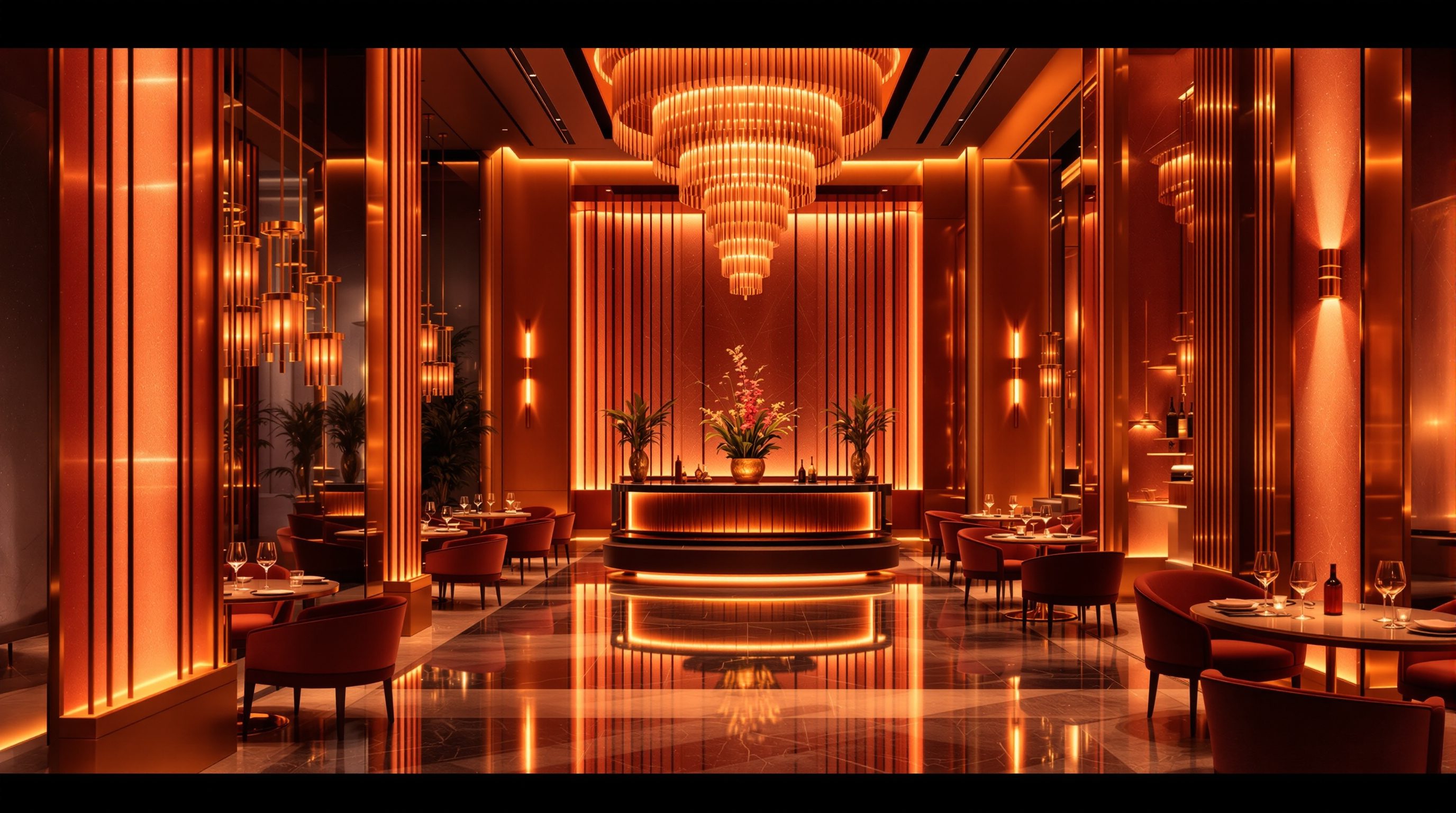
Think of the hospitality places that stay with you. Almost always there is a single clear idea underneath - a palace that remembers its maharajas, a cafe that feels like a friend's cluttered kitchen, a bar built around the romance of the night train, a resort that is really one long conversation with the sea. You could not photograph the idea, but you felt it in everything: the way you arrived, the light, the music, the menu, the word the staff used to greet you. That coherence is not luck or lavish budget. It is narrative design - the discipline of finding one true concept and then expressing it, faithfully and at every scale, until a guest stops noticing design at all and simply believes the place.
This is where good becomes memorable, and it is also where hospitality design goes most embarrassingly wrong. The same impulse that produces a moving, coherent world produces, in clumsy hands, the themed restaurant that is all plastic props and borrowed cliche, the hotel dressed up in a costume it does not believe. Narrative and kitsch are close cousins; the difference is authenticity and restraint, not effort or money. This lesson teaches you to work with story as a serious design tool - to find the concept, carry it through every layer from the massing to the matchbook, and stay on the right side of the line between a place that tells a true story and one that merely shouts a theme.
Write the place in one true sentence. Then carry it down to the matchbook - and resist the plastic parrot.
The concept: one true idea you can say in a sentence
Every memorable hospitality place can be described in a single honest sentence - and that sentence is the concept, the seed from which every design decision grows. "A spice trader's riverside house in old Kochi." "A railway hotel for a journey that no longer exists." "The neighbourhood's living room, if the neighbourhood were kinder." The concept is not a style ("mid-century", "industrial") and not a mood board; it is an idea with a point of view, usually rooted in something real - a place, a history, a person, a ritual, a way of living. Its job is to give every later choice a reason, so that the answer to "should the lobby have a fireplace?" or "what do we call the bar?" is never "because it looks nice" but "because the story says so."
A strong concept does three things. It orients the whole team - architect, interior designer, graphic designer, chef, operator - around one shared fiction, so thousands of separate decisions pull in the same direction. It generates ideas rather than merely decorating them: a good concept keeps suggesting the next move, the name, the scent, the staff greeting, long after the mood board is exhausted. And it edits - it tells you what to leave out, which is the harder and more valuable half. A concept that cannot reject anything is not a concept; it is a wish.
Finding the true concept is research, not invention. You look hard at the site and its history, the city and its culture, the building if one already exists, the operator's brand and the guest you are designing for, and you listen for the idea that is already latent in them and wants to be told. The best concepts feel found, not imposed - they fit the place so naturally that guests assume they were always there. A concept forced onto a site it has nothing to do with - a faux-Tuscan villa on a Chennai arterial road - starts life as a lie, and guests, who are very good lie-detectors of atmosphere, feel it even when they cannot name it. Write the sentence first. If you cannot say what the place is in one true line, you are not ready to choose a single finish.
If you cannot say what the place is in one true sentence, you are not ready to pick a finish.
Narrative: a story the guest moves through
A concept is static; a narrative unfolds. Because hospitality is experienced as a journey over time (the through-line of this whole course), the richest theming is not a stage set you photograph but a story the guest moves through - one that has a beginning, a development and a release, choreographed along the guest journey of arrival, reception, room or table, and departure. The arrival can be the opening line: compression then reveal, a threshold that tells you that you are leaving the ordinary world and entering this one. The public spaces develop the theme; the room or the meal is the heart of the story; the departure is the ending that decides what the guest carries away and tells others.
Narrative design borrows honestly from storytelling craft. It works by suggestion, not exposition - a great story trusts the guest to complete it, dropping cues they assemble into meaning themselves, rather than explaining the theme on a plaque. It uses restraint and pacing: not every space shouts the concept at full volume; there are quiet passages and loud ones, a rhythm of tension and release, just as in music or film. It rewards discovery - details that only the curious or the returning guest find, which make them feel the place has depths, and make them want to come back. And it stays coherent: every element either advances the story or gets out of its way; nothing contradicts it. One jarring, off-concept choice - a generic corporate corridor in the middle of a romantic narrative, a loud television where the story wanted hush - breaks the spell the way a wrong note breaks a melody.
Crucially, the staff and the operation are characters in the narrative, not outside it. The word the receptionist uses, the ritual of the welcome drink, the way a dish is introduced, the uniform, even the music and scent, are all narrative devices - which is exactly why the next lesson on service design is the twin of this one. A beautifully themed space delivered by indifferent, off-script service is a film with wonderful sets and no actors. Narrative design only fully works when the physical story and the human story are written together.
Coherence: the concept in every layer, down to the matchbook
Narrative design succeeds or fails in the follow-through - whether the one idea really does survive into every layer, or quietly evaporates somewhere between the grand gesture and the small reality. This is the unglamorous discipline that separates a place that feels whole from one that feels decorated: carrying the concept consistently through the architecture and massing, the interior materials, colour and light, the FF&E and OS&E (the furniture and the tableware, the subject of the FF&E lesson), the graphic identity and signage, the lighting and music and scent, the menu and its language, the uniforms, and the named rituals of service. A useful mental model is a coherence audit: walk the whole guest journey and ask of every single thing a guest will see, touch, hear or smell - does this belong to our story, is it neutral, or does it contradict it?
The danger points are always the same, because they are the places where budget, operations and inattention quietly overrule the concept. The small touch layer - the coasters, the key card, the corridor carpet, the bathroom amenities, the back of the menu, the "do not disturb" sign, the spoon - is where coherence is usually won or lost, precisely because it is where people stop paying attention and default to the generic catalogue item. A guest rarely registers a single good coaster, but they absolutely register the cumulative effect of a hundred details that all belong, versus a beautiful lobby undercut by off-the-shelf everything beyond it. The concept must also survive value engineering: when budgets are cut, the instinct is to strip the "extras" that are often exactly the story-carrying details, leaving a cheaper building that has also lost its reason to exist. Protecting the load-bearing narrative elements through the cost cuts is a real and underrated design skill.
Coherence does not mean monotony. A one-note place that hammers the same gesture in every room is as tiring as an incoherent one - which is why pacing and quiet passages matter. The goal is unity with variety: one recognisable world, explored through many different but related spaces and moments, so the guest feels the coherence as richness rather than repetition. Hold the idea firmly and express it generously, and the place reads as authored - made by someone who meant it - which is, in the end, what guests respond to.
Authenticity: staying on the right side of kitsch
The constant hazard of theming is kitsch - the point where narrative curdles into costume, suggestion into literal prop, homage into parody. Both a great boutique hotel and a tacky theme restaurant are "themed"; the difference is not effort or money but authenticity and restraint. Kitsch happens when the theme is stuck on rather than grown from the place - applied as surface decoration to a space that has nothing to do with it; when it is literal rather than suggestive - a pirate bar with a plastic parrot, a "heritage" hotel that is a brand-new building wearing fibreglass antiquity; when it shouts where it should whisper; and when it is borrowed cliche rather than specific truth - the generic postcard version of a culture rather than the real, particular, lived thing.
The working test is the one in the figure: does this detail grow from the concept, or is it there only to announce the theme? A spice merchant's house might have worn teak, old ledgers, the smell of cardamom, brass weighing scales that were actually used - details that are true to the idea and reward a closer look. The kitsch version has a cartoon spice sack stencilled on the wall and a waiter in fancy dress. One trusts the guest; the other performs at them. Authenticity also means being honest about what the place actually is: a new-build hotel can be warm, rooted and full of story without pretending to be three hundred years old; faking age or faking a heritage the building does not have is the fast road to pastiche, and it ages terribly - literal theming dates the moment its reference does, while a true idea, well expressed, stays fresh for decades.
There is a deeper reason to care, which the final lesson of this module takes up: when the story draws on a real living culture - as so much Indian and global hospitality does - the difference between authentic narrative and kitsch is also the difference between respect and caricature. Drawing on local craft, history and ritual with depth, specificity, the involvement of the people whose culture it is, and genuine understanding is homage; reducing that culture to a few decorative cliches for the amusement of outsiders is appropriation and, usually, kitsch. The discipline that keeps theming on the right side of the line - truth, specificity, restraint, respect - is the same discipline that makes it move people in the first place.
Narrative trusts the guest and suggests; kitsch performs at them and shouts. Grow the detail, do not stick it on.
Operator brand standard / concept guardrails
How much narrative freedom the brand allows; what must stay on-standard
In a branded hotel the concept works within the operator's rulebook - confirm how far theming can go before it breaks a brand standard. Module 1, Module 10.
Cultural authenticity & permissions
Drawing on a living culture, craft, motif, image or religious element
Respect vs appropriation is a design judgement, not a checklist - involve the community and get permissions for protected motifs/images. See lesson 9.4.
Fire, egress & materials (NBC 2016)
Themed props, drapery, finishes and set-dressing are still building materials
A narrative detail must still meet fire-rating, egress and finish requirements - defer binding values to the code and a fire/life-safety specialist.
Workshop — write the concept, then test its coherence
Narrative design begins with one true sentence and lives or dies in the follow-through. In this workshop you will author a concept for a real or imagined small hospitality project, then audit how faithfully it could carry through every layer.
A notebook and curiosity. This is about authoring and editing an idea, not drawing - no software needed, though quick sketches of the arrival and one key detail help.
Goal: one concept sentence + a coherence audit across the guest journey
Inputs: a site or building you know (or invent a plausible one) + this lesson + a notebook
Time: ~60 minutes
- 1FIND the idea: research the site, its history, city, culture and likely guest, and write ONE true concept sentence - an idea with a point of view, rooted in something real. Reject any sentence that is merely a style or a mood.
- 2WRITE the narrative: sketch how the concept unfolds along the guest journey - the opening (arrival/threshold), the development (public spaces), the heart (room or meal) and the ending (departure). Note one moment of discovery you would hide for the curious guest.
- 3RUN a coherence audit: list at least twelve specific things a guest will see, touch, hear or smell - from the massing down to the coaster, key card, uniform, music, scent, the name of the bar - and for each decide whether it advances the story, is neutral, or contradicts it.
- 4HUNT the kitsch: find two ideas that would tip into pastiche (literal props, borrowed cliche, stuck-on theme) and rewrite them as suggestive, authentic alternatives that grow from the concept instead.
- 5PROTECT the core: mark the three story-carrying details you would defend hardest if the budget were cut by a fifth - the ones without which the place loses its reason to exist.
You’ll walk away with
A one-page concept brief: the single true sentence, a short narrative across the guest journey, a twelve-plus-item coherence audit, two kitsch-to-authentic rewrites, and the three load-bearing details you would protect through value engineering.
Three altitudes on the same idea
Read the band that fits you — or all three.
The concept should be set before the massing, because the biggest narrative moves are architectural and cannot be retrofitted. The arrival sequence, the threshold and reveal, the courtyard or the view the building chooses to frame, the compression and release of the public volumes, the relationship to site and climate - these are the opening and the spine of the story, and they are base-build decisions. Fight for the concept at the earliest stage, when a section or a site strategy can still embody it cheaply; a narrative bolted on later in the interiors is always thinner. Coordinate the idea with the operator and brand early, protect the load-bearing architectural gestures through value engineering, and remember that an honest new building rooted in its place beats a fake-heritage pastiche every time.
The interior is where most of the narrative is actually delivered, and coherence in the detail is squarely your craft. You carry the concept through material, colour, light, FF&E and OS&E, graphics, scent and the hundred small touch points where theming is usually won or lost. Run the coherence audit obsessively - the coaster and the key card matter as much as the feature wall. Work by suggestion and restraint rather than literal props; resist the slide into kitsch; protect the story-carrying details when budgets are cut. And design the interiors for the journey and its pacing, with quiet passages as well as loud ones, so the guest experiences the concept as a rich, unfolding world rather than one gesture repeated.
Train yourself to read the concept: in every hotel, bar or restaurant you admire, try to write the one true sentence it is built on, then notice how - or whether - that idea survives into the smallest details. This single habit will teach you more about hospitality design than any style guide. Practise telling narrative from kitsch: what makes one themed place moving and another embarrassing? Usually it is authenticity, restraint and specificity. You are not expected to run a full concept process yet, but you should be able to find the idea, test a detail against it ("does this grow from the story or just announce it?"), and see why the word the receptionist uses is as much a design decision as the light fitting.
“Theming means picking a fun theme and decorating the place to match it - a Bollywood bar, a jungle restaurant, a Rajasthan-palace lobby - with as many themed props and references as the budget allows. The more obviously you signal the theme, the stronger the experience.”
Do it yourself
No tools needed - reason it through.
- 1Why does a hospitality concept have to be expressible in one true sentence, and what three jobs does a strong concept do?
- 2Explain the difference between a concept (static) and a narrative (unfolds), and why the guest journey shapes the story.
- 3What is a coherence audit, and why is the small 'touch layer' - coasters, key cards, amenities - where coherence is usually won or lost?
- 4Give the working test for telling narrative theming from kitsch, with an example of each.
- 5Why are staff and service 'characters in the narrative' rather than outside it?
The one line to carry out
Peer-reviewed journals & authoritative standards
- 01Storytelling as a craft and its principles — Wikipedia — Storytelling, 2026.
- 02Brand - a name, identity and story made physical — Wikipedia — Brand, 2026.
- 03The experience economy and staging experiences — Wikipedia — Experience economy, 2026.
- 04The boutique hotel and concept-led hospitality — Wikipedia — Boutique hotel, 2026.
A story only comes alive when people tell it - so next we design the service and its touchpoints alongside the space, choreographing staff and guest through the moments that make a stay.
The author
Amogh N P
Architect, interior designer, and creative polymath. Studio Matrx began in his notebooks — his vision of design made honest, useful, and open to everyone. Its Academy is written and taught in his memory, and free, forever.
More about Amogh →