
 Lesson 2.1
Lesson 2.1 · Vision, Brief & Feasibility
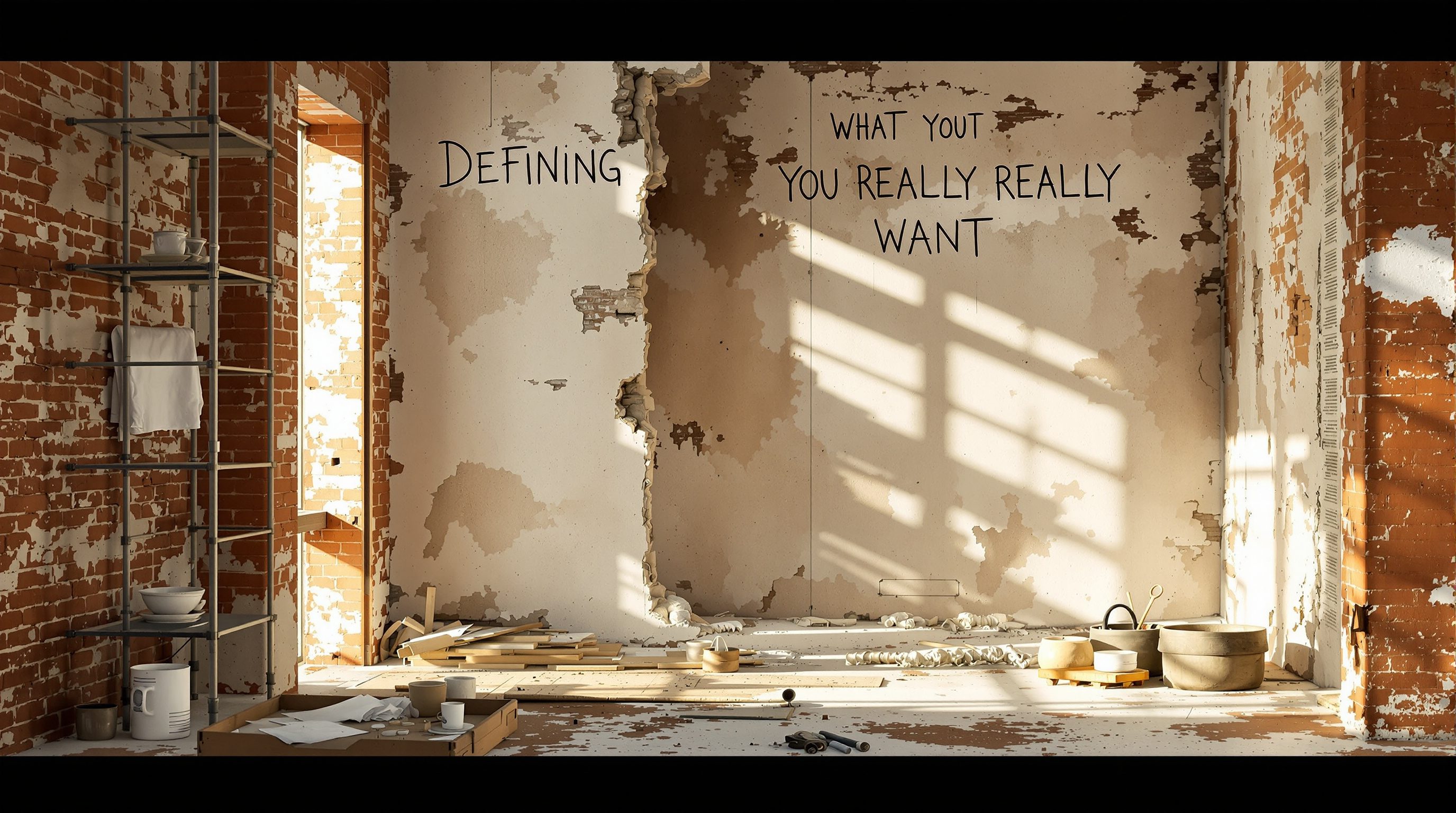
Defining What You Really Want
Before you can renovate well you have to know what you are actually trying to fix, and that almost never turns out to be the first thing you asked for
Nobody actually wants an open-plan kitchen. They want to cook while the children do their homework - and that is a very different thing to design for.
Almost every renovation begins with a wish stated as a solution: an open-plan kitchen, a loft conversion, a bigger bathroom, a home office. It feels like a brief, but it is really an answer to a question nobody has asked out loud. The skill this lesson teaches - and it is a skill, practised by every good architect and designer - is to stop, resist the pull of the obvious fix, and dig underneath the wish to the real need driving it. Because if you design for the stated solution instead of the underlying need, you can spend a fortune delivering exactly what was asked for and still leave the owner vaguely unhappy, because the thing that was actually wrong was never named.
This is diagnosis applied to people rather than to plaster. Just as the course's through-line says you diagnose the building before you change it, here you diagnose how the household actually lives before you decide what to build. A renovation is expensive, disruptive and largely irreversible, so the most valuable work happens before any drawing is made - in conversations, observations and honest lists that turn a vague discontent into a clear, prioritised brief. Get this right and every later decision has a reference to measure against. Get it wrong and you are decorating to a trend, not solving a life.
You are not renovating a house. You are solving a life. Name the life first.
The wish is a solution in disguise
When someone says they want an open-plan kitchen, they have handed you a solution, not a need - and your first job is to gently take it apart. Ask why, and the real drivers surface: they want to cook while keeping an eye on the children; they feel boxed in by small dark rooms; the family never gathers because everyone scatters to separate spaces; the kitchen is cut off from the garden and the light. Each of those is a genuine need, and - crucially - open-plan is only one of several ways to meet them, and not always the best one for that building. A wide opening with a sliding door, a reconfigured doorway, a borrowed-light panel, or simply moving the dining table can sometimes serve the same need with far less cost and structural risk.
The technique professionals use is borrowed from problem-solving everywhere: keep asking "why do you want that?" until you reach something that is about living, not about construction. "I want to knock this wall down" - why? "So the kitchen feels bigger" - why does that matter? "Because we eat in here and it feels cramped when guests come" - now you have the real brief: *seat six comfortably for meals*, which a wall removal might solve, or might not. This laddering-down from solution to need is the single most useful conversational habit in renovation, and it applies whether you are the designer interviewing a client or the homeowner interrogating your own wish list.
There is a deeper reason this matters. The building, as the whole course insists, has its own realities - a wall may be load-bearing, a drain may be fixed, an approval may be needed. If you are locked onto one solution, every one of those realities reads as a defeat. But if you are clear on the *need*, the building's constraints become a design puzzle with many possible answers, and you can trade one solution for another without losing what you actually care about. Naming the need, not the fix, is what keeps a renovation both satisfying and feasible.
'Open-plan kitchen' is an answer. Ask: to what question? That is your real brief.
Diagnose how you actually live
The richest source of a true brief is not a mood-board but the ordinary evidence of how the household already lives - and most people have never looked at it deliberately. The most honest diagnostic is simply to watch and record a normal week. Where does post pile up? Where do coats and shoes land? Which room is always too hot, too dark, too cold, too noisy? Where do arguments about space happen - the one bathroom at 8am, the kitchen when two people cook, the table that becomes a desk by day? Every one of these frictions is a clue to a need, and a need expressed as a friction is far more reliable than one expressed as a wish, because it is grounded in behaviour rather than aspiration.
A practical method is a friction log: for a week, jot down every moment the home gets in the way of life - not solutions, just irritations and near-misses. "Nowhere to drop bags when we come in." "Can't hear the door from the kitchen." "The kids' stuff has colonised the living room." "Drying clothes in the monsoon is a nightmare." Patterns emerge quickly, and they tend to cluster around a handful of real problems - storage, light, noise, a pinch-point at a certain time of day - which are the things worth spending money to fix. This is especially powerful in the Indian context, where a home has to flex for festivals, guests staying over, a parent moving in, puja space, and cooking that is far more intensive than the kitchens many trendy layouts assume.
Equally important is to name what already works and must be protected. Renovations routinely destroy things people loved without meaning to - the morning light in one corner, the cross-breeze that cools the house, the quiet back room, a view. A good brief lists these "keep" items as explicitly as the "change" items, because the fastest way to an unhappy renovation is to solve one problem while casually demolishing an unnamed pleasure. Diagnose the life first, in its frictions and its joys, and the brief writes itself from evidence rather than from the latest thing seen online.
Must-haves, nice-to-haves and the wish list
Once the needs are named, they have to be ranked honestly, because no real renovation has unlimited money or time, and an unranked list quietly lets the budget do the prioritising for you - usually badly, under pressure, late in the job. The discipline is to sort every item into three buckets. Must-haves are the things without which the project has failed - fixing the damp, making the wiring safe, getting a kitchen you can actually cook in, making the house dry and usable. Nice-to-haves carry real value but could be cut or deferred if the budget bites - the wider doorway, the island bench, the extra storage. Wish-list items are the lovely extras that would be wonderful but are the first to go - the imported tiles, the smart lighting, the wine cooler.
The hard, honest truth of this exercise is that if everything is a must-have, nothing is. People instinctively inflate their must-have list because every item feels important in the moment, but a list where twenty things are all "essential" gives you no way to make the trade-offs that every renovation eventually forces. The sort only works if you are ruthless: a must-have is something whose absence means the renovation did not do its job, full stop. Everything that is merely very desirable belongs one rung down. Doing this early, calmly, and in writing is infinitely better than doing it in a panic when the contractor's variation lands and something has to give.
There is a useful tie-back to diagnosis here. The must-haves are usually the un-glamorous, building-health items - the damp, the structure, the services - precisely the things a decoration-first mindset skips and a surgery-first mindset puts first. The nice-to-haves and wish-list items are usually the visible, finish-level choices that magazines obsess over. A brief that gets this ordering right is already half-way to a sane budget, because it spends the certain money on the things that must be right and keeps the discretionary money where it can be flexed. Rank honestly now, or the project will rank for you later.
The brief as a tool - and the trap of copying trends
All of this comes together in a written brief - not a formal document necessarily, but a clear, shared statement of what this renovation is trying to achieve, in order of priority, with the "keep" list and the constraints you already know. A brief is not bureaucracy; it is the single most useful tool in the whole project, because every later decision - every design option, every quote, every painful trade-off - can be checked against it. When the budget tightens or the building throws up a surprise, the brief tells you what to protect and what to let go. Without it, decisions get made emotionally, inconsistently, and in the wrong order, and the renovation drifts.
The great enemy of a real brief is the trend - the seductive image of someone else's home that arrives decontextualised through a feed or a showroom. Trends are not worthless; they are a vocabulary of ideas. But copying a trend is designing for a photograph rather than for your life and your building, and it fails in two predictable ways. First, it imports a solution to a problem you may not have - the open-plan that suits a cold climate and a quiet family may be wrong for an Indian home with heavy cooking, street noise and a need for separable rooms. Second, trends date, and a renovation lasts decades, so a home built entirely to this year's look is tomorrow's dated renovation, while a home built to your genuine needs ages gracefully because needs change more slowly than fashions.
The antidote is simply to run every trend you are drawn to back through the brief: *what need would this serve for us, in this house?* If it maps onto a real need, adopt it in a way that suits your building and budget. If it maps onto nothing but a wish to have what you saw, park it on the wish list and spend the money where it matters. A renovation guided by a clear, prioritised, honestly-ranked brief is calmer, cheaper and more satisfying than one guided by a mood-board - because it is solving your life, not reproducing someone else's photograph.
A brief is a compass. When the budget bites or the building surprises you, it tells you what to protect.
Ladder every wish down to a need
Separating the stated solution from the underlying problem
Ask 'why do you want that?' until you reach something about living, not construction. The need, not the fix, is the brief.
Keep a one-week friction log
Evidence of how the household actually lives
Record daily irritations and pinch-points, not solutions. Patterns reveal the real problems worth spending on.
Sort must / nice / wish - honestly
Ranking the brief before the budget does it for you
If everything is a must-have, nothing is. Must-haves are usually the un-glamorous building-health items.
Flag wants that touch the building
Wishes that may hit structure, services or approvals
Capture these as feasibility questions (next lesson) for the engineer, licensed trades or local authority - do not promise them yet.
Workshop - write the brief beneath the wish
A good renovation brief is excavated, not declared. In this workshop you will take one renovation wish - your own, a family member's, or a notional client's - and dig down to the real needs, then turn them into a ranked, written brief you could hand to a designer.
A notebook or phone and honest conversation. No measuring or specialist input needed yet - this is about finding the right question before anyone answers it.
Goal: a one-page ranked brief built from real needs, not a trend
Inputs: a real home and household + a notebook + this lesson
Time: about 60 minutes, plus a week of logging if you can
- 1State the wish exactly as it first arrives, in the owner's own words ('we want an open-plan kitchen'). Write it at the top so you can see what you started with.
- 2Ladder it down: ask 'why do you want that?' at least five times, writing each answer, until you reach needs about living - cooking while watching the kids, more light, somewhere to gather. List the two or three real needs you find.
- 3Run a friction pass (ideally a one-week log): note every moment the home gets in the way - bags with nowhere to go, a bathroom queue at 8am, a dark room, monsoon drying. Add any new needs these reveal.
- 4Write a 'keep' list: the things that already work and must be protected - the morning light, the cross-breeze, the quiet room, a view - so the renovation does not destroy them by accident.
- 5Sort every item - needs, frictions, and any features you want - into three buckets: must-have, nice-to-have, wish-list. Be ruthless; a must-have is something whose absence means the project failed.
- 6Write the one-page brief: the ranked needs, the keep list, and - flagged separately - any item that looks like it might touch structure, services or approvals and will need a feasibility check and a professional.
You’ll walk away with
A one-page renovation brief: the original wish, the real needs beneath it, a protected 'keep' list, a must/nice/wish ranking, and a flagged list of items needing a feasibility check. Carry it into Lesson 2.2 - you will test it against the building's realities.
Three altitudes on the same idea
Read the band that fits you — or all three.
Brief-writing is a core professional skill, and on a renovation it is also a risk-management tool. Your value at this stage is to interrogate the client's stated solution, extract the underlying needs, and test them against what you already know of the building's structure, services and constraints - so the brief you agree is both ambitious and buildable. Run the laddering-down questions explicitly, record the "keep" list and the must/nice/wish ranking in writing, and get the client to sign up to the priority order before any scheme is drawn. That ranked brief is what protects everyone when a load-bearing wall, a drainage run or an approval forces a trade-off: you are adjusting against an agreed priority list, not renegotiating the whole job. Defer the binding specifics - whether that wall can go, what approval applies - to the engineer and local authority, but capture them as constraints in the brief now.
Most of your briefs arrive as a solution and a Pinterest board, and your craft is to convert them into a needs-led programme. Reconfiguring rooms, kitchens, storage and finishes are squarely your territory, and they are exactly the areas where copying a trend does the most damage - an island that blocks the real work triangle, a fashionable palette that dates, open shelving in a heavy-cooking Indian kitchen. Use the friction log and the three-bucket sort with your clients to separate the must-haves (usually the functional, everyday-life fixes) from the wish-list looks. Protect what already works - the light, the flow, the breeze - as explicitly as you plan what changes. And where a want collides with structure or services - a wall you would love gone, a bathroom you would love moved - flag it as a feasibility question for the next lesson and the relevant professional, rather than promising it in the brief.
Learning to write a brief is learning to listen, and it is one of the most transferable skills in design. Practise the laddering-down technique on real people: ask a family member what they would change about their home, then keep asking "why?" until you reach a need about living rather than a construction solution. Notice how the real brief is almost never the first thing said. Build the habit of distinguishing a need (cook while watching the kids) from a solution (knock down this wall), because studio projects reward clever solutions while real practice rewards solving the right problem. Keep a friction log of your own home for a week - it will teach you more about what renovation is for than any trend board. You are not expected to judge feasibility yet; you are expected to learn to find the real question before anyone rushes to answer it.
“I already know what I want - an open-plan kitchen, a loft conversion, a bigger bathroom. The brief is obvious, so we can skip straight to getting designs and quotes.”
Do it yourself
No tools needed - reason it through and write it down.
- 1Take the wish 'we want an open-plan kitchen' and ladder it down to at least two underlying needs.
- 2Why is designing for the stated solution instead of the underlying need so expensive and disappointing?
- 3What is a 'friction log' and why is a friction a more reliable guide than a wish?
- 4Explain the rule 'if everything is a must-have, nothing is', and sort three example items into the three buckets.
- 5Why should a brief include a 'keep' list, and give two things a renovation might destroy by accident without one?
The one line to carry out
Peer-reviewed journals & authoritative standards
- 01Renovation — Wikipedia - Renovation, 2026.
- 02Home improvement — Wikipedia - Home improvement, 2026.
- 03Interior design and the client brief — Wikipedia - Interior design, 2026.
- 04Open plan living — Wikipedia - Open plan, 2026.
- 05Floor plan — Wikipedia - Floor plan, 2026.
A brief tells you what you want; it does not yet tell you what your building and budget will allow. Next we test every wish against the realities of structure, services, space, approvals and money - the feasibility check that comes before you commit.
The author
Amogh N P
Architect, interior designer, and creative polymath. Studio Matrx began in his notebooks — his vision of design made honest, useful, and open to everyone. Its Academy is written and taught in his memory, and free, forever.
More about Amogh →