
Solar: SHGC, shading, VLT & glare
Glass lets in two things you want - light and view - and two you fight all year: solar heat and glare. One number, the SHGC, decides how much of the sun's heat you let through.
Lesson byAmogh N P· Architect & interior designer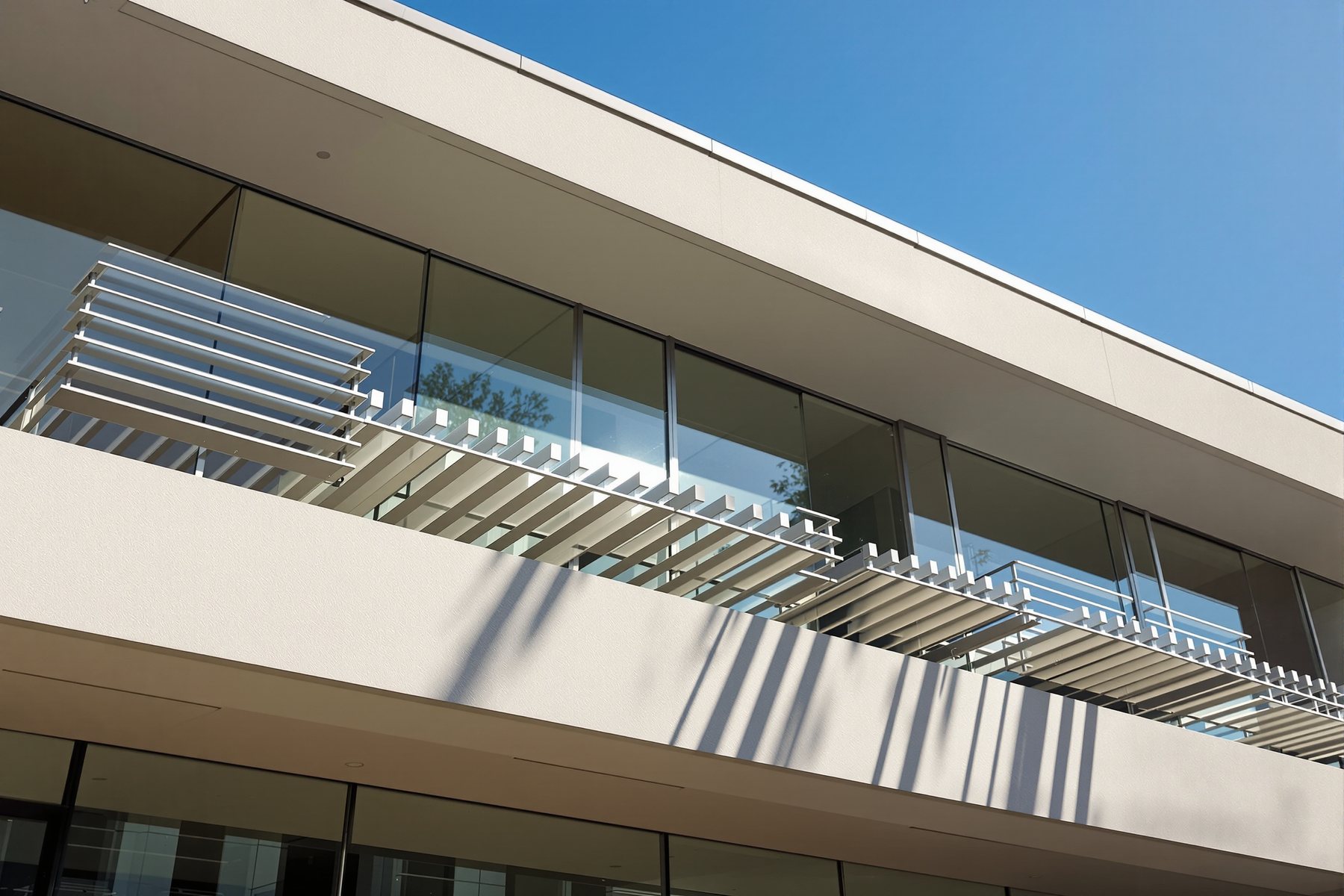
An all-glass west face in Ahmedabad is a solar collector you then pay to fight, hour after hour, all summer.
Walk past a glass tower at 3 pm in May and put your hand near the inside of the west glass - it is warm. That warmth is the part of the sun's radiation the glass let straight through, and it is, by far, the fastest and largest way heat enters a glazed facade. The number that governs it is the **solar heat gain coefficient (SHGC)**, also called the **g-value**: the fraction of incident solar energy that ends up inside, between 0 and 1. A clear single pane is around 0.85; a good solar-control double glazing reaches 0.25 or lower. But the SHGC of the glass alone is not the whole story - a well-designed **external shade** can cut the effective solar gain dramatically, and the trick is to do it _without_ killing the **daylight and view** you put glass there for in the first place. That balance is the whole art of solar facade design.
SHGC, the external shading factor, and VLT
SHGC is the heat you let in; VLT is the light - and you want them far apart
Every glazing product carries two performance numbers that decide its solar behaviour.
SHGC (g-value) is the fraction of incident solar energy transmitted to the inside - directly through the glass, plus the part absorbed by the glass and re-radiated inward. Range 0 to 1, lower is cooler. VLT (visible light transmittance) is the fraction of visible daylight that gets through - higher means a brighter, clearer view but more glare risk.
The prize is glass that lets light through while blocking heat - high VLT, low SHGC. That ratio has a name: the light-to-solar-gain ratio (LSG = VLT / SHGC). A plain tinted glass cuts both about equally (LSG near 1). A good spectrally selective low-E coating can give VLT 0.60 with SHGC 0.27 - LSG above 2 - exactly what a daylit, cool Indian facade wants. In a cooling-dominated climate you chase low SHGC first, then claw back the VLT and glare control you need.
SHGC is the heat tax on your view. VLT is the daylight dividend. The best glass keeps the dividend high while cutting the tax.
An external shade cuts the sun before it reaches the glass - so it counts most
The single most powerful move in solar facade design is to stop the sun outside the glass. Once solar radiation passes the glass it is largely inside; an internal blind only re-radiates absorbed heat back into the room. An external shading device - an overhang, fin, louvre, brise-soleil or deep reveal - intercepts the direct beam before it ever hits the pane.
We capture this as a shading factor or external shading factor (ESF) between 0 and 1: the fraction of solar gain that still gets through after the shade. A horizontal overhang that blocks the high summer sun on a south facade might give ESF = 0.4 (it lets 40% through). The combined performance is the equivalent or effective SHGC: SHGCeff = SHGCglass x ESF.
Geometry matters per orientation: a horizontal overhang works on the south (high sun), vertical fins work on east and west (low morning/evening sun that overhangs cannot catch), and the brutal west low-angle sun is the hardest to shade and the most worth the effort in India.
You can pass the energy code and still blind the occupant
SHGC is a heat problem; glare is a visual-comfort problem, and they are not the same. Glare is excessive luminance contrast - the sun, or its reflection, far brighter than the surfaces around it - that forces people to squint, pull blinds, and often defeat your whole daylighting strategy by blacking out the window.
Glare is driven by high VLT, low-angle direct sun, and bright sky near the line of sight. The cruel irony: the high-VLT glass you chose for great daylight is also the glass most likely to cause glare. The fixes are the same external shades that cut SHGC (they also block the direct beam that causes the worst glare), plus internal control (blinds, fabric) for diffuse sky glare, and careful orientation. The metric the industry uses is Daylight Glare Probability (DGP) or the older Daylight Glare Index - a reminder that a facade can be energy-compliant and still be a place no one wants to sit by the window.
Shading is architecture, not an add-on. The overhangs, fins and reveals that control SHGC and glare are also the facade's deepest expression - shadow, depth, rhythm - so design them as form, oriented correctly: horizontal for south, vertical for east/west, deep for the merciless west. Choose glass for a high light-to-solar-gain ratio so you keep daylight while cutting heat. And remember that the cheapest, most reliable shade is the one fixed outside the glass and cast by the building itself.
You compute the effective SHGC: SHGC_eff = SHGC_glass x ESF, with the ESF derived from shade geometry and sun path per orientation (or from simulation). Report effective, not nominal, SHGC against the code limit, and run a glare check (DGP) for occupied west/east zones - passing the energy SHGC says nothing about visual comfort. Verify the manufacturer's SHGC and VLT are for the actual IGU make-up and that the LSG ratio you specified survives value engineering.
The glass that arrives must be the glass that was specified - coating type, which surface the low-E is on (surface 2 for solar control in a cooling climate), and the IGU make-up all change SHGC and VLT. Check the bug-mark or order labels. And install external shades to the design depth and angle: an overhang built 100 mm shallower, or a louvre set flat instead of angled, quietly raises the effective SHGC and lets the heat and glare back in.
ECBC 2017 (India)
Commercial SHGC limits
Sets maximum SHGC by climate zone and window-wall ratio, and credits external shading via an equivalent-SHGC route. It governs commercial glazing but its shading-credit method is simplified - aggressive shading geometries are better verified by simulation.
Eco-Niwas Samhita 2018 (India)
Residential SHGC within RETV
Folds glazing SHGC and shading into the RETV envelope metric rather than a single hard SHGC cap - so a high-SHGC window can still comply if shaded or offset, which is realistic but easy to game without good shading inputs.
ASHRAE 90.1 / NFRC 200
Global SHGC & rating method
ASHRAE 90.1 sets prescriptive SHGC limits by climate; NFRC 200 is the standard procedure for rating a product's SHGC and VLT. As of 2026 Indian projects often quote NFRC/EN-rated glass data but apply ECBC/ENS limits.
“Tinted or reflective glass solves solar heat gain - just go darker and you cut the heat.”
Darker glass cuts SHGC, but plain body-tinted glass cuts VLT about as much, so you lose daylight and view in equal measure - and absorbed heat in dark tints can re-radiate inward and even cause thermal stress. The smarter route is a spectrally selective low-E coating (low SHGC, high VLT) plus external shading, which cuts the heat at source while keeping the light. Going darker is the crude fix; high light-to-solar-gain glass plus shading is the engineered one.
Worked example - effective SHGC of a shaded west window
We will take a real-feeling west-facing office window in a hot Indian city, combine the glass SHGC with an external shade, and test the effective SHGC against an ECBC-style limit. This is the core solar calculation a facade engineer runs dozens of times per project.
Manufacturer glass data (SHGC and VLT for the exact IGU), a shading factor from geometry or a shading calculator, and the ECBC/ENS SHGC target for your climate zone and window-wall ratio.
GIVEN:

  Glass            : solar-control double-glazed IGU
    SHGC_glass     = 0.27
    VLT            = 0.60   (light-to-solar-gain LSG = 0.60/0.27 = 2.2)
  Orientation      : WEST
  External shade   : vertical fins + 600 mm overhang
    shading factor ESF = 0.55   (lets 55% of solar through)
  ECBC-style target: SHGC_eff <= 0.25 for this WWR/zone

FORMULA: SHGC_eff = SHGC_glass x ESF- 1Start with the glass. SHGCglass = 0.27. On its own, unshaded, the bare window would deliver an effective SHGC of 0.27 - already over_ the 0.25 target. So glass selection alone fails here.
- 2Bring in the shade. The external fins-plus-overhang give a shading factor ESF = 0.55: after the shade, only 55% of the solar that would hit the glass actually reaches it on the design condition.
- 3Combine them: SHGCeff = SHGCglass x ESF = 0.27 x 0.55 = 0.1485, round to 0.15.
- 4Check against the target: SHGC_eff = 0.15 is comfortably below the 0.25 limit. The window now complies - and it did so because of the shade, not the glass. Without the fins (ESF = 1.0) it failed at 0.27.
- 5Confirm the daylight survived. VLT = 0.60 means the glass still passes 60% of visible light; the external shade blocks mostly direct beam, so diffuse daylight largely remains. The LSG of 2.2 tells you this is a daylight-friendly, low-heat result - the goal.
- 6Now sanity-check glare. VLT 0.60 on a west face means strong low-angle evening sun will still cause glare on un-shaded sightlines; note that the vertical fins (good for west) plus an internal fabric blind are needed for visual comfort even though the energy number already passes.
You’ll walk away with
An effective SHGC of 0.15 from a 0.27 glass plus 0.55 external shade - proof that shading, not darker glass, is what makes a west Indian facade comply, while a high LSG keeps the daylight you paid for.
Two quick checks on the solar maths.
- 01Repeat the calculation for a clear single pane (SHGC 0.85) behind the same shade (ESF 0.55): SHGC_eff = 0.85 x 0.55 = 0.47 - still nearly double the limit. Lesson: shading helps, but it cannot rescue genuinely bad glass.
- 02Compute the LSG (VLT/SHGC) for two glasses - a body-tinted (VLT 0.40, SHGC 0.45) and a spectrally selective low-E (VLT 0.60, SHGC 0.27). The low-E's LSG of 2.2 versus the tint's 0.89 is exactly why coatings beat tints for daylit Indian offices.
Solar gain through glass is the fastest, largest heat entry in a glazed facade, governed by the SHGC. The winning strategy in cooling-dominated India is high-LSG glass (low SHGC, high VLT) plus external shading - because effective SHGC = SHGC_glass x ESF, and the shade does the heavy lifting. Pass the energy number and still check glare: an energy-compliant facade can be visually intolerable.
SHGC (g-value) is the fraction of solar energy let inside (0-1); VLT is the visible light let through; you want high VLT and low SHGC (high light-to-solar-gain ratio). External shading cuts effective SHGC: SHGCeff = SHGCglass x ESF. Horizontal overhangs suit south, vertical fins suit east/west. Glare is a separate visual-comfort failure driven by high VLT and low-angle sun.
What is SHGC and what is a good value for India?
SHGC (solar heat gain coefficient, or g-value) is the fraction of incident solar energy that ends up inside, from 0 to 1 - lower means a cooler building. In cooling-dominated India, solar-control double glazing reaching SHGC 0.25-0.30, or an effective SHGC near 0.15-0.20 after external shading, is a strong target; ECBC sets the exact limit by climate zone and window-wall ratio. A clear single pane is about 0.85.
What is the difference between SHGC and VLT?
SHGC is the fraction of solar heat the glass lets in; VLT (visible light transmittance) is the fraction of daylight it lets through. They are independent - good glazing pushes them apart, giving low SHGC (less heat) but high VLT (more daylight). The ratio VLT/SHGC is the light-to-solar-gain ratio; above about 1.25 means the glass is daylight-efficient, and spectrally selective low-E coatings can reach 2 or more.
How does external shading reduce solar gain?
External shades - overhangs, fins, louvres, deep reveals - intercept the sun's direct beam before it reaches the glass, so the heat never gets inside. This is captured as a shading factor (ESF), and the combined performance is the effective SHGC = SHGC of the glass multiplied by the ESF. External shading is far more effective than internal blinds, which only re-radiate already-admitted heat, and it also cuts the worst glare.
Peer-reviewed journals & authoritative standards
- 01An approach to calculate the equivalent solar heat gain coefficient of glass windows with fixed and dynamic shading in tropical climates. Journal of Building Engineering. — Journal of Building Engineering (Elsevier), 2018.
- 02Multi-objective optimization of glazing and shading configurations for visual, thermal, and energy performance of cooling-dominant climatic regions of India. — peer-reviewed (via ResearchGate), 2024.
- 03Li, X. & Wu, Y. A review of complex window-glazing systems for building energy saving and daylight comfort. — Journal of Building Physics (SAGE), 2025.
The author
Amogh N P
Architect, interior designer, and creative polymath. Studio Matrx began in his notebooks — his vision of design made honest, useful, and open to everyone. Its Academy is written and taught in his memory, and free, forever.
More about Amogh →_Heat and light handled, the facade still has to manage water it can't see - vapour diffusing through the wall - and sound. Both can quietly ruin a building, and both come next._