
Mughal, Rajput & the Colonial Encounter
The arch and the dome, the palace interior, and the coming of Europe.
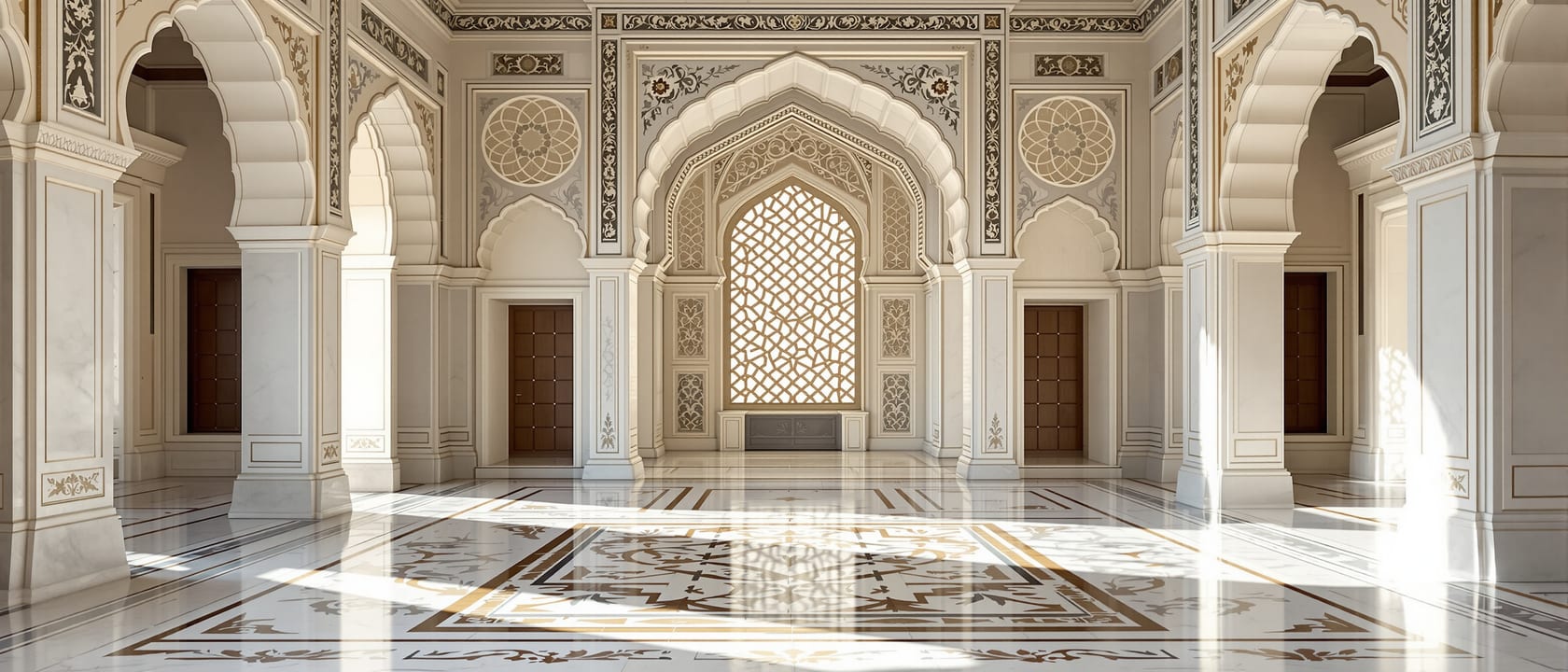
Two waves of ‘foreign’ vocabulary land on Indian soil and are absorbed and re-made. The Indo-Islamic revolution brings the true arch, the dome and the char-bagh garden — India’s first large, column-free interior volumes — reaching a height of white marble and pietra dura in the Mughal interior and a firmament of mirror in the Rajput Sheesh Mahal. Then the colonial encounter brings the verandah-wrapped bungalow, the politically-charged Indo-Saracenic, and the machine-age Deco and Bauhaus-modern of the princely states.
Learning objectives
By the end of this lesson, you will be able to — mapped to the course outcomes for Evolution of Interiors II:
Explain the Indo-Islamic arch, dome and char-bagh and the column-free interior they enabled.
Describe the Mughal and Rajput palace interiors — inlay, jaali and the Sheesh Mahal.
Explain the colonial bungalow, Indo-Saracenic and the princely machine-age interior.
Teach hybridity as the Indian norm, and debunk the Taj 'Italian designer' myth honestly.
The Indo-Islamic & Mughal interior
The true arch and dome give India column-free volume; the char-bagh becomes a plan module; and the interior reaches its height in marble, parchin-kari inlay and the mirrored Sheesh Mahal.[1, 2]
Column-free volume arrives
With the Delhi Sultanate (13th c. onward) India acquires, structurally, what it had largely lacked: the TRUE ARCH, the squinch/pendentive-borne DOME and the VAULT — which means, for the first time, large clear-span, COLUMN-FREE interior volumes. The other imports are formal-spatial: the IWAN (a vaulted hall open on one side), the CHAHAR-BAGH (the quartered paradise-garden as a PLAN module), and a decorative universe that is ANICONIC (no figural idols) — so it pours its inventiveness into geometry, calligraphy, arabesque and the jaali. Early Indo-Islamic work (the Qutb complex) literally RE-USES Hindu/Jain temple columns as spolia; by the mature Mughal period the synthesis is seamless. Hybridity, not import, is the lesson.[1, 3]
The colonial encounter
The verandah-wrapped bungalow where European furniture first colonises the Indian room, the politically-charged Indo-Saracenic hybrid, and the machine-age Deco and modern that reached India in the 1930s — before Chandigarh.[3, 4]
European furniture arrives
From the Bengali bangla hut, the British evolve the BUNGALOW: a single-storey, hip-roofed house wrapped in a deep VERANDAH, set in a compound, with high ceilings and a cellular plan of large rooms — the verandah being the crucial climatic and social filter. Its INTERIOR blends European furniture (the dining table, the planter's chair, the ALMIRAH, the writing bureau) with Indian service — the PUNKAH, a ceiling-hung cloth fan pulled by a punkah-wallah, the precursor of interior climate control. The bungalow is where EUROPEAN FIXED FURNITURE first colonises the Indian interior at scale — the word and the roof are Bengali, but the British systematised the type.[4]
Place it in the whole arc
The hybrid courts and the colonial house sit between the vernacular and the modern — scan the whole Indian story.
Indian style explorer · the interior through time
Buddhist rock-cut
c. 2nd c. BCE – 7th c. CE
- The idea
- Interiors SUBTRACTED from living rock — the chaitya prayer-hall and the vihara monastery.
- The interior
- A barrel-vaulted hall imitating lost timber, a stupa to circumambulate, and (at Ajanta) walls of immersive mural.
- Exemplars
- Karla chaitya · Ajanta · Ellora Kailasa
A handful of Indian devices — the courtyard, the jaali, floor-culture and the ordering grid — run unbroken from the temple to the present.
At a glance
| Aspect | One side | The other |
|---|---|---|
| Indo-Islamic architecture | Myth: 'foreign' to India | Reality: an Indian synthesis — local craft, rapid absorption |
| The Taj's pietra dura | Myth: an Italian ('Veroneo') designed it | Reality: a discredited colonial myth — Indian parchin kari |
| Sheesh Mahal mirrors | Myth: just bling | Reality: a pre-electric low-light amplification system |
| The bungalow | Myth: a British invention | Reality: the word and roof are Bengali; the British systematised it |
| Modern interiors in India | Myth: only after Independence | Reality: Manik Bagh & Art Deco Bombay in the 1930s |
Key terms
The quartered Mughal paradise-garden used as a PLAN module — the ordered setting for the interior.
The Indian inlay of semi-precious stone into marble in floral arabesques — a Mughal interior signature.
The carved marble lattice screen filtering light and air — the Indo-Islamic refinement of the vernacular jaali.
The Rajput mirror-palace whose thikri mosaic turns one lamp into a firmament — pre-electric lighting design.
The verandah-wrapped colonial house (from Bengali bangla) and its pulled cloth ceiling-fan — where European furniture arrives.
The Raj's deliberate Mughal-dressed-European hybrid — an architecture of political message, c. 1870s–1930s.
Study task
Choose one Mughal or Rajput interior and one colonial bungalow, and for each draw a quick plan noting how light, air and threshold are handled. Then write a paragraph on the Indo-Saracenic as an architecture of political message — and flag one common myth (for example, the discredited ‘Italian designed the Taj’ claim) with the honest position.
Self-assessment
1. The Delhi Sultanate's key gift to the Indian interior was —
2. The claim that an Italian named 'Veroneo' designed the Taj Mahal's inlay is —
3. Full-blown modern interiors first appeared in India —
Recap
References & further reading
- [1]Catherine B. Asher, Architecture of Mughal India (New Cambridge History of India) — the authoritative Mughal source.
- [2]George Michell & Antonio Martinelli, The Royal Palaces of India — Rajput/Mughal palace interiors, superbly illustrated.
- [3]Giles Tillotson, The Tradition of Indian Architecture — hybridity, Indo-Saracenic and the colonial 'style' debate.
- [4]Philip Davies, Splendours of the Raj: British Architecture in India 1660–1947 — bungalow, Indo-Saracenic, New Delhi.
- [5]Robert Grant Irving, Indian Summer: Lutyens, Baker and Imperial Delhi; Reto Niggl, Eckart Muthesius: The Maharaja's Palace in Indore.
Further reading
- Catherine B. Asher — Architecture of Mughal India.
- George Michell & Antonio Martinelli — The Royal Palaces of India.
- Philip Davies — Splendours of the Raj.
Sources gathered and fact-checked June 2026. Published values vary by source, sample and method — treat as indicative and confirm against the cited standard before structural use.
The author
Amogh N P
Architect, interior designer, and creative polymath. Studio Matrx began in his notebooks — his vision of design made honest, useful, and open to everyone. Its Academy is written and taught in his memory, and free, forever.
More about Amogh →