
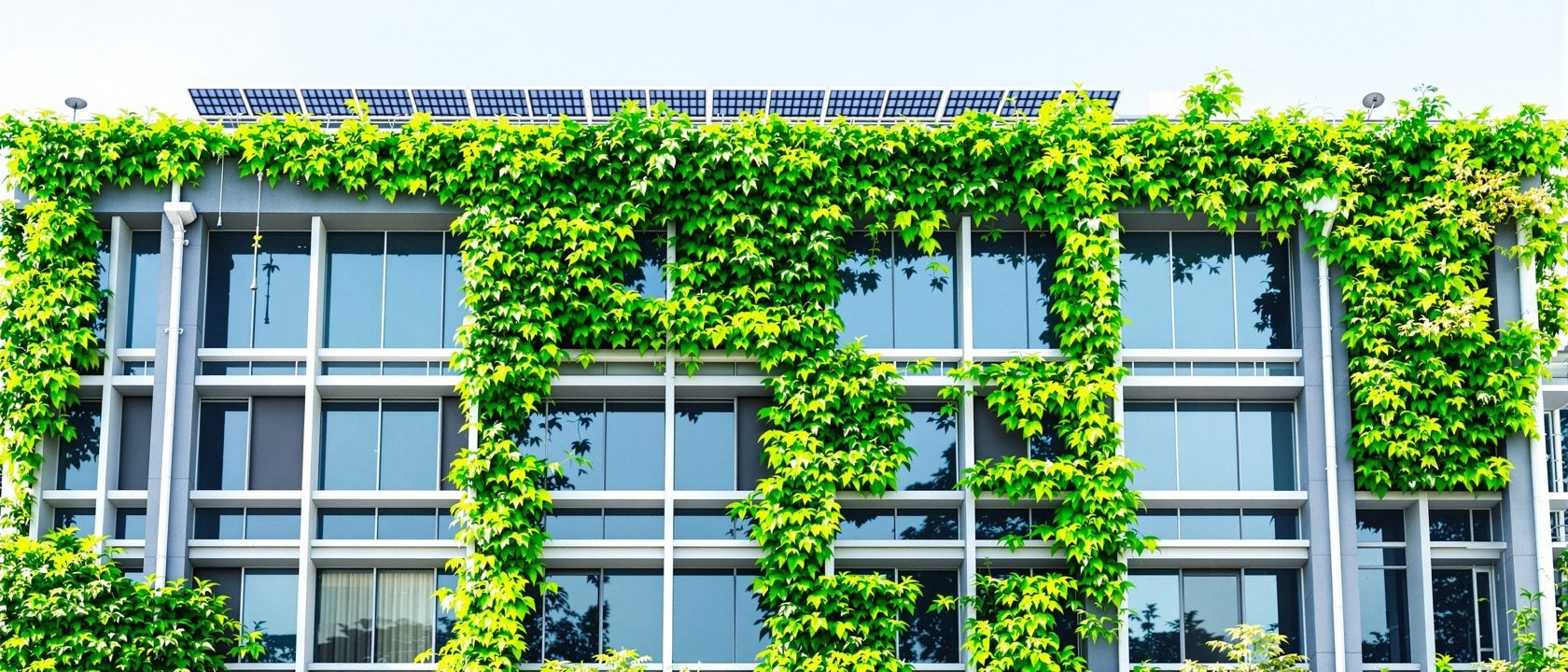
Sustainability & Law
Sustainable development, climate, and India's environmental laws — for design.
Sustainable development (Brundtland, 1987) means meeting present needs without compromising the future. Learn climate change and — a different problem — ozone depletion; India’s environmental laws with the correct years; and, for interiors, embodied energy and the green-building rating systems that reward every good decision from the earlier units.
Learning objectives
By the end of this lesson, you will be able to — mapped to the course outcomes for Environmental Studies:
Define sustainable development and its three pillars (Brundtland, 1987).
Distinguish ozone-layer depletion from global warming — different problems.
State India's environmental laws with the correct years and the role of the CPCB.
Apply embodied energy and green-building rating (GRIHA/IGBC/ECBC) to design.
Sustainability and climate
The three pillars; rain-water harvesting and watershed management; the greenhouse effect; and why ozone depletion is a different problem from global warming.[1, 2]
The Brundtland definition
From Our Common Future (the Brundtland Report, 1987): sustainable development is 'development that meets the needs of the present without compromising the ability of future generations to meet their own needs.' It integrates THREE pillars — environment, economy and society (people, planet, profit). The UN's 17 Sustainable Development Goals (2015, target 2030) extend this idea. It means balancing growth with conservation — NOT stopping development.[1]
India's laws and the design connection
The five core Acts with the correct years, the CPCB structure and the EIA — and, for interiors, embodied energy and green-building rating (GRIHA, IGBC, ECBC).[1, 3, 4]
Get the years right
India's core environmental laws, with the years students most often misremember: WILDLIFE (Protection) Act 1972; WATER (Prevention & Control of Pollution) Act 1974; FOREST (Conservation) Act 1980; AIR (Prevention & Control of Pollution) Act 1981; ENVIRONMENT (Protection) Act 1986. A common error swaps the Air (1981) and Water (1974) Acts, or dates the EPA to 1984 — that is the Bhopal disaster; the Act is 1986.[1]
At a glance
| Aspect | One side | The other |
|---|---|---|
| Ozone vs warming | Ozone: CFCs → UV-B (Montreal 1987) | Warming: greenhouse gases → heat (Kyoto/Paris) |
| Sustainable development | Myth: stop all development | Reality: meet needs without harming the future |
| Greenhouse effect | Natural: makes Earth habitable | Enhanced (human): the problem |
| Law years | Wildlife 1972 · Water 1974 · Forest 1980 | Air 1981 · Environment 1986 |
| Energy in materials | Embodied: to make & deliver it | Operational: to run the building |
Key terms
Meeting present needs without compromising future generations (Brundtland, 1987).
Collecting rainwater for use and for groundwater recharge.
Gases trap outgoing infrared; the enhanced human effect drives global warming.
CFCs destroy stratospheric ozone → more UV-B; a different problem from warming (Montreal Protocol 1987).
India's umbrella environmental law, enacted after Bhopal (1984).
Total energy to make and deliver a material — distinct from operational energy.
Studio task
For a small fit-out, list three moves that would raise its green-building score: one that cuts embodied energy (a material swap), one that saves water (rain-water harvesting or a fixture), and one that protects indoor air. Cite which Indian rating system (GRIHA, IGBC, ECBC) each would count toward.
Self-assessment
1. The Environment (Protection) Act was passed in —
2. Ozone-layer depletion is caused mainly by —
3. 'Embodied energy' of a material means the energy —
Recap
References & further reading
- [1]R. Rajagopalan, Environmental Studies: From Crisis to Cure, OUP, 2016 (Indian environmental law, climate, sustainability).
- [2]World Commission on Environment and Development, Our Common Future (Brundtland Report), OUP, 1987; Montreal Protocol, 1987.
- [3]GRIHA (TERI/MNRE), IGBC (CII) and ECBC 2017 (Bureau of Energy Efficiency) — green-building rating and code.
- [4]Government of India bare Acts — Water 1974, Air 1981, Environment (Protection) 1986, Wildlife 1972, Forest 1980; EIA Notification 2006.
Further reading
- R. Rajagopalan — Environmental Studies: From Crisis to Cure.
- WCED — Our Common Future (Brundtland Report).
- Erach Bharucha — Textbook of Environmental Studies.
Sources gathered and fact-checked June 2026. Published values vary by source, sample and method — treat as indicative and confirm against the cited standard before structural use.
The author
Amogh N P
Architect, interior designer, and creative polymath. Studio Matrx began in his notebooks — his vision of design made honest, useful, and open to everyone. Its Academy is written and taught in his memory, and free, forever.
More about Amogh →