
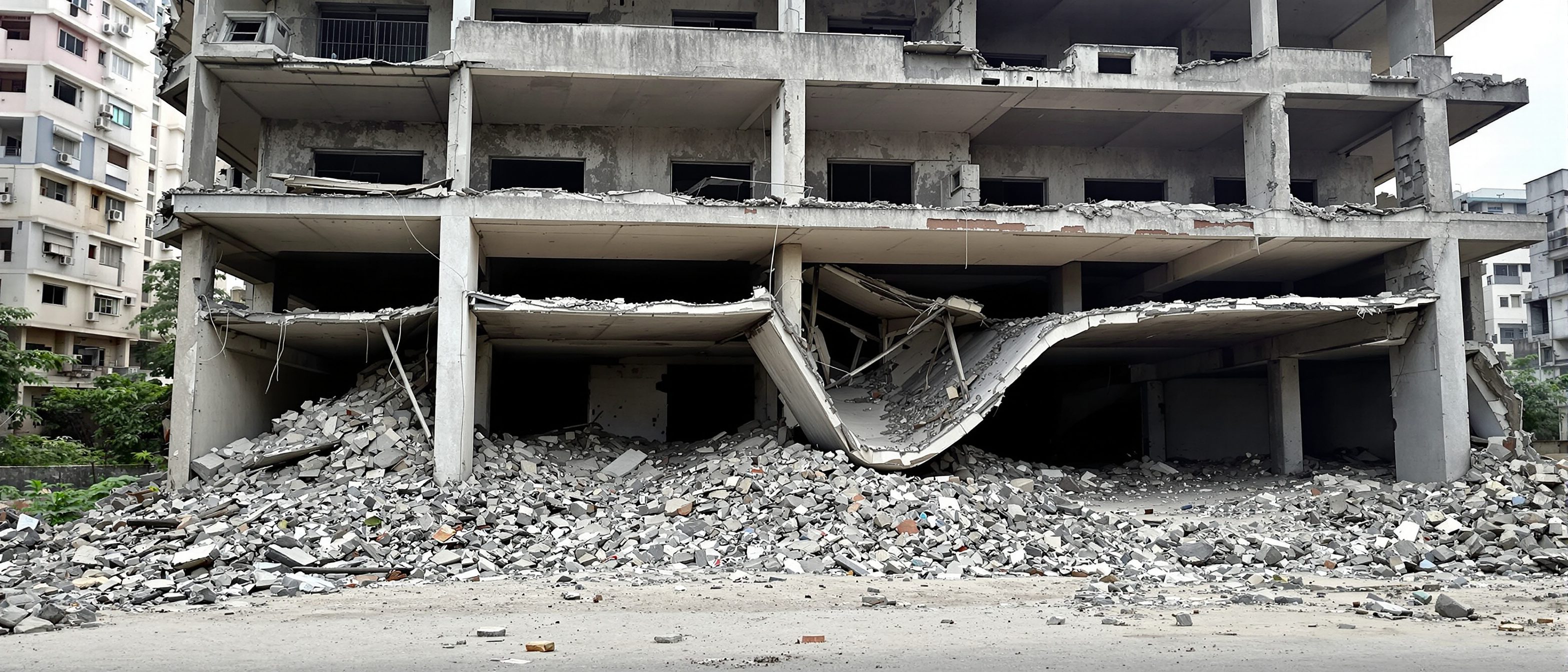
Ground & Building Performance
How the soil and the building actually behave when the shaking comes.
When the shaking comes, the GROUND and the BUILDING behave in ways the architect must anticipate. This unit covers what an earthquake does to the ground — soil rupture, liquefaction and landslides — and why site selection is a seismic decision. It studies how different building structures, equipment and LIFELINES behave and the patterns in which they collapse. And it covers the often-forgotten NON-STRUCTURAL elements — ceilings, partitions, fixtures and services — that injure and disrupt even when the structure stands. Learning how buildings fail is how we design them not to.
Learning objectives
By the end of this unit, you will be able to — mapped to the course outcomes for Earthquake Resistance Architecture:
Explain earthquake effects on the ground — rupture, liquefaction and landslides — and seismic site selection.
Describe how different building structures behave and their collapse patterns.
Explain the behaviour of lifelines and equipment in an earthquake.
Identify non-structural elements that must be restrained against earthquake damage.
What the ground does
Ground behaviour can defeat any superstructure — liquefaction, landslides and rupture make site selection the architect's first seismic line of defence.[2, 3]
Rupture and movement
An earthquake can tear the ground itself: SURFACE RUPTURE along the fault (do not build across an active fault), differential ground movement, and settlement. The ground motion is what the building experiences, so the FIRST seismic decision is the site — avoid fault traces, very soft or filled ground, steep unstable slopes and the edges of cliffs and water bodies, which all worsen the shaking and the risk.[2, 3]
How buildings behave
Buildings feel a horizontal inertia force that must travel a continuous load path; collapse patterns trace to flaws, and even when the structure stands, falling non-structural elements injure.[2, 3]
Inertia fights the shaking
When the ground jerks back and forth, the building's MASS wants to stay put (inertia), so the building feels a horizontal force trying to shear and overturn it — proportional to its weight and to the shaking. How well it copes depends on its STIFFNESS, STRENGTH, DUCTILITY and CONFIGURATION (Unit III). A building must carry this lateral force down to the ground through a continuous, well-connected LOAD PATH — break the path and the building fails.[2]
At a glance
| Aspect | One | The other |
|---|---|---|
| First seismic decision | The structure | The site and ground (it can defeat any structure) |
| Liquefiable soil | Build normally | Avoid / improve / deep-found — designed around |
| Commonest failure | Random bad luck | Soft ground storey (a configuration flaw) |
| Adjacent buildings | Touching: pounding damage | Seismic gap: safe |
| Injuries when structure stands | None | Falling non-structural elements |
Key terms
The tearing of the ground along the fault — never build across an active fault.
Saturated sandy soil losing strength and behaving like liquid under shaking — buildings sink or tilt.
Earthquake-triggered slope failure that buries buildings and roads in hilly terrain.
Adjacent buildings hammering together when too close — provide a seismic gap.
The continuous route by which lateral force travels to the ground; break it and the building fails.
An open/weak ground floor crushing under the storeys above — the commonest Indian failure.
Water, power, gas, roads and communications that must keep working after a quake.
Parapets, ceilings, partitions, fixtures and services that injure when unrestrained.
Studio task
For a real site you know, list the ground hazards you would check (fault traces, soft/filled soil, liquefiable sand, unstable slopes, water bodies) and how each would change your siting. Then walk through a familiar building and list five non-structural elements (parapets, tanks, ceilings, shelves, glazing) that would injure people if unrestrained, and how you would anchor each.
Self-assessment
1. Liquefaction is the phenomenon where —
2. The single commonest collapse pattern in Indian RC buildings is —
3. In many earthquakes, most injuries are caused by —
Recap
References & further reading
- [2]Murty, C.V.R. — Earthquake Tips; IITK-BMTPC Earthquake Design Concepts (NICEE, IIT Kanpur).
- [3]Davis, Ian — Shelter After Disaster / 'Safe shelter within unsafe cities' (disaster vulnerability and rapid urbanisation, Open House International).
Further reading
- C.V.R. Murty — Earthquake Tips (NICEE, IIT Kanpur).
- Ian Davis — Shelter After Disaster.
- NICEE — Guidelines for earthquake-resistant non-engineered construction.
Sources gathered and fact-checked June 2026. Published values vary by source, sample and method — treat as indicative and confirm against the cited standard before structural use.
The author
Amogh N P
Architect, interior designer, and creative polymath. Studio Matrx began in his notebooks — his vision of design made honest, useful, and open to everyone. Its Academy is written and taught in his memory, and free, forever.
More about Amogh →