
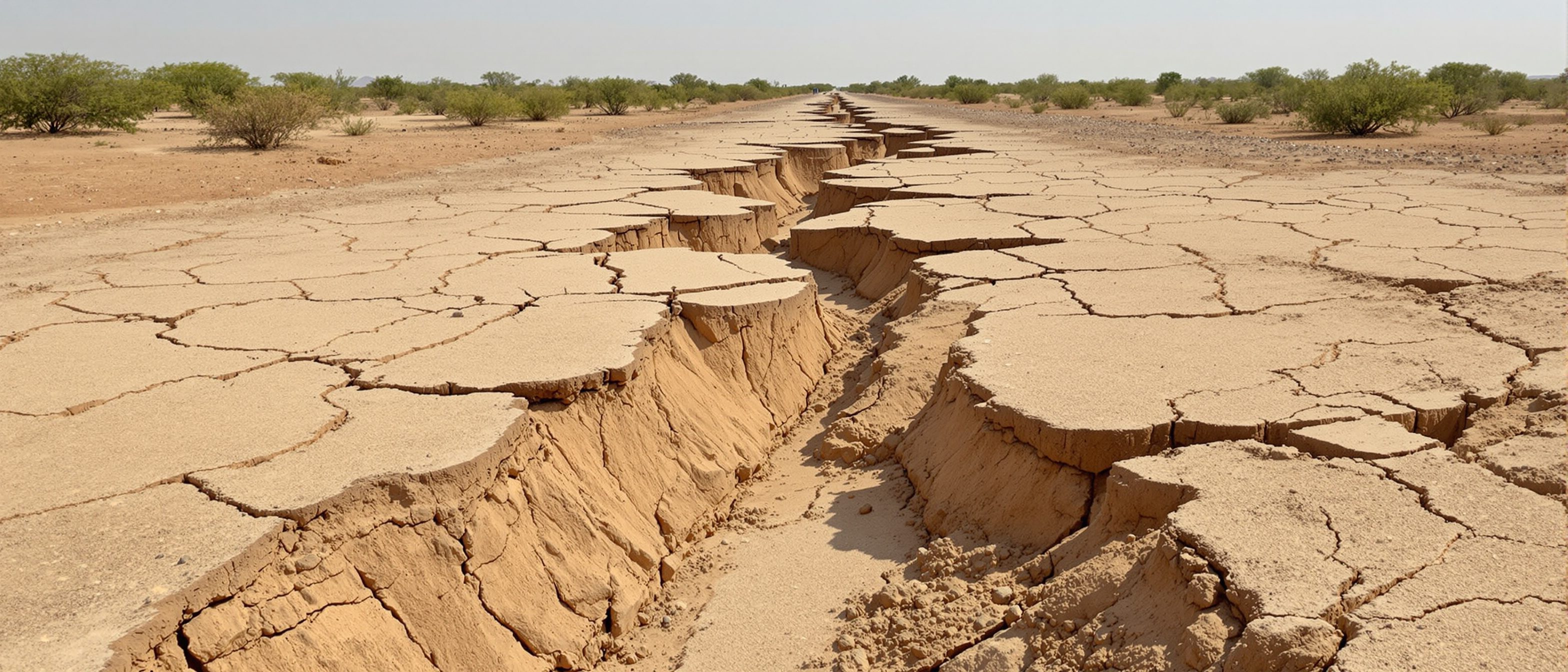
Fundamentals of Earthquakes
Why the ground shakes — plates, waves, and India's seismic zones.
To design against earthquakes you must first understand them. This unit covers the Earth's structure and plate tectonics — the slow drift of the crustal plates whose sudden slip at a fault releases an earthquake's energy as seismic waves. It covers the vocabulary every architect must know — fault, focus, epicentre, focal depth — and how earthquakes are measured (magnitude vs intensity). And it maps India into the IS 1893 seismic zones II to V (there is no Zone I) — so you know how severe the shaking your building must survive really is.
Learning objectives
By the end of this unit, you will be able to — mapped to the course outcomes for Earthquake Resistance Architecture:
Explain plate tectonics and how a fault slip generates an earthquake.
Define fault, focus, epicentre and focal depth, and identify seismic-wave types.
Distinguish earthquake magnitude from intensity and how each is measured.
Identify the IS 1893 seismic zones of India (II–V) and what they mean for design.
Why the ground shakes
Plate tectonics and fault slip cause earthquakes, radiating as seismic waves; know fault, focus, epicentre and depth, and magnitude versus intensity.[2]
The drifting crust
The Earth's outer shell is broken into TECTONIC PLATES that drift slowly on the mantle. Most earthquakes happen at PLATE BOUNDARIES where plates collide, pull apart or slide past — stress builds at a locked FAULT until the rock suddenly slips, releasing stored energy. India sits on the Indian Plate driving into the Eurasian Plate, pushing up the Himalaya — which is why the Himalayan belt is India's most seismically active region.[2]
India's seismic zones
IS 1893 maps India into Zones II–V (no Zone I), each with a Zone Factor Z; hazard is the regional zone plus the local soil, which amplifies shaking.[1, 2]
IS 1893: II to V
IS 1893 (Part 1) maps India into FOUR seismic zones by expected hazard: ZONE II (low), ZONE III (moderate), ZONE IV (severe) and ZONE V (very severe). FLAG THE COMMON ERROR: there is NO Zone I — it was merged into Zone II long ago. Each zone has a Zone Factor Z (II = 0.10, III = 0.16, IV = 0.24, V = 0.36) that scales the design earthquake force. The higher the zone, the stronger and more carefully detailed the building must be. Use the zone explorer.[1]
Explore the seismic zones
Pick an IS 1893 seismic zone and see its severity, its Zone Factor Z, and the relative design force a building there must survive.
Seismic zone · pick a zone (IS 1893)
0.24
Zone Factor Z
Severe
hazard
67%
of max force
Zone IV: Delhi-NCR, the Indo-Gangetic plain, parts of J&K, Himachal, the lower Himalaya and the Northeast.
There is NO Zone I — only II–V. The Zone Factor Z scales the design earthquake force.
At a glance
| Aspect | One | The other |
|---|---|---|
| Magnitude vs intensity | Magnitude: energy at source, one value | Intensity: shaking at a place, varies |
| Focus vs epicentre | Focus: underground rupture point | Epicentre: surface point above it |
| Wave damage | P-waves: felt first, less damaging | S & surface waves: more destructive |
| India's zones | Myth: Zones I–V | Reality: only II–V (no Zone I) |
| Ground | Rock: less shaking | Soft soil: amplified shaking |
Key terms
The slow drift of the Earth's crustal plates; their fault slips cause most earthquakes.
The fracture in the crust where the sudden slip that releases an earthquake occurs.
The underground point where the rupture starts.
The point on the surface directly above the focus.
The depth of the focus — shallow quakes shake the surface harder.
Primary (push-pull, fastest), secondary (side-to-side), and slow, destructive surface waves.
Magnitude = energy at the source (one number); intensity = shaking effect at a place (varies).
India's hazard map, Zones II–V (no Zone I), with Zone Factor Z = 0.10 / 0.16 / 0.24 / 0.36.
Studio task
Find your home town's seismic zone (use the explorer and IS 1893) and write its Zone Factor Z and what that severity means for buildings there. Then label a simple cross-section with the four terms — fault, focus, epicentre, focal depth — and explain in one line why a shallow earthquake on soft soil is more dangerous than a deep one on rock.
Self-assessment
1. The point on the ground surface directly above where an earthquake rupture begins is the —
2. India's seismic zones under IS 1893 are —
3. Earthquake magnitude differs from intensity in that magnitude measures —
Recap
References & further reading
- [1]BIS — IS 1893 (Part 1): Criteria for Earthquake Resistant Design of Structures (seismic zones II–V, Zone Factor Z).
- [2]Murty, C.V.R. — Earthquake Tips / IITK-BMTPC Earthquake Design Concepts (NICEE, IIT Kanpur).
Further reading
- C.V.R. Murty — Earthquake Tips (NICEE, IIT Kanpur, free).
- BIS — IS 1893 (Part 1).
- NICEE / IIT Kanpur earthquake-engineering resources.
Sources gathered and fact-checked June 2026. Published values vary by source, sample and method — treat as indicative and confirm against the cited standard before structural use.
The author
Amogh N P
Architect, interior designer, and creative polymath. Studio Matrx began in his notebooks — his vision of design made honest, useful, and open to everyone. Its Academy is written and taught in his memory, and free, forever.
More about Amogh →