
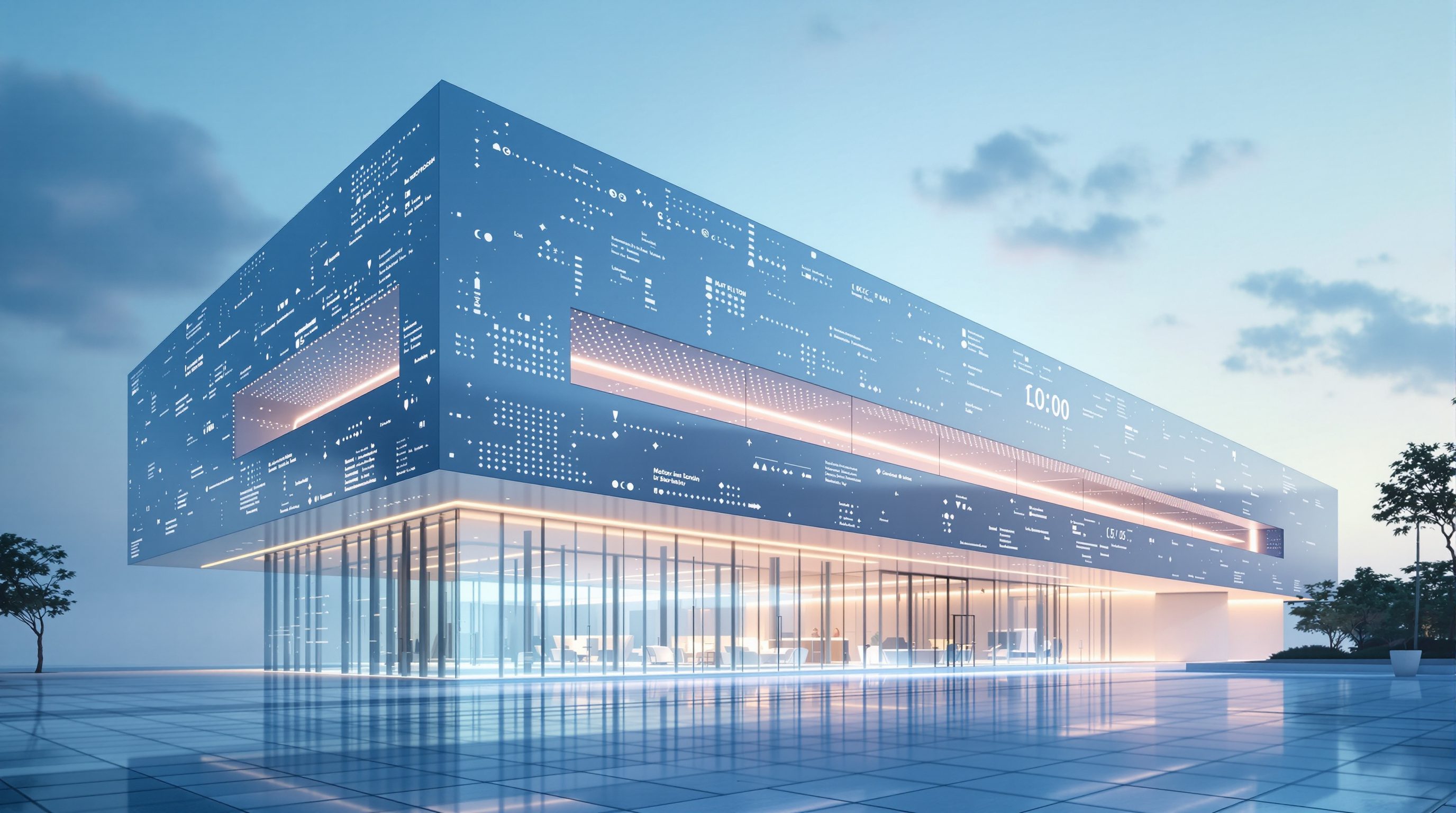
 Lesson 7.3
Lesson 7.3 · Predictive & Autonomous
Self-Optimizing Buildings
Closing the loop: buildings that continuously tune their own setpoints and sequences - and the trust and safety limits of letting them
The most advanced buildings do not wait for an engineer to tune them - they tune themselves, inside limits a human sets.
Most optimisation in buildings is still a human event: an engineer reviews data, adjusts a setpoint, tweaks a sequence, and moves on - if they ever get to it at all. Buildings drift out of tune within months, and the savings quietly leak away.
Self-optimizing buildings close that loop. The digital twin watches the live building, tests changes, pushes new setpoints, measures whether things improved, and adjusts again - continuously, without waiting for a person. It is the natural endpoint of everything so far: sensing, a twin, analytics and predictive control fused into a system that keeps itself tuned. But autonomy is not a free lunch. The hard questions here are not can a building optimise itself, but how far do we trust it, who is watching, and what must it never be allowed to touch?
Close the loop, but bound it. Guardrails > objective. Human can always take the wheel. Life-safety stays deterministic.
Closing the loop: what self-optimizing means
Everything in this course has been building an open loop that ended at a human: sensors report, the twin analyses, an engineer decides, someone acts. A self-optimizing building closes that loop so the system completes the cycle itself - sense, model, decide, act, then evaluate the outcome and adjust again. The controller does not just hold a setpoint a human chose; it chooses and continuously refines the setpoint against a goal like lowest energy at acceptable comfort.
Concretely, this looks like continuous, automated tuning: nudging a chilled-water temperature up until comfort or humidity starts to suffer, then backing off to the best point; resetting supply-air temperature and duct static pressure to the least energy that still satisfies every zone; re-sequencing which chillers or boilers run, and when, as load and weather shift. This is often called continuous commissioning or autonomous optimisation - the twin acting as a tireless controls engineer that never stops looking for a better operating point. The methods span self-tuning rules, MPC that re-optimises every cycle (Lesson 7.2), and learning approaches such as reinforcement learning, where an agent improves a control policy from the consequences of its own actions. What unites them is the closed loop: the building measures the result of its last move and lets that shape the next.
Sense -> model/learn -> act -> evaluate -> repeat. The loop closes without a human in it.
The twin as the brain - and continuous commissioning
The digital twin is what makes safe self-optimisation possible, because it gives the system somewhere to think before it acts. A good twin can simulate a proposed change - what happens to comfort and energy if we raise the chilled-water setpoint by one degree? - and reject bad moves in the model before they ever reach the real plant. It also provides the baseline of expected behaviour that fault detection and diagnostics compares against, so the optimiser is not chasing efficiency on top of a broken damper or a stuck valve. Optimising a faulty system just hides the fault; FDD and self-optimisation belong together.
The practical payoff is fighting performance drift. Buildings are commissioned once, beautifully, and then decay: sensors go out of calibration, occupants override, seasons change, tenants churn, and within a year or two the building is running well off its best point - the well-known phenomenon behind the value of continuous commissioning. A self-optimizing loop treats tuning as a permanent background process rather than a one-off project, holding the building near its optimum as conditions move. It sits, like MPC, as a supervisory layer above the BMS: it changes setpoints and sequences, while the fast, proven control loops underneath still enforce them. That separation is not just architecture - it is a safety boundary, keeping the experimental brain away from the reflexes that must always work.
The limits of autonomy: trust, safety and guardrails
Autonomy is exactly where honesty matters most, because a system acting on the real building can do real harm. The governing principle is bounded autonomy: the loop is free to optimise, but only inside a hard envelope a human defines and the system cannot exceed. Comfort bands, minimum fresh-air rates, equipment operating limits, and rate limits on how fast or how far any setpoint may move all act as constraints the optimiser must respect no matter what its objective says. An optimiser told only to minimise energy will, unconstrained, starve ventilation, freeze a coil, short-cycle a compressor or drift comfort - not from malice but from taking its instruction literally. The guardrails, not the goal, are what keep it civilised.
Three limits are non-negotiable. Life-safety systems - fire detection, smoke control, emergency egress, essential ventilation - must never be handed to an optimiser; they stay deterministic, hard-wired and independently certified, and statutory sign-off belongs to qualified professionals, not an algorithm. Human oversight must be real: clear dashboards showing what the system is doing and why, alerts when it hits a limit, and an always-available manual override - a person must be able to take back control instantly. And security is inseparable from autonomy - a system that can act on the building is a system an attacker would love to seize, so the operational-technology security of Module 8 is a precondition, not an afterthought. The useful mental model is a ladder of autonomy: earn each rung - monitor, advise, approve, supervised-auto, full-auto - only after the system has proven itself trustworthy on the one below.
Bounded autonomy: free to optimise inside a hard envelope a human sets. Life-safety stays off the ladder.
Learning to control, and how you know it worked
Some of the most-hyped self-optimisation uses reinforcement learning (RL), where an agent improves a control policy by trying actions and learning from their consequences against a reward such as low energy at good comfort. The promise is real - RL can discover strategies a human would not hand-code - but so is the danger: an RL agent learns by exploring, and exploration on a live, occupied building means experimenting on real people and real plant. The responsible pattern is to let the agent explore inside the digital twin or a simulator, where mistakes are free, and only deploy a policy to the building once it is proven and hemmed in by the same guardrails as any other optimiser. Learning offline, acting cautiously online: that is the difference between innovation and recklessness.
Whichever method tunes the building, self-optimisation is worthless unless you can measure that it helped, and this is subtler than it looks. You cannot simply compare this month to last, because weather, occupancy and tenancy all moved; honest evaluation needs a baseline model of what energy the building would have used under the same conditions - weather-normalised, occupancy-adjusted - so the saving is a like-for-like difference, the logic behind measurement-and-verification practice and tools such as ENERGY STAR Portfolio Manager for benchmarking. Continuous monitoring also guards against silent regression: an optimiser that quietly drifts comfort, or whose gains decay as the building changes, must be caught fast. The mature posture treats a self-optimizing loop like any safety-relevant automation - instrumented, baselined, watched, and reversible - so that improved is a claim backed by evidence rather than a vendor's dashboard.
Getting there in practice - and honest expectations
Real deployments do not flip a building to full autonomy overnight; they climb the ladder. A sane path starts with the twin in advisory mode - proposing setpoint changes an engineer reviews and applies - which both builds savings and, just as importantly, builds trust and a track record. As the recommendations prove reliable, more of them are allowed to execute automatically within tight limits, always with oversight and override. Each rung is earned by evidence, and the whole thing is monitored so a regression is caught fast.
Be clear-eyed about the hype. "Autonomous building" and "AI that runs your building" are heavily oversold; many products badged this way are really rule-based analytics with a human still firmly in the loop, which is often exactly right. The genuine, defensible value is concrete: continuous commissioning that stops performance drift, automated setpoint resets that recover savings humans never get around to, and a building that stays near its optimum as the world changes around it - all inside guardrails, with a person able to see and stop it. Full closed-loop autonomy over comfort-critical or safety-adjacent systems is still rare, appropriately cautious, and rightly bounded. It also helps to be precise about language: a building that automatically resets a few setpoints within tight limits is not the same as one running a closed-loop learning controller over its whole plant, yet both get marketed as autonomous. Ask exactly which decisions the system makes on its own, which limits bound them, and who is watching - the answers separate real, bounded self-optimisation from a slide deck. The measure of a good self-optimizing building is not how little a human touches it, but how much it improves while remaining completely under human authority.
Closed-loop / self-optimizing control
The system chooses, applies and refines setpoints against a goal
Completes the loop without a human deciding each move - inside guardrails.
Continuous commissioning
Ongoing automated re-tuning to hold a building near its optimum
Directly fights the performance drift that decays buildings within a year or two.
Bounded autonomy / guardrails
Hard limits the optimiser must respect - comfort, ventilation, rate limits
The constraints, not the objective, are what keep autonomy safe.
Ladder of autonomy
Monitor -> advise -> approve -> supervised-auto -> full-auto
Earn each rung with evidence; life-safety systems never climb it.
Reinforcement learning
Learning a control policy from the consequences of actions
Promising for optimisation but needs a safe model or twin to explore in, not the live building.
Workshop — design a bounded self-optimizing loop on paper
Autonomy is a design problem before it is a software one. Take one control decision and design the loop that could optimise it - including the limits that make it safe.
A building system you understand and a notebook. No software - this is a systems-and-safety design exercise.
Goal: design a safe closed loop and its guardrails
Inputs: one building system you understand (e.g. an office AHU or chilled-water plant), a notebook
Time: ~35 minutes
- 1Pick one optimisable decision - say, the chilled-water supply temperature, or supply-air temperature reset. Write the objective: minimise energy while holding comfort and humidity acceptable.
- 2Draw the closed loop: what it senses, how the twin or logic decides a new setpoint, how it acts through the BMS, and how it evaluates whether the last change helped. Mark clearly where the loop closes without a human.
- 3List the guardrails: the hard limits the optimiser must never cross - comfort band, minimum fresh air, equipment min/max, and a rate limit on how fast the setpoint may change. These are non-negotiable.
- 4Place your loop on the ladder of autonomy (monitor, advise, approve, supervised-auto, full-auto). Which rung would you deploy at first, and what evidence would let you climb to the next?
- 5Identify what this loop must never touch, and design the override: how does a human see what it is doing, get alerted at a limit, and take back control instantly? Note which systems (fire, smoke, egress) stay entirely off this loop.
You’ll walk away with
A one-page design for one self-optimizing loop: its objective, the closed sense-decide-act-evaluate cycle, an explicit guardrail list, the autonomy rung you would start at, and the human-oversight and override mechanism - plus a note on what it must never control.
Three altitudes on the same idea
Read the band that fits you — or all three.
Autonomy is only as good as the building and systems it runs on. A self-optimizing loop needs clean, well-tagged data, plant with the turn-down and metering to be optimised, and a clear separation between the experimental supervisory brain and the life-safety systems that must stay deterministic. Design that separation and that data quality in - and insist that statutory and safety sign-off stays with qualified professionals, never an algorithm.
Continuous optimisation should be invisible when it works and obvious who is in charge when it does not. A building that self-tunes can hold comfort and air quality near their best all year - but occupants still need agency and reassurance. Argue for interiors where people retain meaningful local control and where the system serves their comfort inside firm bands, rather than trading it away for a lower energy number.
This is the frontier - and the place hype is thickest. Learn the closed loop, the supervisory/BMS split, and the ladder of autonomy, and you can tell a genuinely self-optimizing system from rule-based analytics wearing an AI badge. The rarest, most valuable instinct here is safety judgement: knowing what an optimiser must never touch, why guardrails and override matter more than the objective, and why trust is earned one rung at a time.
“A truly smart building runs itself with AI and needs no humans - the less anyone touches it, the better it is working.”
Do it yourself
Design the limits, not just the loop.
- 1What does it mean to 'close the loop', and how does a self-optimizing building differ from one an engineer tunes once?
- 2Why does the digital twin make autonomous optimisation safer?
- 3What is 'performance drift', and how does continuous commissioning fight it?
- 4Name three guardrails a self-optimizing loop must respect no matter what its objective says.
- 5Why must life-safety systems stay off the ladder of autonomy, and what should an operator always be able to do?
The one line to carry out
Peer-reviewed journals & authoritative standards
- 01Control theory — Wikipedia, 2026.
- 02Digital twin — Wikipedia, 2026.
- 03Fault detection and isolation — Wikipedia, 2026.
- 04Building management system — Wikipedia, 2026.
- 05Machine learning — Wikipedia, 2026.
We have let the building optimise itself against energy and comfort. Next we centre the people: occupant-responsive control, where the building adapts to who is actually present - and where occupant agency and efficiency have to be balanced.
The author
Amogh N P
Architect, interior designer, and creative polymath. Studio Matrx began in his notebooks — his vision of design made honest, useful, and open to everyone. Its Academy is written and taught in his memory, and free, forever.
More about Amogh →