
 Lesson 2.1
Lesson 2.1
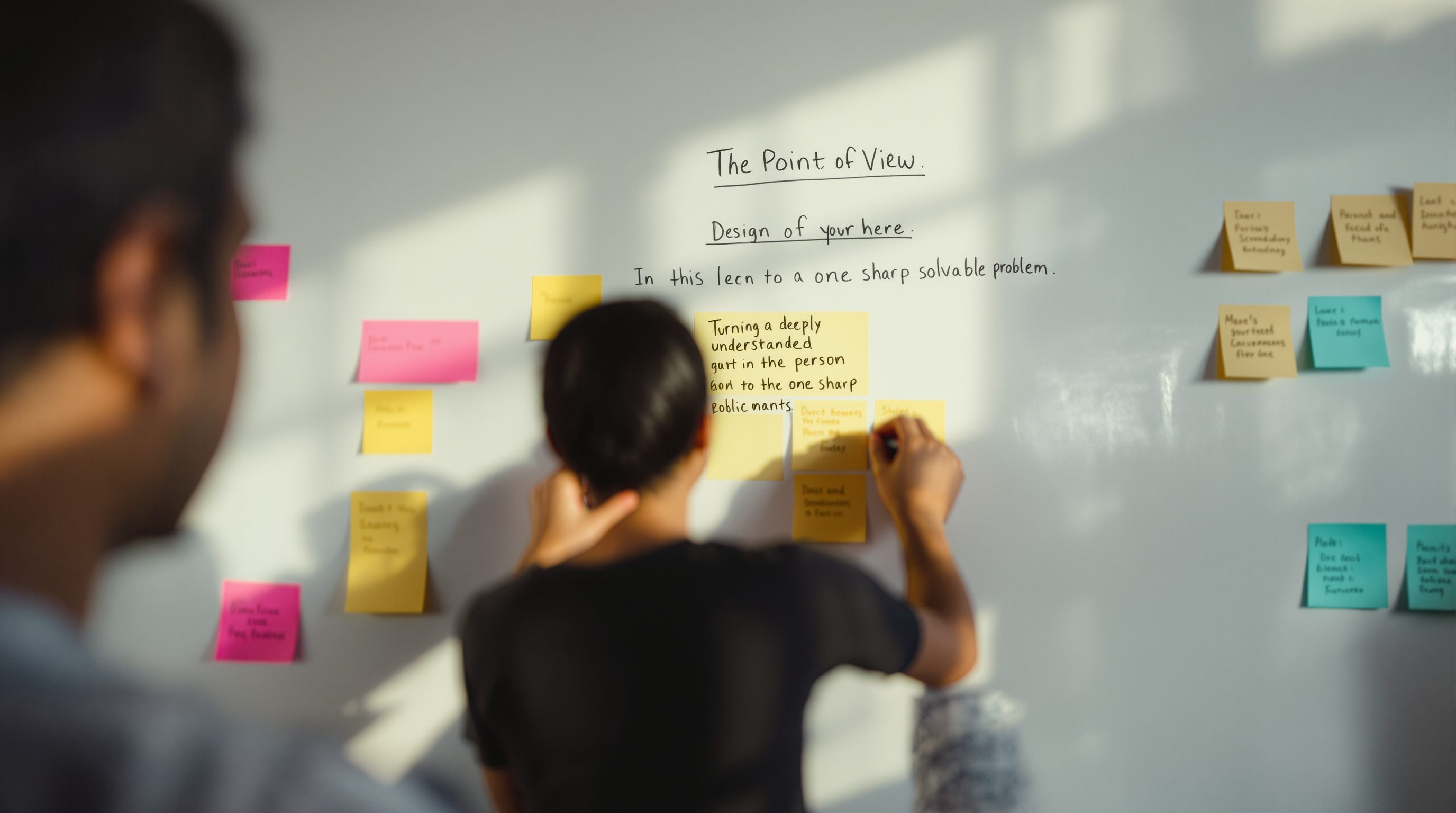
The Point-of-View statement
Turning a deeply understood person into one sharp, solvable problem
The hookTwo designers understand Lakshmi completely. Designer A writes 'design a good 2BHK for the family' — it points nowhere. Designer B writes 'Lakshmi, a visiting mother, needs a dignified space of her own in a home that isn't hers — because she'd rather belong than ask and risk being a burden' — a loaded spring that fires off ideas against your will. The difference between those sentences is this lesson.
The most dangerous gap
Understanding a person is not the same as having a problem to solve. There's a gap between insight and action, and the Define mode bridges it. Define is the first hard convergence: squeeze everything into a single sharp statement of the problem worth solving. The tool is the Point-of-View (POV) statement — and writing it well is half of designing well.
The anatomy: [user] needs [need] because [insight]
The user is specific (from your persona) — 'Lakshmi, a visiting mother' beats 'an elderly user' beats 'the family.' The need is a verb, a goal, never a solution — 'needs a prayer corner' is a solution in disguise; the real need is 'to worship with dignity and privacy,' which opens many answers. The needs come from the gaps in your empathy map. The insight is the surprising, emotional why — the deep driver from the iceberg — 'because she'd rather belong than ask and risk being a burden.' A POV without a real insight is just a task; with one it's a problem you want to solve.
Watch a POV get fixed
First attempt: 'Lakshmi needs a prayer corner because she likes to pray' — the need is a solution, the insight flat. Second: 'Lakshmi needs to worship with dignity and privacy because she likes to pray' — better need, flat insight. Third: 'Lakshmi, a visiting mother, needs to worship with dignity and privacy in a home that isn't hers — because she'd rather feel she belongs than ask for anything and risk being a burden.' Now it's a loaded spring.
Why a sharp POV is a loaded spring
A well-framed POV generates solutions because it contains the shape of its own answers, all serving the same insight ('belong without asking'): a permanent prayer nook (never has to ask), supportive seating (never has to ask for help rising), a space that's hers by default, a kitchen for two. The test of a good POV: does it generate ideas, or just sit there? A vague POV is a dead spring.
Framing beats talent
How you frame a problem determines which solutions you can even see. A brilliant designer working from a badly framed problem produces a brilliant solution to the wrong problem. The POV is how you take control of the frame deliberately, instead of letting the client's casual words frame it by accident.
Test your need against the why/how ladder: if 'why?' climbs to something more fundamental, you were too solution-y; if 'how?' descends to something concrete, you were too vague. The sweet spot is a real goal still spatial enough to design toward. A project has multiple POVs that conflict — name the conflict rather than suppressing it; the collision between two well-framed POVs is your richest problem. And beware the seductive, premature POV — it's a hypothesis, not a verdict, revisable when prototype or test reveals you framed the wrong problem.
1. Take your overlooked inhabitant's persona and the gap you circled in 1.5. Write a first-draft POV: [user] needs [need] because [insight]. Audit in three passes — is the user specific? is the need a verb/goal not a solution? is the insight surprising and emotional? Then test the spring: write three different design ideas it fires off. Can't get three? Reframe until it generates.
Check yourself
3 quick questions — pick an answer to see why.
Q1What is the correct anatomy of a Point-of-View statement?
Q2Why is 'Lakshmi needs a prayer corner' a weak need for a POV?
Q3What is the practical test of a well-framed POV?
Key terms
- Point-of-View (POV) statement
- The Define-mode tool that squeezes a deeply understood person into one sharp, solvable problem using the form [user] needs [need] because [insight].
- Insight
- The surprising, emotional 'why' behind a need — the deep driver that turns a task into a problem worth solving.
- Loaded spring
- A well-framed POV that contains the shape of its own answers and fires off multiple solutions all serving the same insight.
A statement, however sharp, is still closed. How do you turn that problem into an open invitation — a question phrased so it pulls ideas out of you? And what do you do when two POVs collide?
The author
Amogh N P
Architect, interior designer, and creative polymath. Studio Matrx began in his notebooks — his vision of design made honest, useful, and open to everyone. Its Academy is written and taught in his memory, and free, forever.
More about Amogh →