
 Lesson 2.2
Lesson 2.2
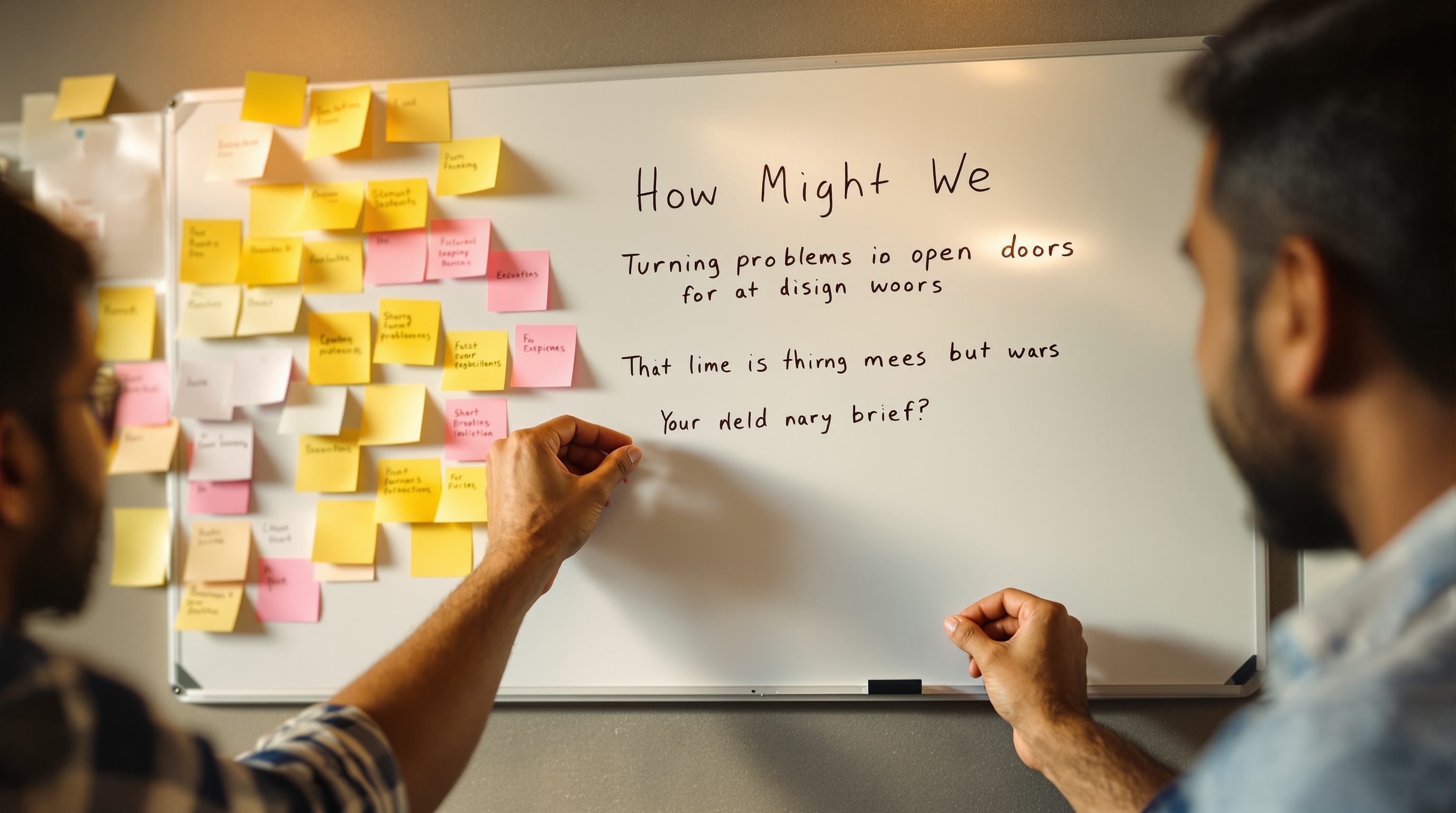
How Might We
Turning problems into open doors
The hookYou have Lakshmi's sharp POV. Why not design now? Because a statement is closed — the mind reads it and looks for the answer. The best design comes from generating many answers first. So you make one grammatical move: 'Lakshmi needs to belong' becomes 'How might we help Lakshmi belong without asking?' Three little words that change a closed problem into an open door.
Why a question beats a statement
A statement invites judgement; a question invites generation. 'How might we...' shifts the mind from judging one solution to producing options. This is the bridge from Define to Ideate: converge to the right problem, then deliberately reopen that specific problem for solutions. Each word does work: 'how' assumes a solution exists and asks for method; 'might' lowers the stakes and gives permission to be wild and imperfect; 'we' makes solving a shared act, not a lone-expert verdict.
The Goldilocks problem: scope
Too broad — 'how might we make Lakshmi happy?' — no traction, every idea is technically on topic so none is aimed. Too narrow — 'how might we fit a prayer shelf in the corner?' — a solution smuggled in, generating trivial variations. Just right — 'how might we give Lakshmi a space that feels her own, without her having to ask?' — tied to the real insight, open enough for many genuinely different solutions, focused enough to aim them. Test: a good HMW lets you generate five genuinely different ideas in a minute.
When two POVs collide
A real home has multiple personas with colliding POVs — Lakshmi needs a calm prayer corner, the teenager a lively study/music space, in the same room. Don't pick a winner; frame the collision as one both/and question: 'how might the same room be a calm retreat for Lakshmi's dawn prayers and a lively space for the teenager in the evening?' The time dimension from the day-in-the-life map dissolves it — Lakshmi prays at dawn, the teenager occupies the evening; a flexible, time-shifting room serves both. The HMW turns an either/or into a both/and, and the both/and is the most interesting design problem in the house.
Generate several HMWs from one POV
From 'belong without asking': how might we give her a space that's hers by default? make her feel like family rather than a guest? let her contribute without being in the way? design for her comfort so she never has to request help? Carry several into Ideate; let them generate from multiple directions.
Vary the HMW's angle deliberately — amplify the good, remove the bad, question an assumption, or use the opposite ('how might we make a shared room feel private — must privacy mean a separate room at all?'). The unexpected angles hide original ideas. The HMW is the last cheap place to change the problem — spend real time getting it right. And resist resolving the collision in the question itself ('how might we add a folding screen...' pre-decides the answer); keep the conflict live and let Ideate find the resolution.
1. Convert your POV to one HMW (check all three words do their job). Test the altitude — can you generate five genuinely different solutions in a minute? Adjust until you can. Generate three more HMWs from the same POV, each a different angle. Then write one collision HMW holding two personas' conflicting needs together without pre-deciding the answer — and notice whether time dissolves the conflict.
Check yourself
3 quick questions — pick an answer to see why.
Q1What does each word in 'How Might We' contribute?
Q2An HMW like 'how might we make Lakshmi happy?' fails because it is:
Q3When two personas' POVs collide, the lesson recommends you:
Key terms
- How Might We (HMW)
- A grammatical move that reopens a closed POV into an open, generative question, bridging Define to Ideate.
- Scope (the Goldilocks problem)
- The craft of pitching an HMW neither too broad nor too narrow, so it can generate five genuinely different but related ideas.
- Both/and question
- An HMW that holds two colliding personas' needs together without choosing a winner, turning an either/or into the richest design problem.
You have a beautifully framed open question. But when you step through it your mind hands you your first idea, and you'll want to grab it. Why is that first idea almost always a trap, and how do you generate the many before you choose the one?
The author
Amogh N P
Architect, interior designer, and creative polymath. Studio Matrx began in his notebooks — his vision of design made honest, useful, and open to everyone. Its Academy is written and taught in his memory, and free, forever.
More about Amogh →