
 Lesson 4.2
Lesson 4.2
Physical prototyping
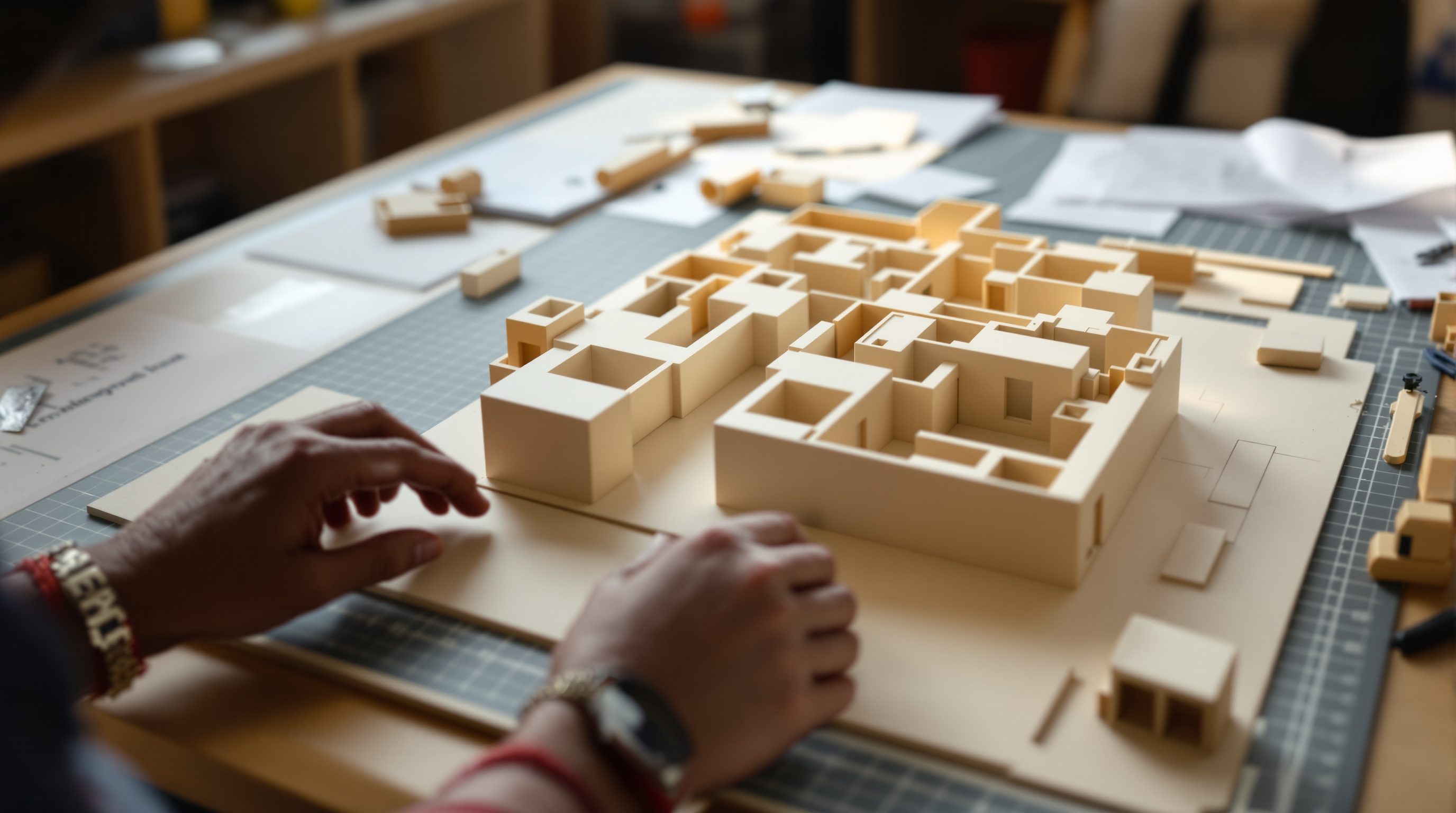
Foam-board massing and paper floor plans at 1:50
The hookA student is sure their layout works — checked carefully on screen. The tutor hands them foam-board: 'build it, at 1:50, in an hour.' Within ten minutes they're frowning — standing inside the little model, eye to the opening, they suddenly see what the screen hid: the sofa wall blocks the path to the balcony, and you squeeze sideways past the dining table to reach the kitchen.
Why physical, in a digital age
Physical models do three things screens struggle with. They force the third dimension to be honest — you walk around, crouch to eye level, look through openings; the cramped corner the screen flattened announces itself. They're honest about roughness — a foam-board model visibly says 'provisional, change me,' inviting the client to physically move a wall. And they engage the body, which notices things the eye misses — your spatial intuition (this feels tight, this feels generous) comes to bear in a way a mouse-click doesn't. Software is superb for the upper rungs; at the bottom, the humble physical model is faster, cheaper, more honest.
The paper floor plan at 1:50
A plan drawn at real, consistent scale that you lay things on and move around. 1:50 means 1cm on paper = 50cm in reality (2cm = a metre). A sketch lies about size — your hand makes the sofa the size you want — but a 1:50 plan forces every element to its true relative size: the sofa either fits the wall or it doesn't, and the paper tells the truth. The power comes from making the furniture movable — cut 1:50 paper rectangles for each piece and slide them around like game pieces, testing ten layouts in ten minutes, every test dimensionally true.
Foam-board massing models
Some questions live in the third dimension — height, volume, proportion, feel. Build the building's masses as simple blocks and planes from foam-board (cheap, easy to cut, stands on its own, fast to reassemble). You're modelling bulk and arrangement, not the finished building. What it reveals that the plan cannot: vertical relationships and spatial feel — does the double-height void make the small room feel generous or wasteful; does the loft make the space below feel sheltered or oppressive. Keep massing models monochrome and rough — detail pretends the design is more decided than it is.
Physical models invite others in
Most clients can't read a floor plan — to them it's an abstract puzzle of lines. But a physical model they understand instantly; they look into it, point, say 'the kitchen feels small.' The model becomes a conversation tool that lets the client — including the overlooked Lakshmi — participate directly and catch desirability problems early. Empathy and prototyping fuse: you test the design and deepen your understanding of the people in the same five minutes.
Getting your eye to the model's scale is a learnable technique — beginners look down at a massing model like a god surveying a plan, which tells you about arrangement but nothing about experience; lower your eye to the model's ground and look horizontally through the openings, and the cramped-corner and blocked-sightline flaws reveal themselves. The most valuable prototype is sometimes 1:1, not 1:50 — for a specific ergonomic question ('is this passage too narrow?'), tape the plan out on the floor at full size and walk through it; your body tells the truth instantly, and it costs nothing. And physical and digital are partners up the ladder, not rivals — use cheap physical models at the bottom to lock down concept, arrangement, fit, and proportion, then take the de-risked design into software for precision and the walkthrough.
1. Draw your plan at 1:50 (2cm = 1 metre) with door swings and windows. Cut true-scale furniture rectangles and slide them around — find one arrangement that doesn't fit, and notice the paper told you so. Build a rough white massing model of your most three-dimensional idea. Lower your eye to its ground and look through it — write down one thing you perceived about the space's feel that the flat plan never told you.
Check yourself
3 quick questions — pick an answer to see why.
Q1What three things do physical models do that screens struggle with?
Q2At 1:50 scale, how much paper represents one metre in reality?
Q3When reading a foam-board model, what reveals cramped corners and blocked sightlines?
Key terms
- 1:50 paper plan
- A floor plan drawn at consistent real scale (1cm = 50cm) on which true-scale furniture cut-outs are slid around, so the paper can't lie about fit.
- Foam-board massing model
- A cheap monochrome model of a building's bulk and arrangement built as simple blocks, used to test vertical relationships, volume, and spatial feel.
- 1:1 prototype
- Testing an ergonomic question by taping the plan out at full size on the floor and walking through it, so the body tells the truth instantly.
Renders and models show space. But there's a tool that's genuinely new: AI that generates a photorealistic room in seconds. How do you use digital and AI prototyping well — harnessing their speed without falling for their seductive polish?
The author
Amogh N P
Architect, interior designer, and creative polymath. Studio Matrx began in his notebooks — his vision of design made honest, useful, and open to everyone. Its Academy is written and taught in his memory, and free, forever.
More about Amogh →