
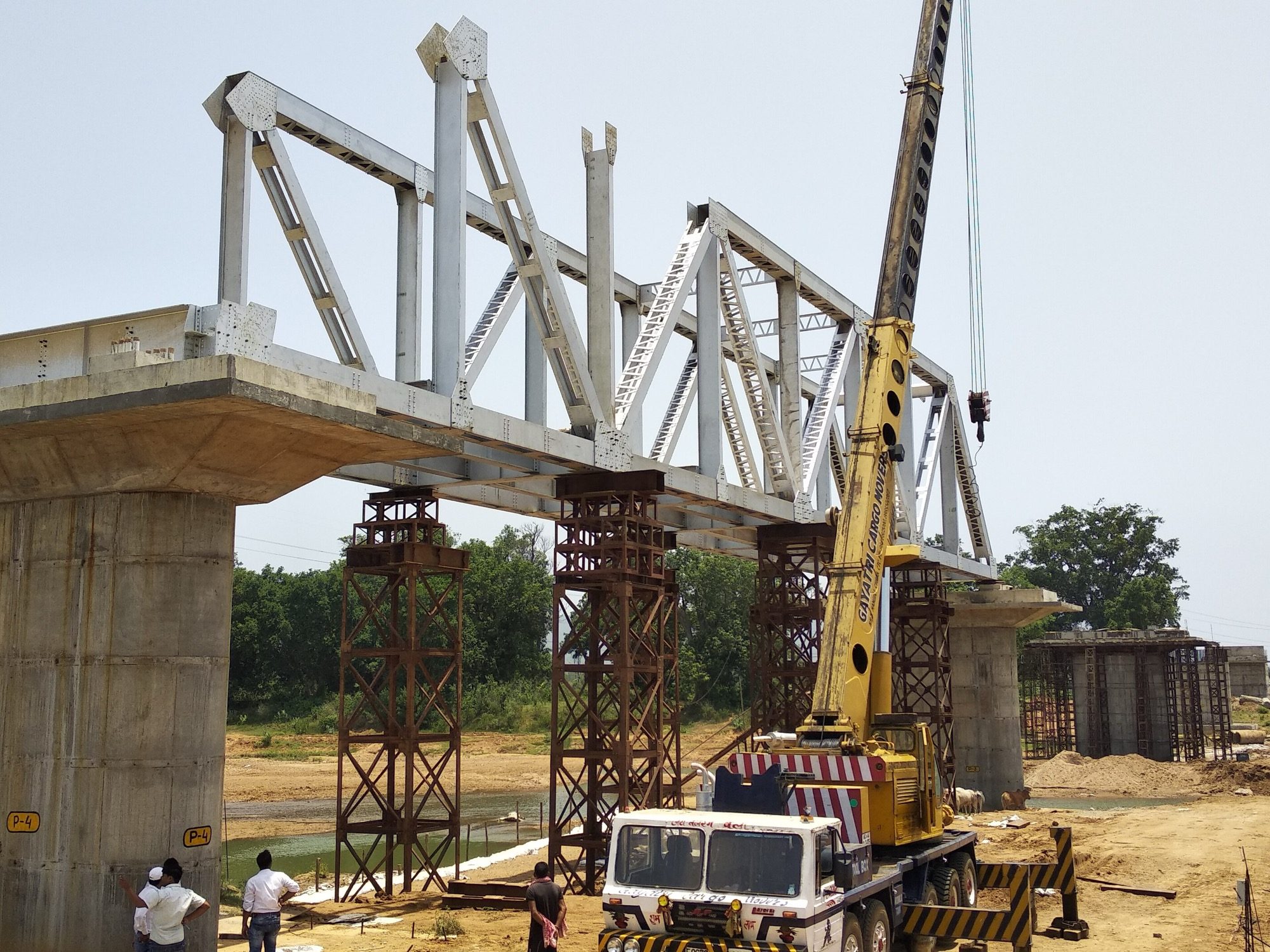
Steel Sections & Welded Joints
The material, the rolled sections, the limit-state idea — and the fillet weld.
Steel is the most predictable structural material — it has a sharp, well-defined yield point and a long ductile plateau, which is exactly what lets us design it by the Limit State Method. This opening unit lays the groundwork: what structural steel is, the standard rolled sections you will size, the two partial safety factors that separate the steel code from the old working-stress method, and the first real design problem — the fillet weld.
Learning objectives
By the end of this lesson, you will be able to — mapped to the course outcomes for Design of Structures I:
State the properties of structural steel (fy, fu, E) and read the ductile stress–strain curve.
Identify the standard IS rolled sections and where SP 6 tabulates their properties.
Explain the Limit State Method and the role of the partial safety factors γf, γm0 and γm1.
Design a fillet weld — size the leg, find the effective throat and length, and compute its capacity.
The material and the sections
Structural steel (IS 2062 E250/Fe410) has fy = 250 and fu = 410 MPa; its ductile stress–strain curve is the reason limit-state design works. The hot-rolled sections — ISMB, ISMC, ISA, ISHB — are tabulated in SP 6.[1, 4]
Structural steel (IS 2062)
The standard structural grade is E250 (old designation Fe410): minimum yield fy = 250 MPa, ultimate fu = 410 MPa, modulus of elasticity E = 2.0×10⁵ MPa, Poisson's ratio 0.3, density 7850 kg/m³. Higher grades (E300, E350, E410) trade ductility for strength. Each grade has qualities A/B/C by Charpy impact. fy reduces with plate thickness.[1, 4]
Limit state, and the fillet weld
Limit State Design applies separate factors to loads (γf) and material (γm0 = 1.10 for yielding, γm1 = 1.25 for rupture). A fillet weld is then sized by its throat: te = 0.7s, and — because it works in shear on that throat — its strength is fu/(√3·γmw).[1]
Two families of limit states
Limit State Design checks the limit state of strength (yielding, rupture, buckling — i.e. safety/collapse) and the limit state of serviceability (deflection, vibration, durability). It applies separate partial safety factors to loads (γf, e.g. 1.5 on dead+live) and to material resistance (γm), unlike the single global factor of the old working-stress method.[1]
Fillet-weld calculator
Set the leg size, length and weld type and read the throat, design stress and capacity. A 6 mm shop weld 200 mm long carries about 150 kN.[1]
Fillet weld · design strength
te = 0.7s; fwd = fu/(√3·γmw) (shear on the throat); effective length = L − 2s. Fe410, fu = 410 MPa.
0.0 kN
Weld capacity
0.0 mm
Effective throat te
0 MPa
Design stress fwd
0 N/mm
Strength / mm
0 mm
Effective length
The √3 is because a fillet weld is checked in shear on its throat plane.
At a glance
| Aspect | One | The other |
|---|---|---|
| Design philosophy | Limit State: separate γf (loads) and γm (material), checks strength + serviceability | Working stress: one global factor of safety, elastic only |
| Two material factors | γm0 = 1.10 — yielding / buckling | γm1 = 1.25 — ultimate / rupture |
| Two weld factors | Shop weld γmw = 1.25 | Site weld γmw = 1.50 (poorer field quality) |
| Two weld types | Fillet — shear on throat → fu/(√3·γmw) | Butt — direct stress → no √3 |
| Leg vs throat | Leg size s — the nominal weld size | Effective throat te = 0.7·s — used in design |
Key terms
Characteristic yield (250 MPa) and ultimate tensile (410 MPa) strength of Fe410/E250 steel.
Partial safety factor on resistance governed by yielding or buckling.
Partial safety factor on resistance governed by ultimate stress / rupture.
Weld material factor — 1.25 for shop welds, 1.50 for site (field) welds.
The nominal weld size, measured along each fusion face of a fillet weld.
The design thickness of a fillet weld; te = 0.7·s for a 60–90° fillet.
Load-carrying weld length = actual length − 2s; must be ≥ 4s.
The ISI Handbook for Structural Engineers — tabulates the properties of IS rolled sections.
Worked example
Design a shop fillet weld, 6 mm leg, 200 mm long, Fe410. te = 0.7×6 = 4.2 mm; fwd = 410/(√3×1.25) = 189.4 MPa; strength per mm = 4.2×189.4 = 795 N/mm; effective length = 200 − 12 = 188 mm; capacity = 795×188 ≈ 149.5 kN. Re-run it in the calculator as a site weld and note the ~17% drop.
Self-assessment
1. The effective throat thickness of a 10 mm fillet weld (90° fusion) is —
2. In IS 800:2007 the partial safety factor for resistance governed by rupture (ultimate) is —
3. The √3 in the fillet-weld design stress fwd = fu/(√3·γmw) appears because the throat is checked in —
Recap
References & further reading
- [1]IS 800:2007 — General Construction in Steel, Code of Practice (3rd rev.). Bureau of Indian Standards, New Delhi. (Tables 4, 5, 21; cl. 5, 10.5.)
- [2]SP 6 (Part 1) — ISI Handbook for Structural Engineers: Structural Steel Sections. Bureau of Indian Standards.
- [3]N. Subramanian, Design of Steel Structures (2nd ed.). New Delhi: Oxford University Press, 2016.
- [4]IS 2062:2011 — Hot Rolled Medium and High Tensile Structural Steel, Specification. Bureau of Indian Standards.
- [5]S.K. Duggal, Limit State Design of Steel Structures (2nd ed.). McGraw-Hill Education, 2014.
- [6]IS 808:1989 — Dimensions for Hot Rolled Steel Beam, Column, Channel and Angle Sections. Bureau of Indian Standards.
Further reading
- N. Subramanian, Design of Steel Structures — the comprehensive reference for this course.
- S.K. Duggal, Limit State Design of Steel Structures.
- M.R. Shiyekar, Limit State Design in Structural Steel. PHI Learning.
Sources gathered and fact-checked June 2026. Published values vary by source, sample and method — treat as indicative and confirm against the cited standard before structural use.
The author
Amogh N P
Architect, interior designer, and creative polymath. Studio Matrx began in his notebooks — his vision of design made honest, useful, and open to everyone. Its Academy is written and taught in his memory, and free, forever.
More about Amogh →