
 Lesson 7.3
Lesson 7.3 · Putting It Together (Capstone)
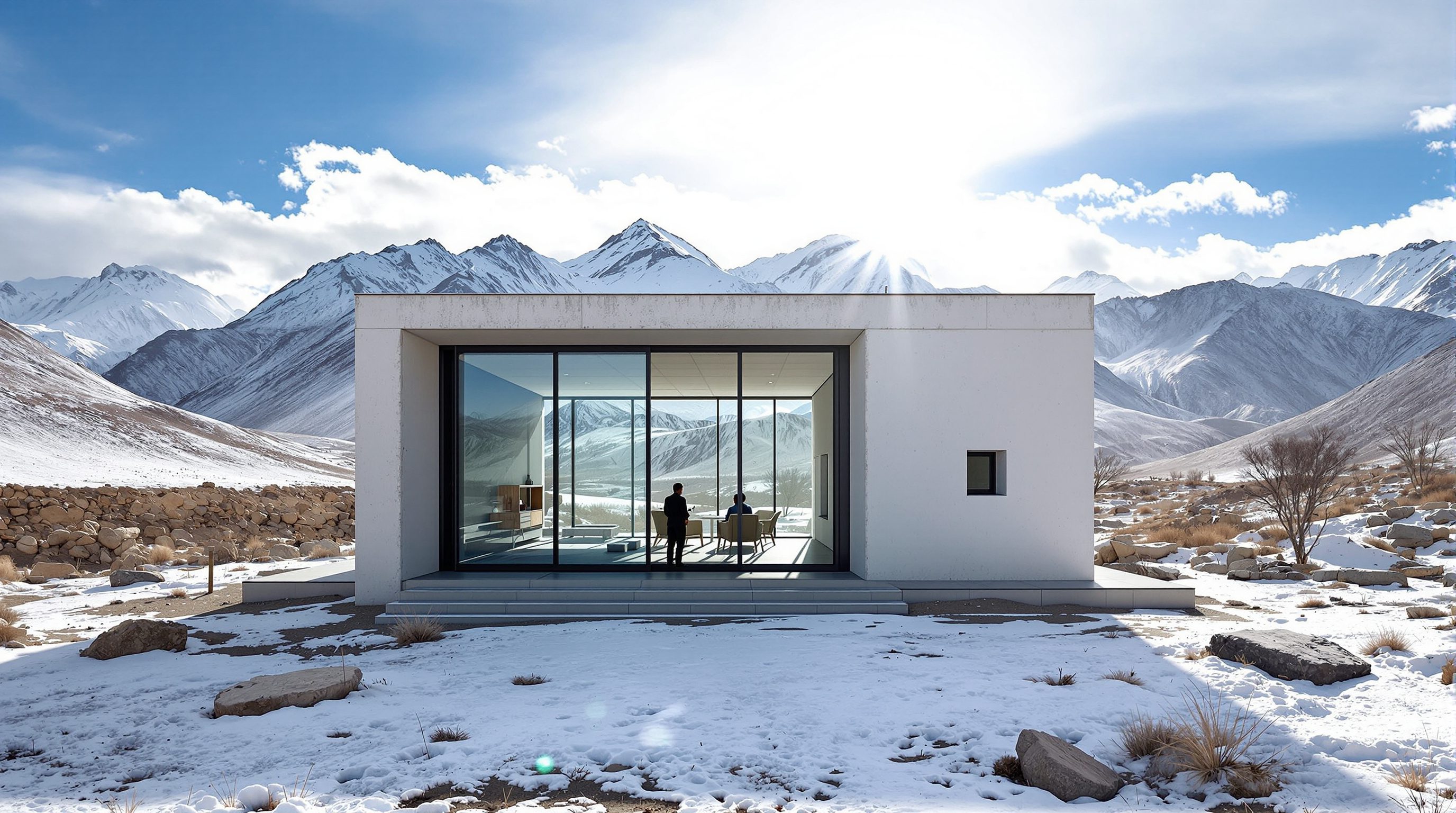
Leh: A Cold House
At 3,500 m in the cold desert, every hot-climate instinct reverses: catch the sun and keep the heat in.
The sun is no longer the enemy — it is the saviour
We've fought heat in three forms — composite Hubballi, relentless-wet Kochi — and now meet its opposite. Leh sits at 3,500 m on a high desert plateau in the Himalayan rain shadow, and here the whole logic inverts. Winter nights plunge to ~-20°C and the temperature barely climbs above freezing for months; the air is astonishingly dry (humidity in single digits); the day-night swing is enormous. For the first time, the sun is not the enemy but the saviour — and what a sun: Leh enjoys 300+ clear days a year and one of the highest solar resources in the inhabited world.
So every reflex reverses. Where the hot-climate house excluded the sun, the Leh house chases every ray. Where Kochi banished mass, Leh hoards it — not to store coolness now, but the sun's warmth against the brutal night. Where Kochi opened to the breeze, Leh seals tight against a wind that would steal its hard-won heat. The single law is Kochi's mirror image: catch the sun, and keep the heat in.
Mass: hero in the desert, villain on the coast, hero again in the cold. The sky decides — every time.
The brief from nature is the photographic negative
Leh is defined by cold and sun in equal measure — a punishing winter bathed in extraordinary solar abundance. Its winter days hover around 2°C while nights fall to roughly -20°C, with only a brief mild summer; the goal here is heating, not cooling, so the building's job is to hold heat in. It sees 300+ clear days a year and around 6 kWh/m²/day of solar resource, among the world's highest — so the design must capture the sun aggressively as free heat. The diurnal swing is huge, often more than 20°C between sun-blasted day and frigid night, which means the day's solar gain must be stored in mass to survive the dark. And the air is bone dry (RH 6–24%) with almost no rain or snow, so there is no monsoon or mould worry at all — the sole enemy is cold.
The brief from nature is the photographic negative of everything before: harvest the powerful winter sun, store its warmth in heavy mass, and seal the house against heat loss to the bitter cold. This is the pure cold-climate logic of Module 5 — and mass, the villain of Kochi, is the hero again, for a brand-new reason. In the desert it stored *coolness* for the hot day; in Leh it stores the *sun's heat* for the freezing night. Same material, third distinct job, chosen by the sky.
Every hot-climate instinct reverses. The sun goes from exclude to capture via south glass; mass from banish (or store coolness) to store solar heat; the envelope from open-to-breeze to sealed-against-wind; the form from spread-out to compact, minimal-surface; and glazing from minimise-and-shade to maximise-on-south-and-insulate-at-night.
The brief: a family in a Leh village living a traditional Ladakhi life; a compact home of about 90 m² with a living/kitchen core, beds and a store; winter-survivable without grid heat; an open plateau with an unobstructed south horizon and a cold N/NW wind; a modest budget and passive solar; staying warm through a -20°C winter using the sun, not firewood.
Kochi banished the sun and the mass. Leh chases both. Same method — the sky flipped the sign.
Step 2 — the seven decisions, reversed
The method holds; the answers complete their inversion — and what they assemble is the Ladakhi solar house, almost exactly what traditional builders and modern passive-solar projects in the region arrived at.
First, orient the long face due south and put the main living rooms on it — where the hot-climate house shaded the sun and faced away (1.1, 5.1). Second, keep the plan compact and deep, minimum surface for the volume, against the dry house's spread-out open court (5.2). Third, give the south a large glazed face for the low winter sun and keep the N/E/W windows tiny, inverting the rule to minimise and shade glazing (5.1, 6.3). Fourth, load heavy internal mass plus a Trombe wall to store the day's solar heat, where the coast banished mass and the desert shaded it (5.3, 4.3). Fifth, insulate aggressively everywhere and add night shutters over the glass, where the hot house let heat escape and ventilated freely (5.2). Sixth, seal against air leakage and add a buffer/sunspace porch on the south, against the open-to-the-breeze instinct (5.2, 5.3). Seventh, tuck the house low against the wind with a sheltered lee-side entry, where the warm-humid house caught the breeze and rose off the ground (1.5, 5.2).
This is the traditional Ladakhi house rediscovered: south-facing, compact, thick-walled, small-windowed except to the south, with a glazed sunspace — the *rabsal* — trapping the day's heat. Modern passive-solar homes in Ladakh carry families through a -20°C winter with little or no purchased fuel. The vernacular, once again, had already solved it.
Mass has now played three roles across our three houses — storing coolness in the hot-dry desert, becoming a liability on the humid coast, and storing solar heat in the cold desert. Perfect proof of the course's thesis: a material is neither good nor bad in itself; only the sky decides what job it does, or whether it has one.
Same seven steps as Hubballi and Kochi. Every answer flips. The method is the constant; the climate is the variable.
Step 3 — one job: survive the night
Where Hubballi switched across seasons and Kochi persisted against one condition, the Leh house has a single dramatic daily task: capture enough of the day's sun to survive the night.
Its deep-winter 24-hour cycle runs in three acts. On a sunny day, with only ~2°C outside, the low winter sun pours through the big south glass and the sunspace, strikes the heavy floor and the Trombe wall which soak up the heat, and the room warms well above freezing. At dusk, shutters and insulated curtains close over the glazing to stop the day's gains escaping back out through the cold glass, and the sunspace becomes a thermal buffer. Then through the frigid night, with ~-20°C outside, the charged mass and Trombe wall release their stored solar heat slowly into the rooms, riding the family to dawn, while the tight, heavily-insulated envelope lets that heat go only slowly.
It is the desert's day-night mass cycle (2.1) run in reverse: there the mass discharged *coolness* into the hot evening; here it discharges *warmth* into the frozen night. Same time-lag physics, storing the resource the climate gives by day to spend it when the climate turns hostile — only the sign has flipped.
Charge by day, coast through the night. The desert cycle exactly — with the sign reversed.
Three altitudes on the same idea
Read the band that fits you — or all three.
In Ladakh the sun is your fuel and the walls are your battery. Face your main rooms and biggest windows due south to catch the winter sun; keep the north, east and west windows small. Build heavy inside — thick walls, solid floors — so the mass soaks up the day's sunshine and gives it back at night, and insulate the outside of those walls and the roof as heavily as you can. Add a glazed sun-porch — a *rabsal* — on the south, and shutters or thick curtains to close over the glass at dusk so the day's warmth doesn't leak away. Done well, the sun alone keeps you warm through a Ladakhi winter — as traditional homes have always known.
Design for solar capture and heat retention together. Orient the long axis E–W so the major façade faces true south; concentrate glazing there, sized for winter sun and daylight, and minimise it elsewhere (5.1, 6.3). Provide direct-gain mass — an exposed floor slab, internal masonry — and consider a Trombe wall or attached sunspace/rabsal for time-lagged delivery (5.3). Insulate aggressively, with high R-value walls, roof and floor, and detail for airtightness; movable night insulation over the glazing is critical, since the south glass that gains by day loses heavily by night. Validate against the ENS Cold-zone path: the one zone where the envelope (except the roof) is judged by a U-value limit (at or below 1.8) rather than the RETV (6.2) — because here the logic genuinely is to stop heat escaping. Account for high-altitude UV and freeze-thaw.
Weigh the two competing flows. Solar gain (5.1): a south vertical window in Leh's clear winter gets ~4 kWh/m² on a sunny day; with 6 m² at SHGC ~= 0.7, Q_gain = 6 * 0.7 * 4 ~= 16.8 kWh/day — like a 2 kW heater running over 8 hours. Heat loss (5.2): the indoor-outdoor difference is savage — 18°C inside against -20°C is dT = 38°C — so Q_loss = sum of U*A*dT is large unless the U-values are driven right down.
This is why the two Module 5 strategies are inseparable here: the solar gain only wins if the insulation makes the heat stay. A leaky single-glazed box loses the day's 16.8 kWh almost as fast as it gains it; a compact, heavily-insulated, sealed envelope with night shutters holds it, coasting the house to morning. The arithmetic states the cold-climate creed exactly: capture aggressively (south glass, mass) and conserve ruthlessly (insulation, airtightness, night insulation) — gain and retention as one, the mirror image of the hot-climate exclude-and-ventilate.
“Big windows are the enemy in a harsh climate — to stay warm in Leh you should make all the windows small.”
Run the method yourself
Step the design-decision walkthrough one last time, and watch every hot-climate instinct turn over.
- 1Step the walkthrough and, at each decision, name the hot-climate instinct it reverses and why the cold flips it.
- 2Mass has now done three jobs across Hubballi, Kochi and Leh. State each, and the single climatic factor that assigns it.
- 3Compute the daily solar gain for 8 m² of south glass at SHGC 0.6 receiving 4.2 kWh/m². How many hours of a 2 kW heater is that? (~20 kWh, ~10 h.)
- 4Explain why the cold zone is the one place the ENS judges the envelope by a U-value instead of the RETV.
↳ Use the worksheet below to record your answers.
Take it with you
The course completes its arc by inverting it
Three houses, three climates, one method — and now the method itself steps forward. We designed Hubballi, Kochi and Leh by the same underlying process: read the site, derive the brief, sequence the decisions. The next lesson distils that process into a climate self-audit framework — a repeatable, site-agnostic procedure you can point at *any* plot of earth, anywhere, to read its climate and reason out its building. The worked examples become a tool you can carry to a site you have never seen.
The author
Amogh N P
Architect, interior designer, and creative polymath. Studio Matrx began in his notebooks — his vision of design made honest, useful, and open to everyone. Its Academy is written and taught in his memory, and free, forever.
More about Amogh →