
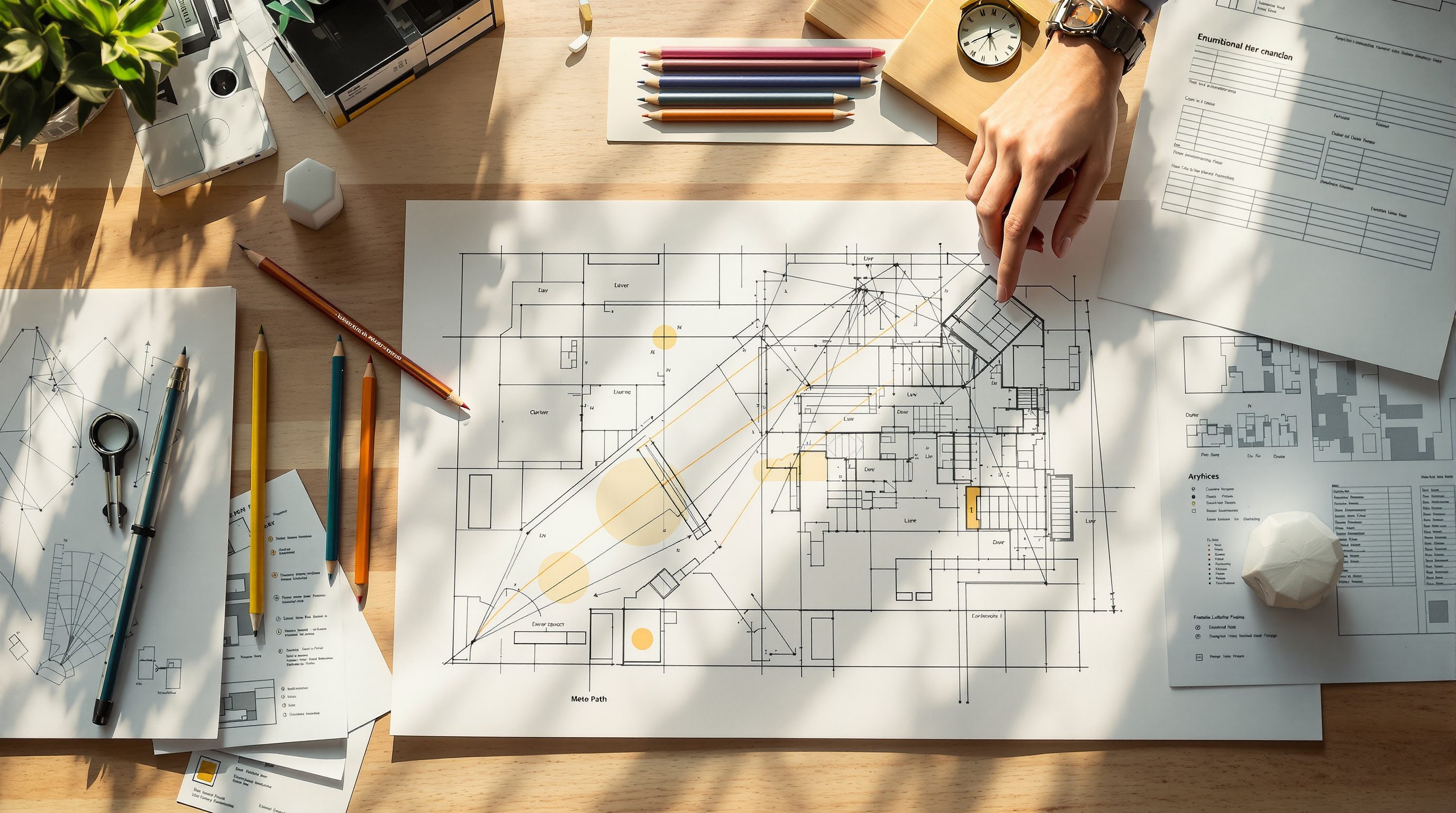
 Lesson 7.4
Lesson 7.4 · Putting It Together (Capstone)
The Climate Self-Audit Framework
One repeatable method, small enough to carry in your head to a site you have never seen.
Three houses, one method walked three times
Hubballi, Kochi and Leh looked like three different journeys — but they were one journey walked three times. Each began by reading the sky, turned that reading into a short list of jobs the building had to do, then sequenced a chain of decisions to do them, checking against the code. The houses came out utterly different because the skies differed. The *method* never changed. A worked example only helps on the site it was worked for; a method helps everywhere. This lesson hands you the method.
A worked example helps on one site. A method helps everywhere. Carry the method.
The framework: five steps that never change
Every climate-responsive design — desert, coast or frozen plateau — runs the same five steps. The answers change with the site; the steps never do.
1. Read the climate. Gather the handful of numbers that decide everything: temperature range and how hot or cold it gets, the diurnal swing, humidity, rainfall, the sun (how much, from where, when) and the prevailing wind. Use station data, a psychrometric or bioclimatic chart, degree-days. Ask: is the problem heat, cold, wet, or a mix — and does it change by season?
2. Classify and derive the brief. Place the site in a climate type — hot-dry, warm-humid, composite, cold, temperate — and write the short list of jobs the building must do, the brief nature hands you. Ask: what must this building DO — exclude heat? catch breeze? capture sun? shed rain? all at once?
3. Decide the big moves, in order. Sequence the chain — orientation, then form, then the ventilation-or-sealing decision, then mass, then shading and glazing, then roof, then rain and damp detailing. Each follows from the last. Ask: where does the sun go, where does the air go, where does the mass go?
4. Quantify and check. Put numbers on the key moves — U-values, RETV or cold-zone U, solar gain, roof load — and validate against the Eco-Niwas Samhita and the adaptive comfort band. Ask: do the numbers confirm the intuition, and does it meet the code as a by-product?
5. Cross-check the vernacular. Look at how buildings were traditionally made in this exact place, before machines. Agreement is powerful confirmation; a difference is a flag to investigate before you trust the new idea.
Step 5 is the humility check. Three times our from-scratch reasoning landed on the local vernacular. When your clever modern idea disagrees with it, the vernacular is usually right and you've missed something.
Run it on your own site
The audit is not a lecture to absorb — it is a procedure to perform. Choose what your site's climate is actually like and watch the framework read it, classify it, and assemble the passive strategy, the same logic that built our three houses.
This is the most valuable thing the course can give you, because it makes the knowledge portable. You no longer depend on worked examples — you carry the method that makes them. Run it on the place you live, then on a climate the course never named. The framework will hold, because the physics is the same everywhere; only the sky changes.
The whole course folded into a tool small enough to carry in your head.
Six questions the steps reduce to
The framework works because each step is really a single decisive question, and the answers chain. Stripped right down, the entire course reduces to six.
Is the enemy heat, cold, or wet — and does it change by season? That decides everything downstream. What must the building DO? That decides the strategy. Is there a cool (or warm) period to store mass FOR? That decides whether mass is hero or villain. Do I want the outside air IN (breeze) or OUT (sealed)? That decides open versus sealed envelope. Do I want the sun IN (capture) or OUT (exclude)? That decides glazing and shading. How much rain must I shed, and is ground damp a threat? That decides roof form and plinth.
The most powerful is the mass question, because it caught us out three times. Mass only earns its place if the climate gives a period — a cool night, or a warm sunny day — whose temperature the mass can store and release later. Ask "store *for* what?" and the answer tells you instantly whether mass is hero (desert, cold) or villain (humid coast). Every hard call in the course collapses to one of these six questions, which is why the framework travels anywhere.
Three altitudes on the same idea
Read the band that fits you — or all three.
You can run a simple version of this before you ever meet an architect. Notice your site's climate honestly: is it the heat that's the problem, the cold, or the damp? Do nights cool down or stay warm? Is the air dry or muggy? How hard does it rain? Those answers point you at the right instincts — breeze and light construction for muggy heat, mass and night-cooling where nights are cool, sun-capture and insulation where it's cold. Then look at the oldest houses in your area: they usually encode the right answer already. You don't need the maths for the big moves — you need to read your sky honestly and respect what local builders learned.
Adopt this as a standard pre-design ritual on every project, before any form-making. Assemble the climate data — TMY or station data, psychrometric and bioclimatic analysis, degree-days, sun path, wind rose — classify the zone, and write the explicit brief of climatic jobs. Sequence the passive moves and only then begin massing: climate leads form, not the reverse. Quantify against the Eco-Niwas Samhita and adaptive comfort early so compliance is designed-in rather than retrofitted. Always run the vernacular cross-check. Document the audit as a one-page record in the project file — it disciplines the team, justifies the design to clients, and is the single habit most likely to keep buildings climate-responsive under deadline pressure.
The audit can be written as an explicit decision tree, which is exactly what the tool runs. The trunk is the heat-vs-cold split; the branches are swing, humidity, rain and seasonality. IF cold -> capture sun + mass + heavy insulation + seal + compact. ELSE (heat): IF big swing + dry -> mass + night flush + shade + courtyard (hot-dry); IF small swing + humid -> lightweight + max ventilation + raise + deep shade (warm-humid); IF distinct seasons -> a switching building combining the above (composite). THEN all paths converge: shed the rain per its intensity, tame the roof always, and check against the ENS. Trace the three houses through it: Leh exits at the first branch; Kochi at "small swing + humid"; Hubballi at "distinct seasons". The tree is not a rote lookup — the real skill is reading the climate accurately at the top and resolving contradictions — but it shows the whole course is a finite, learnable procedure, not an art reserved for the gifted. Read the inputs honestly and the strategy follows; that is what makes climate-responsive design teachable and portable.
“Now that I have the rules, I can skip the climate reading and just apply the standard answer for the climate type.”
Run the method yourself
Run the framework yourself — once on home ground, once on a climate this course never named.
- 1Run the audit tool for the place you live. Does its verdict match how local buildings — old and new — actually behave?
- 2Take a climate this course never covered (a temperate hill station, or a hot-dry coast) and run all five steps on it from scratch.
- 3Find two cities of the same climate "type" that would still need different buildings. What specific readings separate them?
- 4Write the five-step audit for your own current or dream project as a one-page document, ending with the vernacular cross-check.
↳ Use the worksheet below to record your answers.
Take it with you
The method, not the examples
You now hold the method, not just the examples — the ability to walk onto any site and reason from its sky to its building. The final lesson steps back from technique entirely to ask the longer question: how do you keep doing this, well, for thirty years? How does climate-responsive thinking become not a checklist you consult but an instinct you carry — a permanent habit that shapes every project and quietly makes the built environment a little better, one design at a time? The course closes not with a technique but with a practice.
The author
Amogh N P
Architect, interior designer, and creative polymath. Studio Matrx began in his notebooks — his vision of design made honest, useful, and open to everyone. Its Academy is written and taught in his memory, and free, forever.
More about Amogh →