
 Lesson 4.2
Lesson 4.2 · Composite and Temperate Strategies
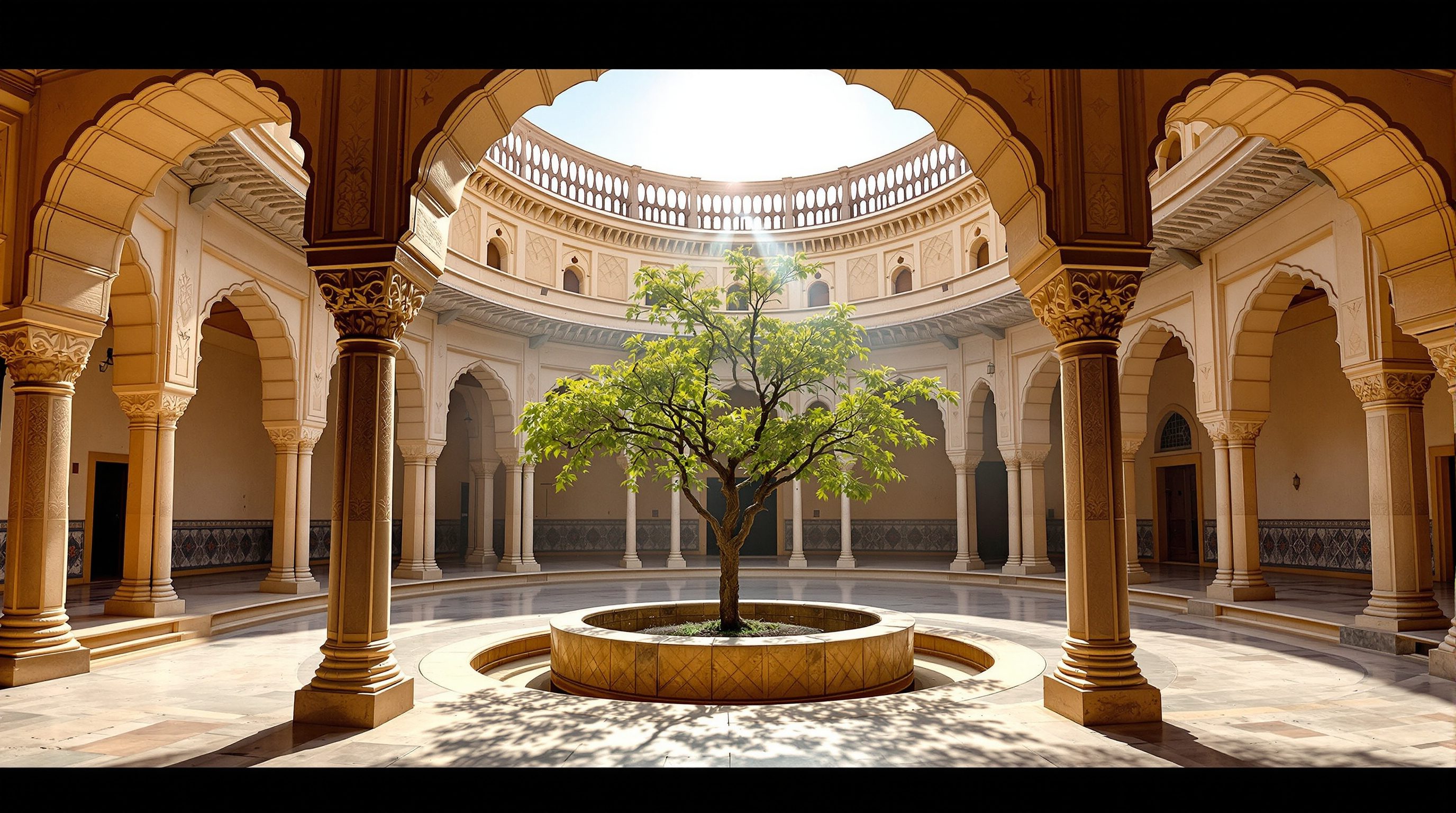
The Courtyard as Year-Round Mediator
One unchanging void that is a cool well in summer, a chimney in the monsoon, and a sun-trap in winter.
One void, four jobs — and the seasons throw the switch
A switching building (4.1) needs elements that play several roles, and the courtyard is the supreme example — which is why it sits at the heart of the haveli across the composite belt, from Jaisalmer to Lucknow to Ahmedabad. The same unchanged void behaves completely differently as the year turns: a blazing dry summer makes it a deep, shaded cool-air well; the monsoon turns it into a vertical chimney driving ventilation; winter fills it with low sun that warms the rooms; and the mild months make it the loveliest room in the house. One element, four jobs, no moving parts — the switch is performed by the sun and the season, not the occupant.
Same walls all year. Summer shades, monsoon vents, winter warms — the courtyard is a climate machine with the seasons for controls.
One geometry, four seasons
The same geometry produces the right effect each season because the sun's height and the air's character do the switching for it.
In the hot-dry summer the court is a cool shaded well: its deep proportion keeps the floor in shadow and it pools the cool, dense night air exactly as the hot-dry chowk did (2.2). In the humid monsoon it becomes a ventilation chimney — warm air rises out of the open top and pulls a cross-flow through the rooms, the stack effect borrowed straight from Module 3 (3.1). In winter the very same void turns into a sun-trap: the low winter sun reaches all the way to the floor, warming the mass and the rooms around it. And in the mild months of October and March it is simply the best room in the house — open, comfortable, the social heart of the plan.
Summer and winter both rely on Lesson 1.1: the sun is high in summer, so a deep court stays shaded, and low in winter, so it slips past the same walls to reach the floor. The court does not change — the sun changes for it. The single void contains the whole course. The courtyard house is the original switching building, a climate machine whose controls are the seasons; the haveli was passive automation centuries before the word existed.
The four-season courtyard — a reusable instrument
Picture one courtyard section held perfectly still while the simulator steps it through summer, monsoon, winter and mild. The walls never move, but the sun angle, the shade line, the airflow and the warmth all change as the season switches around them.
Step into summer and a near-overhead sun is shut out of the floor, while a blue arrow shows cool night air sinking into the rooms. Switch to monsoon and the arrow reverses and climbs — warm air streaming up and out of the open top, dragging a cross-breeze behind it. Switch to winter and a low, slanting sunbeam reaches all the way to the floor, lighting up the mass it will warm. Switch to mild and the court simply opens, comfortable and unforced.
This is not a one-lesson toy. The same instrument makes the abstract claim of the whole module concrete: that one fixed element can be tuned to do opposite jobs in opposite seasons, because the climate — not a mechanism — performs the switch.
The walls stay put; the sun and the season throw the switch. One section, four jobs.
Designing one court for all seasons
Proportions and details must let the seasons do the switching. The court needs to be deep enough to exclude the high summer sun from the floor, yet open enough to admit the low winter sun — an H:W set by the latitude's solstice angles from Lesson 1.1. It wants low room-to-court openings so summer night air can pool and feed the rooms, and a tall, open section so the monsoon stack can drive ventilation. One fixed geometry, asked to satisfy two suns and two air regimes at once.
Onto that fixed geometry you then layer light seasonal adjustability. A retractable shade or vela can be drawn across the open top for the few hottest weeks and removed the rest of the year. Planting or a water feature adds evaporative relief in the dry months — but it must be controllable, or it will raise humidity in the monsoon when you least want it. Rain closures keep the worst of the monsoon out of the void without sealing it.
This is the composite move in miniature: design the unchanging form for the average of the year, then give the occupant a few simple controls to handle the extremes — exactly the operability that defines a switching building.
Three altitudes on the same idea
Read the band that fits you — or all three.
A central courtyard or light-well is among the best moves you can make in a composite home: it brings daylight and fresh air right into the middle of the plan, and with the right proportions it looks after you in every season — shaded and cool in summer, breezy in the monsoon, and sunny and warm in winter. A water feature or some planting helps cool it through the dry months, and a retractable cover handles the few hottest weeks. Treat it as the year-round heart of family life, not a decorative gap — it is the one element that earns its keep in all four seasons at once.
Proportion the court to the site latitude so the summer noon sun is excluded from the floor while the winter noon sun penetrates (the 1.1 solstice altitudes). Detail low room-to-court openings for night-air pooling and a tall open section for the monsoon stack. Provide a retractable shade or vela and a rain-closure for the open top, and use water or planting for dry-month evaporative effect — but make it controllable so it doesn't raise monsoon humidity. Finally, organise the plan and the seasonal-use zoning (4.1) around the court: it is the environmental core the whole building turns on, not an amenity bolted into a leftover space.
The noon sun height is the solstice altitude beta_noon = 90 - |phi - delta|, with delta = +23.45 deg in summer and delta = -23.45 deg in winter. For Delhi at phi = 28.6 deg N: summer beta = 90 - 5.15 ~= 84.8 deg (nearly overhead, so a deep court shades the floor), and winter beta = 90 - 52.05 ~= 38 deg (low, so it slants in to warm the floor). The deepest court that still lets the winter noon sun reach the floor satisfies H/W <= tan(beta_winter); here tan(38 deg) ~= 0.78, so a court up to H/W ~= 0.78 admits the winter noon sun while shading most of the summer sun. One proportion does both jobs precisely because the two suns are so far apart in the sky.
“A courtyard is a hot-dry feature — it doesn't belong in a building that also has to handle humidity and cold.”
Run the method yourself
Step the simulator through the year, then prove the geometry with the solstice maths before the next lesson.
- 1Step the simulator through all four seasons and write one line each for the summer, monsoon and winter behaviour of the same void.
- 2For your own latitude, compute the summer and winter noon sun angles with beta = 90 - |phi - delta|. How different are they?
- 3Using H/W <= tan(beta_winter), find the deepest court proportion that still admits the winter noon sun. Does that same depth shade the summer sun?
- 4List the seasonal add-ons (retractable shade, water or planting, rain-closure) needed so the fixed court performs in every season.
↳ Use the worksheet below to record your answers.
Take it with you
The composite building's central organ
The courtyard switches for free, driven by the sun. The wall is harder. Mass is a hero in the dry summer — storing heat for the night flush — and a villain in the humid monsoon, where it becomes a night-time radiator. So how can a composite building have mass when it needs it and not suffer when it doesn't? Next: selective mass — placing, shading and controlling thermal mass so it works in the seasons that reward it and stays out of the way in the seasons that don't.
The author
Amogh N P
Architect, interior designer, and creative polymath. Studio Matrx began in his notebooks — his vision of design made honest, useful, and open to everyone. Its Academy is written and taught in his memory, and free, forever.
More about Amogh →