
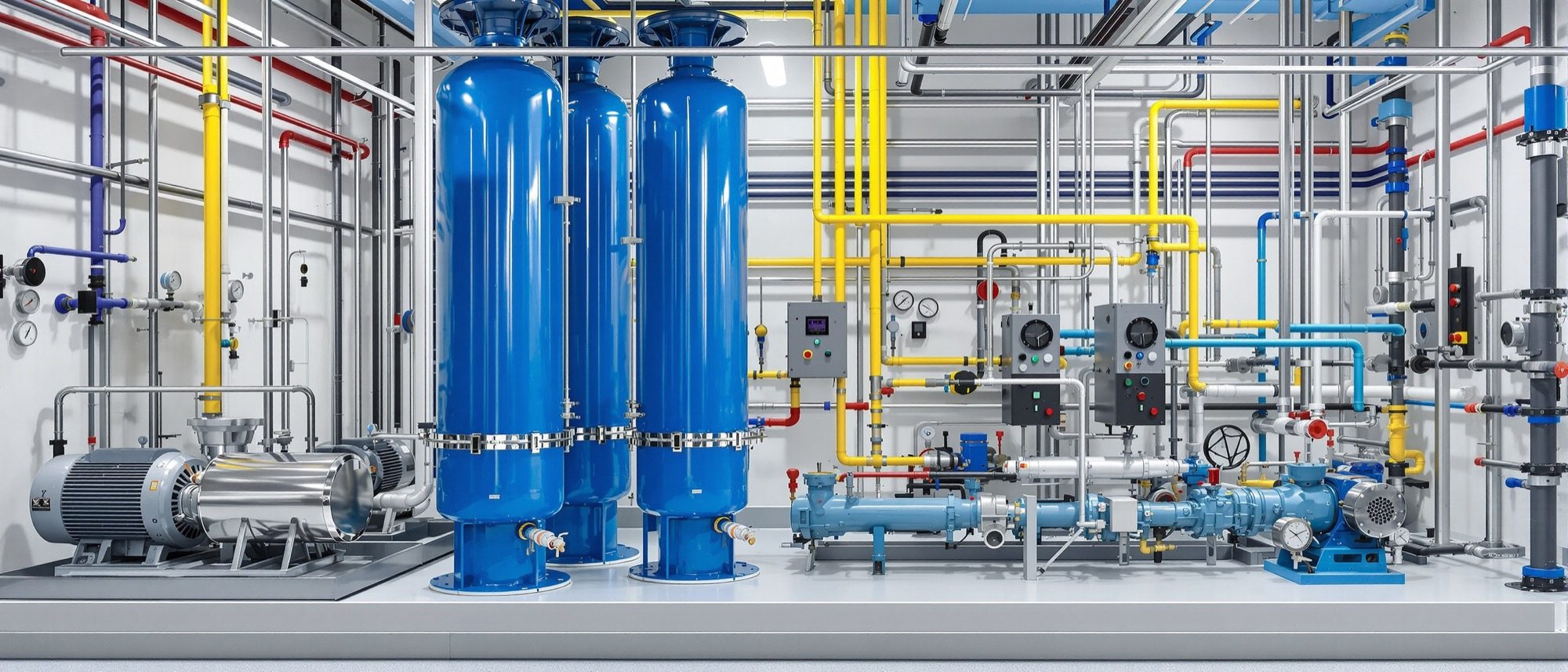
Water Supply for Tall Buildings
Pumping water up a hundred metres — and taming the pressure on the way down.
Getting water to the top of a tower is the easy half; the hard half is that the same column presses down with about one bar for every ten metres, so the taps at the bottom would burst before the top floor saw a drop. Learn the demand and storage, the three distribution systems, and the central idea of pressure zoning. Try the pressure-zone explorer below.
Learning objectives
By the end of this lesson, you will be able to — mapped to the course outcomes for Building Services for Special Buildings:
Estimate water demand and storage for a high-rise building.
Compare down-feed, up-feed and hydro-pneumatic distribution.
Apply pressure zoning with break-pressure tanks and PRVs.
Locate tanks, pumps and service floors in the building section.
Demand, storage & supply
Size storage to a day's demand (with a separate fire reserve), and distribute by down-feed, up-feed or hydro-pneumatic.[1, 5]
How much, and where
Design starts with DEMAND: a baseline of about 135 litres per person per day (lpcd) for basic supply, rising to ~150–200 lpcd with full amenity. STORAGE is at least a day's demand, usually split between a large UNDERGROUND sump (fed from the mains) and a smaller OVERHEAD tank (pumped up). A separate, dedicated FIRE-WATER reserve is held on top of this — never counted in the domestic storage.[1, 5]
Pressure zoning
Static head adds ~1 bar per 10 m, so a tall building must be split into vertical pressure zones with break tanks and PRVs. Try the explorer.[4]
Pressure zoning · slide the building height
3
zones
2
break tanks
9.0
bar at base*
*If served as ONE zone, the static head at the base would be ~9.0 bar — far over the ~3–4 bar a fixture takes. So the tower is split into 3 zones of ≤ 35 m, each reset by a break-pressure tank or PRV.
Static head ≈ 1 bar per 10 m — the taller the building, the more pressure zoning dominates the water design.
Gravity is the problem
A column of water adds about 1 BAR OF PRESSURE for every 10 m of height. So in a 100 m tower, the fixtures at the base would see ~10 bar — far above the ~3–4 bar a tap can take (and the NBC ~5.5 bar maximum). FLAG THE MYTH: a tall building CANNOT run on one pressure zone — the static head would burst the lowest fixtures. The taller the building, the more this dominates the whole water design.[4]
At a glance
| Aspect | One | The other |
|---|---|---|
| The easy vs hard half | Getting water up: pumps do it | Taming pressure down: zoning does it |
| Distribution | Down-feed: roof tank, gravity down | Hydro-pneumatic: pressure vessel + pumps |
| The physics | Static head: ~1 bar per 10 m | Fixture limit: ~3–4 bar (NBC max ~5.5) |
| The myth | One zone for a whole tower | Reality: zone every ~8–12 floors |
| Reset the head | Break-pressure tank (service floor) | Pressure-reducing valve (on the riser) |
Key terms
Litres per capita per day — the unit of water demand (~135 basic, 150–200 with full amenity).
Pump to a roof tank, then gravity-feed down — the standard high-rise method.
A pressure vessel with an air cushion and booster pumps holding pressure without a high tank.
The pressure of a water column — about 1 bar per 10 m of height.
Splitting a tall building into vertical zones (~8–12 floors) to keep fixture pressure usable.
An intermediate tank that resets the static head zone by zone in a down-feed system.
A valve that drops the pressure on a riser to keep a zone within fixture limits.
A plant floor punctuating a tower, housing tanks, PRVs and booster pumps.
Studio task
For a 30-storey tower, use the explorer above to decide how many pressure zones it needs, then sketch the section — mark the underground sump, the roof tank, the break-pressure tanks and the service floors that house them.
Self-assessment
1. A column of water in a tall building adds about — of pressure per 10 m of height.
2. A tall building must be split into vertical pressure zones because —
3. In a down-feed system, the head is reset zone by zone using —
Recap
References & further reading
- [1]CPHEEO — Manual on Water Supply and Treatment. Ministry of Housing & Urban Affairs, Government of India.
- [4]National Building Code of India 2016, Part 9 — Plumbing Services (water supply pressures). BIS.
- [5]IS 1172:1993 — Basic Requirements for Water Supply, Drainage and Sanitation. BIS.
Further reading
- CPHEEO Manual on Water Supply and Treatment. MoHUA.
- S. C. Rangwala, Water Supply and Sanitary Engineering. Charotar.
- V. K. Jain, Building Construction and Services.
Sources gathered and fact-checked June 2026. Published values vary by source, sample and method — treat as indicative and confirm against the cited standard before structural use.
The author
Amogh N P
Architect, interior designer, and creative polymath. Studio Matrx began in his notebooks — his vision of design made honest, useful, and open to everyone. Its Academy is written and taught in his memory, and free, forever.
More about Amogh →