
Steel Sections, Connections & Foundations
The pieces of steel — and how they are joined.
Steel construction is a kit of standard parts. Rolled at the mill to fixed sizes, the sections — I-beams, channels, angles and hollow tubes — are cut, drilled and welded in the shop, then bolted together on site. This unit learns the parts, the three ways they are joined, and how a steel building meets the ground.
Learning objectives
By the end of this lesson, you will be able to — mapped to the course outcomes for Building Materials & Construction III:
List the properties of structural steel and the grade Fe410 / E250.
Identify the hot-rolled sections by their IS designations and uses.
Compare the riveted, bolted and welded connection methods.
Describe a steel grillage foundation and a stanchion base.
The steel sections
Hot-rolled to IS 808: the I-beam (ISMB) and the heavy near-square column section (ISHB), channels (ISMC), angles (ISA) and hollow tubes (SHS/RHS/CHS) — plus built-up sections for heavy loads.[2, 3]
Steel-section explorer
I-beam (ISMB / ISLB)
The everyday floor and roof beam, carrying bending about its strong axis.
Connections & foundations
Members are joined by riveting (historic), bolting (black or HSFG) or welding (fillet or butt). At the ground, a grillage foundation or a stanchion base plate with anchor bolts spreads the load to the soil.[1]
Joining on site
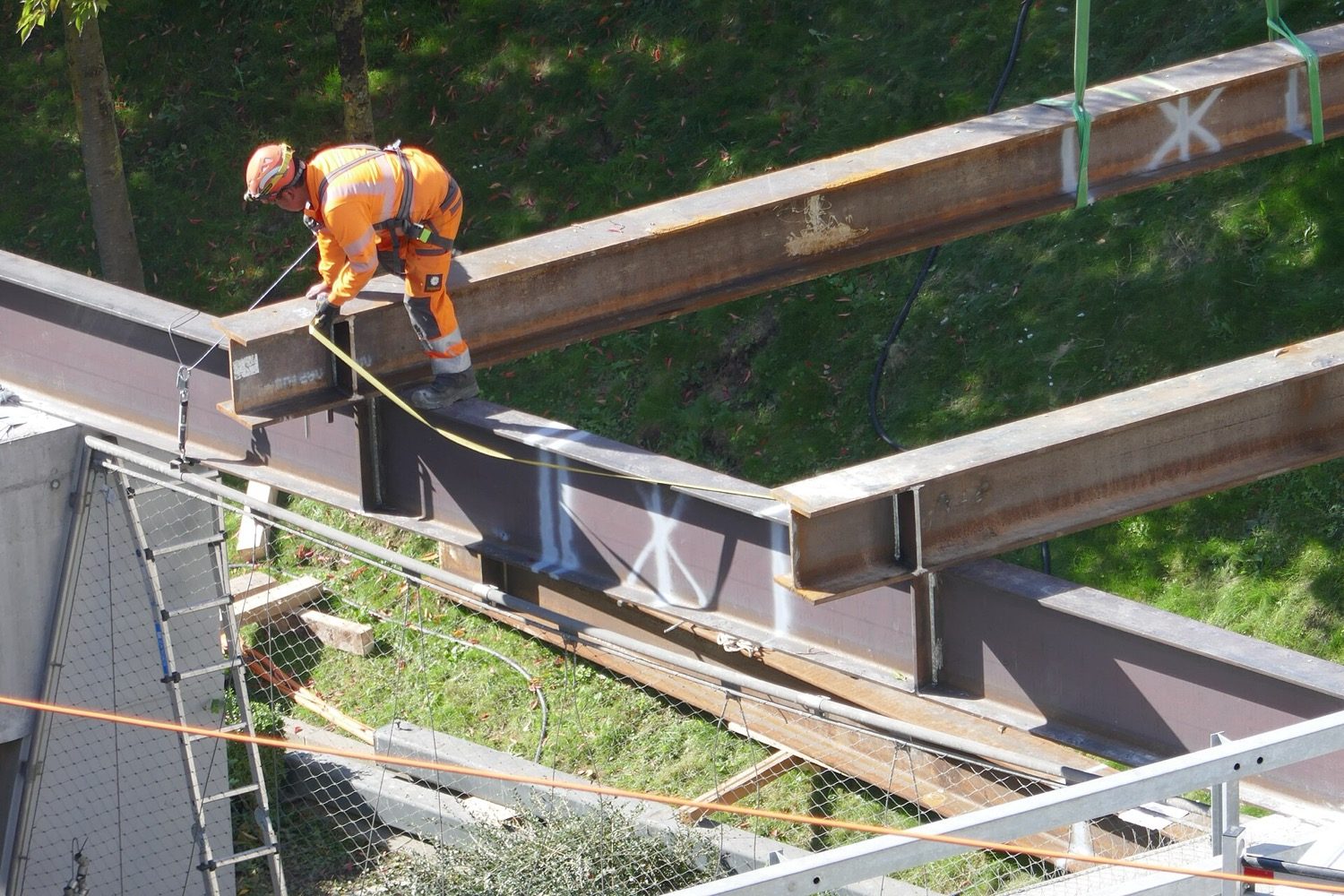
Riveting (a hot rivet hammered to clamp plates) is historic. Today work is bolted: ordinary black bolts (class 4.6, bearing-type) for light or temporary work, and pre-tensioned HSFG bolts (8.8/10.9) that grip by friction for dynamic and fatigue loads. Bolting is fast and demountable.[1]

The key distinctions
| Aspect | One | The other |
|---|---|---|
| Connection — site | Bolted: fast, demountable, no power/skill | Welded: rigid, clean, permanent, skilled |
| Bolt type | Black bolt (4.6): bearing, light/temporary | HSFG (8.8/10.9): friction, dynamic loads |
| Weld type | Fillet: corner, no edge prep | Butt: full parent-metal strength |
| Section — beam vs column | ISMB: narrow-flange beam (strong-axis bending) | ISHB: near-square heavy H column (both axes) |
| Section — rolled vs built-up | Rolled: single mill shape, economical | Built-up: plate girder / laced for heavy loads |
Key terms
Medium beam / wide-flange beam / heavy near-square H used as a column (IS 808).
Standard channel and angle sections.
Square / rectangular / circular hollow sections (IS 4923).
Mild structural steel (IS 2062) — yield 250, ultimate ~410 N/mm².
Ordinary bearing-type bolt (4.6) vs pre-tensioned friction-grip bolt (8.8/10.9).
Triangular corner weld vs full-penetration prepared-edge weld.
Tiers of I-beams at right angles, encased in concrete, spreading heavy loads.
A steel column.
Drafting task
Sketch the cross-sections of an ISMB beam and an ISHB column side by side and label the difference. Then draw a bolted lap joint and a fillet-welded tee joint, and in two lines say when you would choose bolting over welding on site.
Self-assessment
1. The near-square heavy section best suited to a steel column is the —
2. HSFG bolts carry load mainly by —
3. A grillage foundation spreads a heavy steel column load by —
Recap
References & further reading
- [1]IS 800:2007 — General Construction in Steel: Code of Practice. Bureau of Indian Standards.
- [2]IS 808 — Dimensions for Hot Rolled Steel Beam, Column, Channel and Angle Sections; SP 6(1) steel tables. BIS.
- [3]IS 2062 — Hot Rolled Medium and High Tensile Structural Steel (Fe410/E250). BIS.
- [4]IS 4923 — Hollow Steel Sections for Structural Use. Bureau of Indian Standards.
Further reading
- N. Subramanian, Design of Steel Structures. Oxford University Press.
- S.K. Duggal, Limit State Design of Steel Structures. McGraw-Hill Education.
- S.S. Bhavikatti, Design of Steel Structures. I.K. International.
Sources gathered and fact-checked June 2026. Published values vary by source, sample and method — treat as indicative and confirm against the cited standard before structural use.
The author
Amogh N P
Architect, interior designer, and creative polymath. Studio Matrx began in his notebooks — his vision of design made honest, useful, and open to everyone. Its Academy is written and taught in his memory, and free, forever.
More about Amogh →