
Building Section & Components
The vertical anatomy of a building — and how its load reaches the ground.
Before any material, a building is a system for carrying load to the ground. This first lesson reads a building in section — every part from the footing to the parapet — then asks the question that decides everything else: do the walls carry the load, or does a frame? And it follows the load all the way down to the soil.
Learning objectives
By the end of this lesson, you will be able to — mapped to the course outcomes for Building Materials & Construction I:
Name every component of a typical building section, from footing to parapet, and its purpose.
Distinguish a load-bearing structure from a framed (RCC) structure.
Trace the gravity load path from slab to soil — and why it must stay unbroken.
Read a section drawing and judge which foundation type suits the soil and load.
The typical building section
Read a section from the ground up. Each component has one job; together they keep the building up, dry and usable.
Lowest part; spreads the building's load safely onto the soil.
Wall between ground level and floor level; raises the floor clear of rain and damp.
A waterproof layer at plinth level that stops ground damp rising into the walls.
Encloses space and, in load-bearing work, carries load to the foundation.
A bedding course under a window frame so it does not bear directly on masonry.
A beam over a door or window that carries the wall load across the opening.
A projecting sunshade over openings that throws off sun and rain.
Horizontal members that collect floor/roof loads and pass them to columns or walls.
A low wall at the edge of a roof or terrace for safety.

Load-bearing vs framed (RCC)
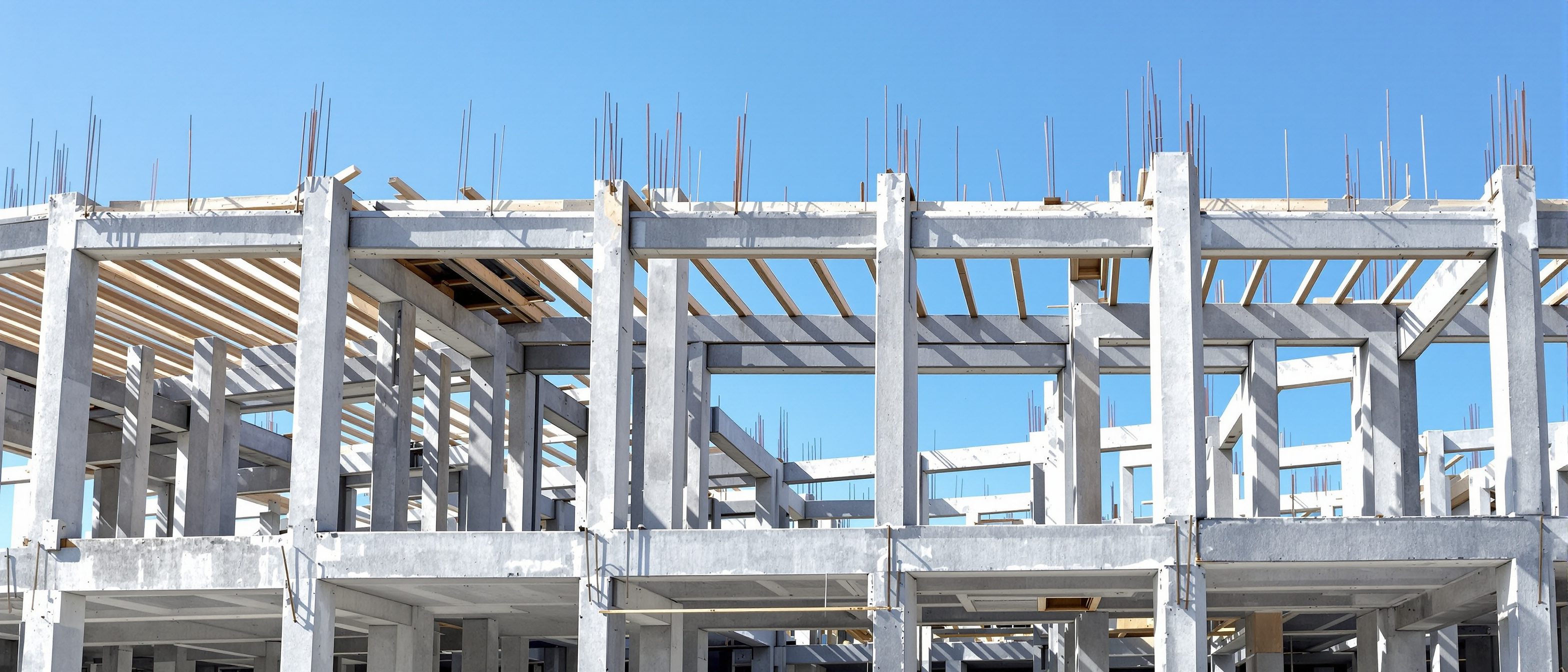
Every building is one of two things. In a load-bearing structure the walls carry the load. In a framed structure a skeleton of columns and beams carries it, and the walls are just infill. This single choice drives wall thickness, how many floors you can build, and how freely you can plan.[1]
| Load-bearing | Framed (RCC) | |
|---|---|---|
| Load path | slab → wall → foundation | slab → beam → column → foundation |
| Walls | structural — carry the load | infill / partition — frame carries the load |
| Wall thickness | thick; grows with height | thin, constant with height |
| Storeys | economical to ~3 floors | economical for multi-storey / high-rise |
| Flexibility | low — walls cannot move | high — free planning, movable partitions |
| Best for (India) | low-rise houses, stone/brick regions | urban multi-storey, seismic zones |

The load path
Gravity load flows down a chain — slab → beam → column or wall → foundation → soil — and the chain must never break. Lateral forces from wind or an earthquake travel sideways into walls and frames and then down to the foundation. A broken load path is a leading cause of failure.[5]
Foundations
The foundation spreads the building's load onto soil that can bear it. The choice follows the soil's safe bearing capacity and the load: a firm site takes simple pads; weak or heavy ground needs a raft or piles.[2]
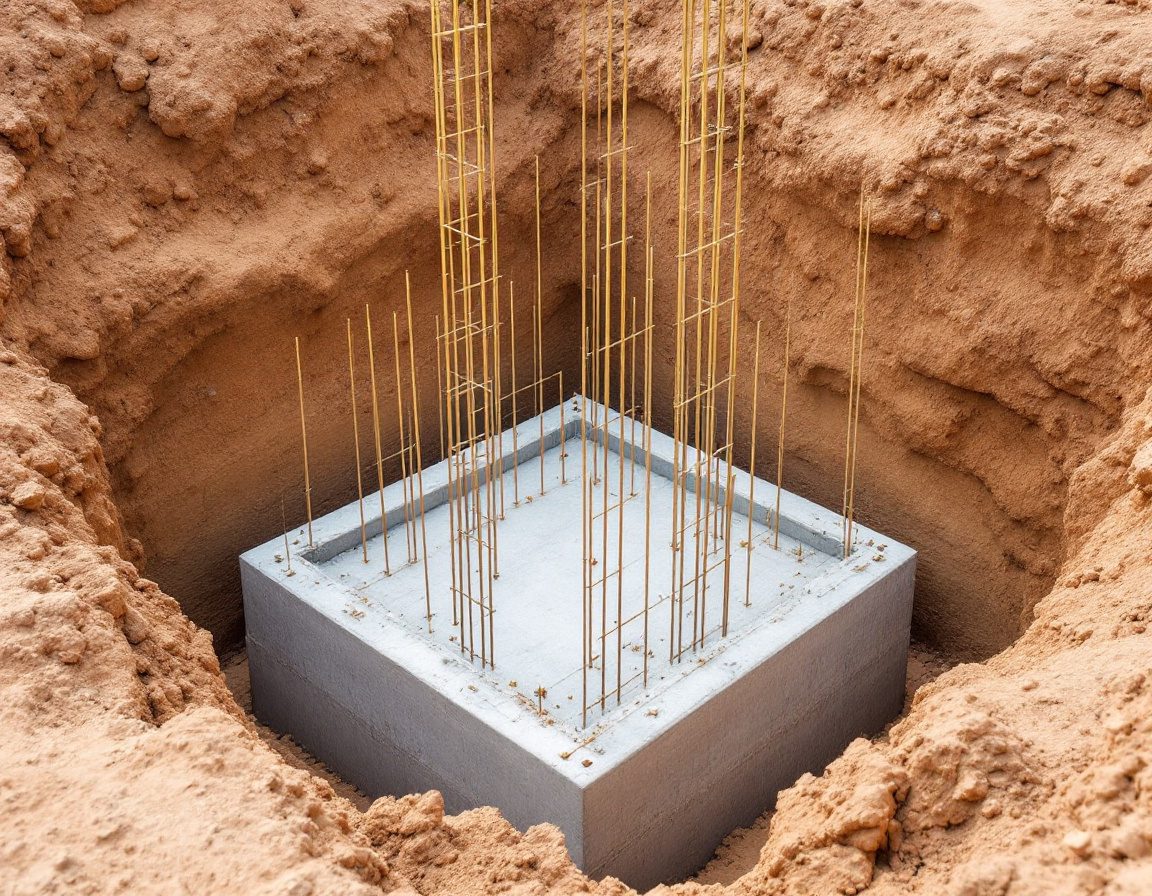
Isolated (spread / pad) footing
A single pad of concrete under one column — the most common shallow foundation where soil is firm and columns are well spaced.
Self-assessment
1. In a load-bearing structure, what carries the building's load down to the foundation?
2. Which is the correct gravity load path?
3. On weak or variable soil with heavy loads, which foundation spreads load over the whole footprint?
Recap
References & further reading
- [1]IS 456:2000 — Plain and Reinforced Concrete — Code of Practice (Fourth Revision). Bureau of Indian Standards. https://law.resource.org/pub/in/bis/S03/is.456.2000.pdf
- [2]IS 1904:1986 — Code of Practice for Design and Construction of Foundations in Soils — General Requirements (Third Revision). BIS. https://law.resource.org/pub/in/bis/S03/is.1904.1986.pdf
- [3]IS 800:2007 — General Construction in Steel — Code of Practice (Third Revision). BIS. https://archive.org/details/gov.in.is.800.2007
- [4]National Building Code of India 2016, Part 6 — Structural Design. Bureau of Indian Standards. https://www.bis.gov.in/standards/technical-department/national-building-code/
- [5]Components of a building & the structural load path — engineering overviews (civiconcepts; structural load-path references). https://civiconcepts.com/blog/components-of-building
Further reading
- Punmia, B.C., Jain, A.K. & Jain, A.K. Building Construction. New Delhi: Laxmi Publications.
- Rangwala, S.C. Building Construction. Anand: Charotar Publishing House.
- McKay, W.B. Building Construction (metric, multi-volume). London: Routledge.
- Chudley, R. & Greeno, R. Building Construction Handbook. London: Routledge.
- Barry, R. The Construction of Buildings (Vol. 1). Oxford: Wiley-Blackwell.
Sources gathered and fact-checked June 2026. Published values vary by source, sample and method — treat as indicative and confirm against the cited standard before structural use.
The author
Amogh N P
Architect, interior designer, and creative polymath. Studio Matrx began in his notebooks — his vision of design made honest, useful, and open to everyone. Its Academy is written and taught in his memory, and free, forever.
More about Amogh →