

Bamboo
The grass that builds — anatomy, properties, joints and where it goes in a building.
Bamboo is not wood — it is a giant grass, and one of the most intelligent building materials on earth. A hollow, jointed stem that grows in a single season can carry a roof, span a floor, and bend through an earthquake. This lesson takes it seriously: the science of why it works, the species used across India, how it really fails (at the joints), how to make it last, and how to draw it. Every figure here is cited.
Learning objectives
By the end of this lesson, you will be able to — mapped to the course outcomes for Building Materials & Construction I:
Identify bamboo's properties and explain why they suit construction.
Select bamboo techniques for walls, roofs, floors and furniture.
Recognise and draw the four principal bamboo joints.
Read a detailed bamboo construction drawing and prepare your own.
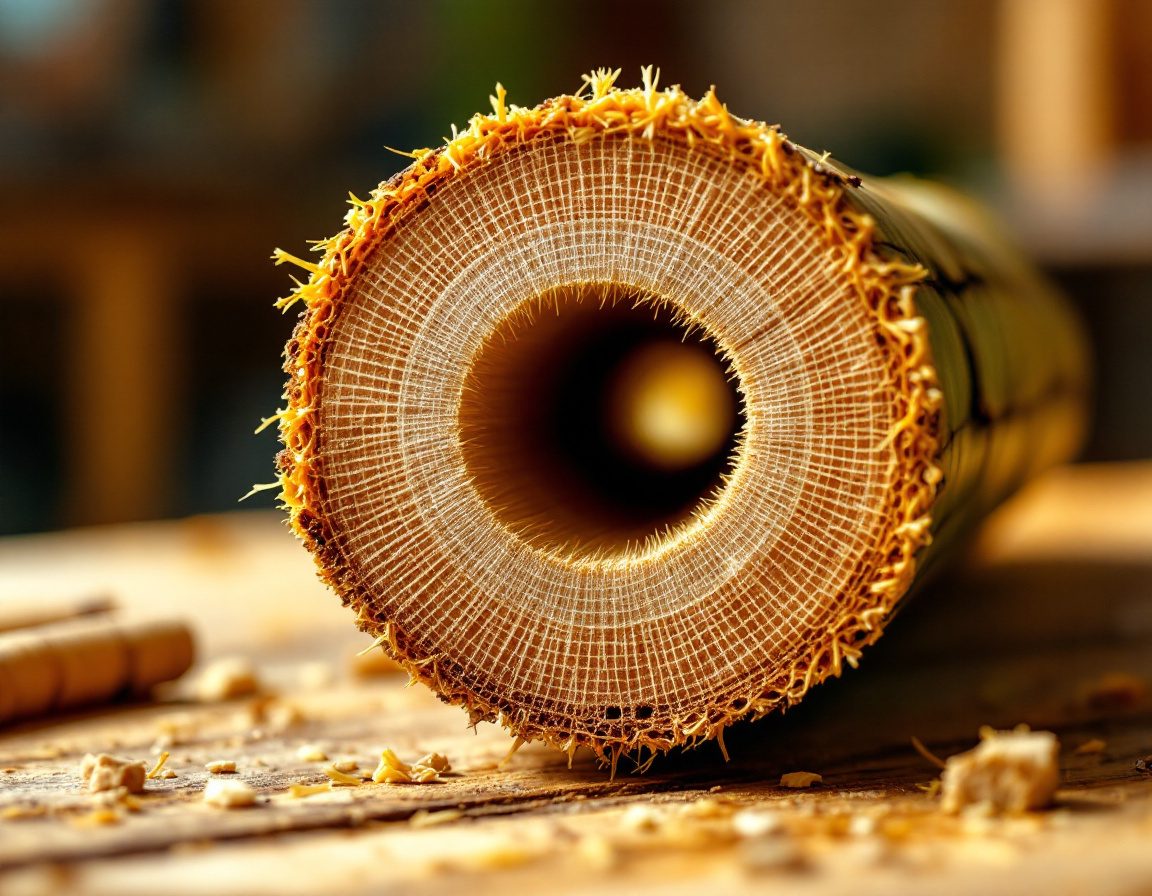
Anatomy of a culm
Tap each marker to learn the part. A bamboo stem is the culm; the rings are nodes, and the hollow lengths between them are internodes.
Why it's strong
Bamboo is a natural functionally graded composite. Strong cellulose fibres (vascular bundles) are not spread evenly through the wall — they are packed densely near the outer skin and thin out toward the hollow core. Because bending stress is also greatest at the outer surface, nature puts the strongest material exactly where the load is highest.
- Fibre bundle density: ≈ 8 / mm² at the outer wall vs ≈ 2 / mm² at the inner wall[1]
- Fibre volume fraction: rises from ≈ 0.10 (inner) to ≈ 0.44 (outer)[1]
- Single-fibre strength gradient: ≈ 1569 MPa (outer) down to ≈ 441 MPa (inner)[1]
- Section logic: the hollow tube puts material far from the centre — high stiffness for very little weight, like a steel pipe
Properties at a glance
Bamboo's tubular, fibre-reinforced structure gives it a remarkable strength-to-weight ratio — its tensile strength rivals mild steel while it weighs a fraction as much. These bars compare bamboo qualitatively (relative, illustrative scale).
Key caveat: untreated bamboo is vulnerable to insects, fungus and moisture. Traditional treatment — smoking, soaking in water, lime or borax — is essential for durability.
Measured properties
Real test values — note how widely they vary by species, culm position and moisture. Always test to IS 6874 / ISO 22157 before design.
| Property | Typical value | Note |
|---|---|---|
| Tensile strength ∥ fibres | ≈ 113–234 MPa | Varies strongly by species and culm position; outer fibres test far higher than the wall average.[2] |
| Compressive strength ∥ fibres | ≈ 60–80 MPa | Tends to rise toward the top of the culm (more fibre), though moisture content confounds the trend.[2] |
| Bending strength (MOR) | ≈ 131–133 MPa | Measured on Moso (a Chinese reference species) at 12% moisture; node and internode are similar.[3] |
| Modulus of elasticity (MOE) | ≈ 17.6–20 GPa | Stiffness; lower than steel (~210 GPa) but excellent for the weight.[3, 2] |
| Air-dry density | ≈ 600–800 kg/m³ | Roughly a tenth of steel’s ~7850 kg/m³ — the basis of its strength-to-weight advantage.[17] |
| Strength ordering | tensile > bending > compressive | Bamboo is best in tension along the grain and weakest across the grain (the joint problem).[3] |
Is bamboo really “stronger than steel”?
“Bamboo is stronger than steel” is an oversimplification. In absolute terms treated bamboo is well above softwood timber but below mild steel. Its real engineering edge is strength-to-WEIGHT (specific strength), because it weighs ~a tenth of steel.
Absolute tensile strength
MPawinner: Mild steel
Strength-to-weight (specific strength)
MPa ÷ g/cm³winner: Bamboo
Steel is far stronger pound-for-pound is the wrong test. Per unit weight, bamboo outperforms both — which is why a light bamboo roof spans so efficiently.[2]
Structural species in India
India has over 130 bamboo species. A handful do the structural work — and which one you get depends entirely on where you are.
| Species | Where & what | Culm | Use |
|---|---|---|---|
| Dendrocalamus strictusMale / solid bamboo | India’s most widely distributed bamboo (~half the country’s bamboo area); dry deciduous forests. | 6–15 m tall, 2.5–8 cm dia.; nearly solid in dry/arid conditions. | Light-to-medium construction, furniture, laminated board, paper. |
| Bambusa balcooaBalcooa / heavy-construction bamboo | Indian subcontinent; widely grown in NE & East India. | Up to ~25 m, up to ~150 mm dia.; very thick-walled, clumping. | Structural poles, heavy construction; high biomass yield. |
| Bambusa bambosGiant thorny bamboo (syn. B. arundinacea) | Throughout India incl. the peninsular south (~15% of India’s bamboo forest). | 20–30 m, 10–15 cm dia.; wall 25–50 mm. | House construction, scaffolding, rafters, roofing. |
| Melocanna bacciferaMuli bamboo | Dominant in NE India — Mizoram, Tripura, Assam; famous for ~48-year mass flowering (mautam). | 10–25 m, 1.5–15 cm dia.; thin-walled. | Lighter construction, matting, pulp; erosion control. |
| Dendrocalamus giganteusGiant / dragon bamboo | NE India & sub-Himalaya (often planted); among the largest bamboos. | 20–30 m, 20–30 cm dia.; wall 2–2.5 cm. | Scaffolding, structural members, laminated lumber. |
Species data compiled from INBAR / forestry sources; properties vary by site.[18]
Bamboo joints
Because culms are round and hollow, you can't just nail them. Joints are cut, shaped and lashed. Select a joint to study it.
Fish-mouth (saddle) joint
The end of one culm is cut into a curved “mouth” so it sits snugly against the round side of another, then pinned or lashed. The most common joint for frames.
Typical use: Posts to beams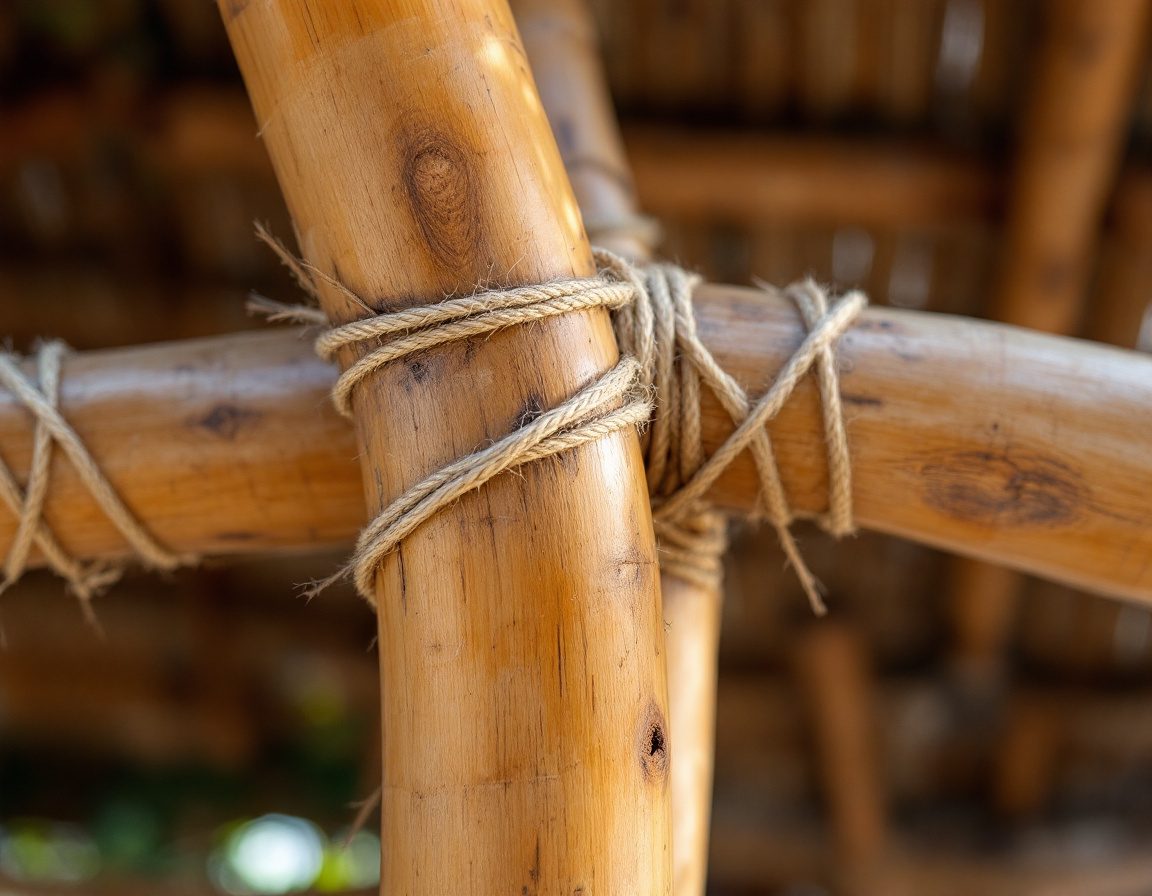
The joint is the weak point
The joint — not the culm — is the structural weakness of a raw-bamboo building. Because the culm is a hollow, thin-walled tube with almost no fibres running across the grain, it is weak in transverse tension and longitudinal shear. The classic failure is the culm splitting lengthwise at a bolt hole, during drilling or under load.[4]
How engineers solve it
Mortar / grout infill (the Simón Vélez method)
Colombian architect Simón Vélez pioneered injecting cement mortar into the hollow at a bolted joint. The infill spreads bearing load across the node and resists local crushing and splitting — though it more than doubles the joint’s weight and needs careful curing.[4]
Transverse confinement (hose-clamps / banding)
Wrapping the culm with steel hose-clamps or banding at the connection confines it, so a ductile bolt yields before the brittle culm splits — letting engineers use capacity-based design and dissipate earthquake energy.[5]
Generous end-spacing
Keeping bolts 6–8 diameters from the culm end gives ductile behaviour; closer than ~4 diameters triggers brittle splitting or block shear.[5]
Where bamboo goes in a building
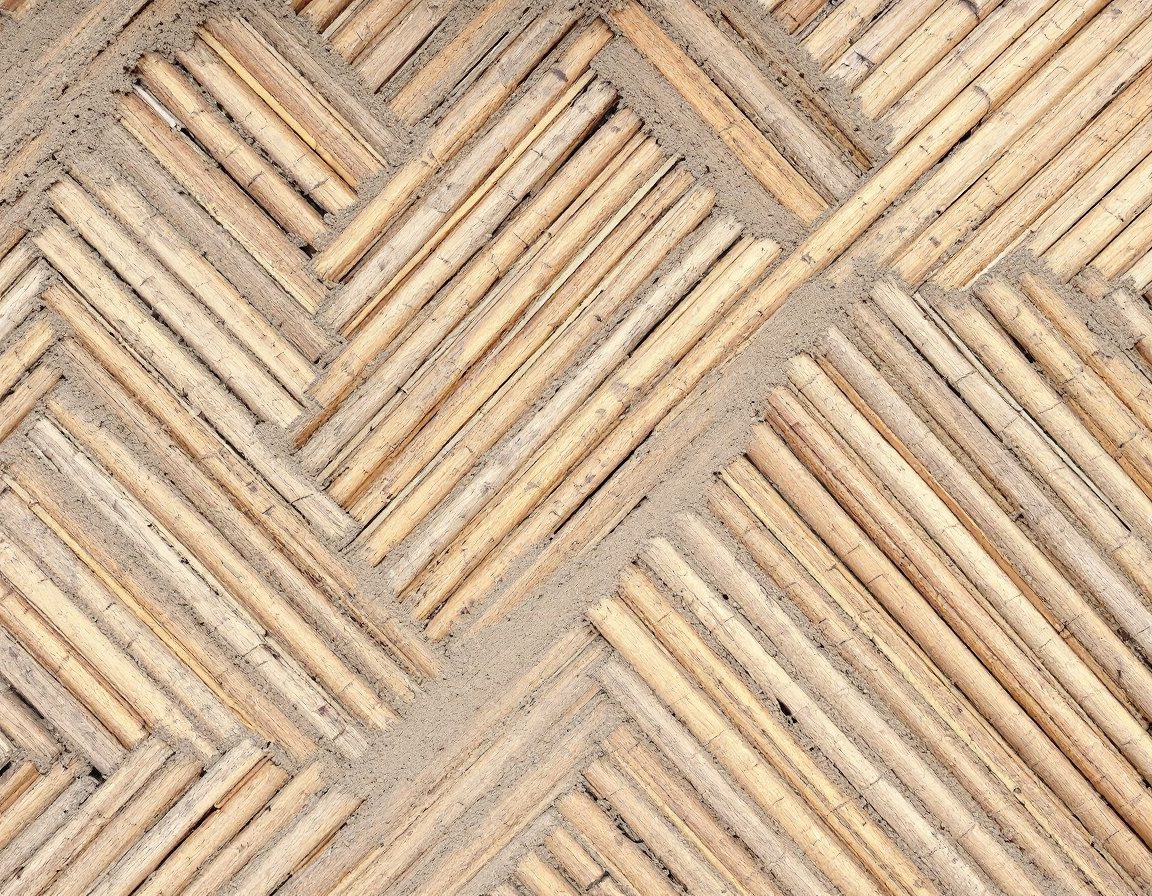
Walls — ekra / wattle
A frame of whole culms carries split-bamboo or woven matting (chatai). The weave is often plastered with mud or lime for weatherproofing and thermal mass — the traditional wattle-and-daub principle.
Construction sequence
How a bamboo wall panel comes together, step by step.
Durability & preservation
Green bamboo is full of starch and sugars — food for fungi, termites and powder-post beetles. Every preservation method, traditional or modern, works by removing those nutrients or by adding a toxin the pests avoid. Untreated, bamboo may last only a few years; treated and detailed to stay dry, it lasts decades.
Smoking / smoke-curing
TraditionalCulms hung over a hearth dry out and absorb smoke compounds; starch drops sharply (≈ 34% in 8 h) and decay weight-loss falls from ~56% to ~12% vs untreated.[7]
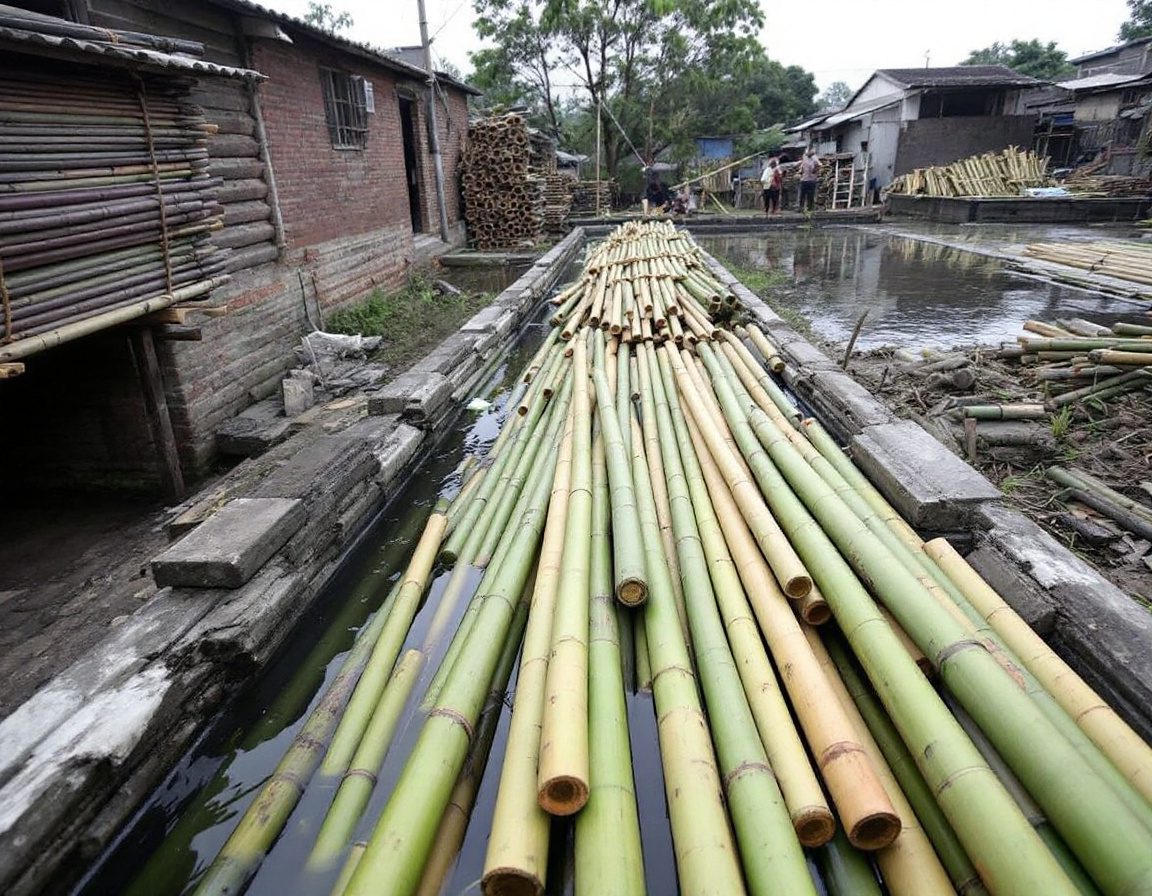
Water-leaching / soaking
TraditionalSubmerging culms for 3–4 weeks washes out and ferments the starch and soluble sugars, making them less attractive to borers. Cheap, but only modestly durable on its own.[7, 8]
Lime washing
TraditionalA slaked-lime coat makes the surface alkaline, delaying fungal attack, and acts as a moisture and UV barrier.[7]
Boron — Modified Boucherie
ChemicalA borax/boric-acid solution is pushed under pressure into a fresh green culm from one end, displacing the natural sap through the vessels. Best for plantation/commercial scale.[9]
Boron — Vertical Soak Diffusion (VSD)
ChemicalInternal node walls are punctured, the culm stood upright, and a borate solution (~5% for furniture, ~10% for construction) poured in to diffuse through the green wall. Ideal for small/rural workshops.[10]
In controlled tests, boric acid (1.5%) + borax (3.0%) in a 1:2 ratio, applied by a 72-hour cold soak, improved decay resistance by over 80% against both white-rot and brown-rot fungi.[11]
Sustainability & seismic behaviour
Renews in years, not decades
Bamboo reaches harvest maturity in 3–5 years and is cut selectively every year without replanting — the clump regrows. Some species grow up to 91 cm in a single day.[12]
A working carbon sink
A managed hectare of Moso bamboo can sequester ≈ 5 tonnes of carbon a year (about 1.5× a comparable fir stand); living bamboo stocks ≈ 100–400 t C/ha. Figures are species- and management-dependent.[12, 13]
Low embodied energy
Grown locally and worked by hand, structural bamboo carries a fraction of the embodied energy of steel or reinforced concrete — provided it is durably detailed so it lasts.[13]
Earthquakes. Light, flexible bamboo frames have long been observed to sway through earthquakes without collapse — low mass means low inertial force, and well-detailed joints dissipate energy. But this is not automatic: codes treat whole-culm bamboo conservatively, permitting only a low behaviour (response-modification) factor of about 2. Good connection design, not the material alone, earns the earthquake performance.[14]
Codes & standards
India’s design code for structural bamboo — grading, permissible stresses, jointing and detailing.
How to test round bamboo for physical and mechanical properties.
Test methods for split-bamboo material.
Bamboo sits beside timber in the structural-design part of the national code.
The international design standard; a country-adaptable framework developed with INBAR.
The companion test-method standard (≥ 12 specimens, sampled by culm position).
INBAR — the International Bamboo and Rattan Organisation (Beijing; formerly the International Network for Bamboo and Rattan) — is the intergovernmental body behind the global push for bamboo standards, and drove the ISO 22156 / 22157 work.
Label the bamboo house section
Drag each term onto the correct part of the section. On touch devices, tap a term then tap its slot.
Draw it yourself
As the syllabus requires — material sample collection, a site visit and detailed drawings. Architecture lives in the hand, not only the screen.
- Draw a fish-mouth joint at 1:2 scale, sectioned, with dimensions and lashing.
- Draw a detailed section of a raised bamboo floor showing stilt, joist and deck.
- Collect two real bamboo samples; sketch and annotate node spacing and wall thickness.
Trace from the bamboo joints sheet below, then redraw each detail freehand. In the live platform your tutor reviews and annotates your uploaded sketches.
Reference downloads
Self-assessment
1. Why does bamboo have such a high strength-to-weight ratio?
2. Which joint is generally the strongest traditional bamboo connection?
3. Untreated bamboo's main weakness in construction is that it:
Recap
References
- [1]Ray, A.K., Mondal, S., Das, S.K. & Ramachandrarao, P. (2005). Bamboo — a functionally graded composite: correlation between microstructure and mechanical strength. Journal of Materials Science, 40(19), 5249–5253. https://doi.org/10.1007/s10853-005-4419-9
- [2]Awalluddin, D. et al. (2017). Mechanical properties of different bamboo species. MATEC Web of Conferences, 138, 01024 (EACEF 2017). https://doi.org/10.1051/matecconf/201713801024
- [3]Zhou, J. et al. (2021). Comparison of the mechanical properties of the node and internode of Moso bamboo. Journal of Engineered Fibers and Fabrics, 16. https://doi.org/10.1177/15589250211066802
- [4]Hong, C., Li, H., Lorenzo, R., Wu, G. et al. (2019). Review on connections for original bamboo structures. Journal of Renewable Materials, 7(8), 713–730. https://doi.org/10.32604/jrm.2019.07647
- [5]Pradhan, N.P.N., Paraskeva, T.S. & Dimitrakopoulos, E.G. (2020). Quasi-static reversed cyclic testing of bamboo connections with steel connectors. Journal of Building Engineering, 27, 100983. https://doi.org/10.1016/j.jobe.2019.100983
- [7]Eco-friendly preservation of bamboo species: traditional to modern techniques. BioResources (NC State University). https://bioresources.cnr.ncsu.edu/resources/eco-friendly-preservation-of-bamboo-species-traditional-to-modern-techniques/
- [8]Scientific investigation of the traditional water-leaching method for bamboo preservation (research synthesis). https://www.academia.edu/17589232
- [9]ABARI — Bamboo treatment: the Modified Boucherie process (after W. Liese). http://abari.earth/treatment
- [10]Vertical Soak Diffusion (VSD) boron treatment of bamboo. ECHO Community technical note. https://www.echocommunity.org/en/resources/a88b5f85-ac77-415b-93b2-7a8e13987173
- [11]Improvements in the physical properties and decay resistance of bamboo via modification with boric acid and borax. BioResources (NC State University). https://bioresources.cnr.ncsu.edu/resources/improvements-in-the-physical-properties-and-decay-resistance-of-bamboo-materials-via-modification-with-boric-acid-and-borax/
- [12]INBAR — Understanding bamboo’s climate-change potential. International Bamboo and Rattan Organisation. https://www.inbar.int/understanding-bamboos-climate-change-potential/
- [13]Nath, A.J., Lal, R. & Das, A.K. (2015). Managing woody bamboos for carbon farming and carbon trading. Global Ecology and Conservation, 3, 654–663. https://doi.org/10.1016/j.gecco.2015.03.002
- [14]Kaminski, S. et al. Seismic performance of whole-culm bamboo structures and recommendations for design using ISO 22156.
- [17]Janssen, J.J.A. (1991). Mechanical Properties of Bamboo. Forestry Sciences Vol. 37. Dordrecht: Kluwer Academic.
- [18]Species data compiled from INBAR, ICFRE/IPIRTI and forestry databases; properties vary — test to IS 6874 / ISO 22157 before design.
Further reading
- Janssen, J.J.A. (2000). Designing and Building with Bamboo. INBAR Technical Report No. 20. Beijing: INBAR.
- Janssen, J.J.A. (1991). Mechanical Properties of Bamboo. Forestry Sciences Vol. 37. Dordrecht: Kluwer Academic.
- Minke, G. (2016). Building with Bamboo: Design and Technology of a Sustainable Architecture (2nd rev. ed.). Basel: Birkhäuser.
- Hidalgo-López, O. (2003). Bamboo: The Gift of the Gods. Bogotá: self-published.
- Jayanetti, D.L. & Follett, P.R. (1998). Bamboo in Construction: An Introduction. INBAR Technical Report No. 15. High Wycombe: TRADA Technology / INBAR.
Sources gathered and fact-checked June 2026. Figures vary by species, age, moisture and culm position — treat published values as indicative and test to standard before structural design.