
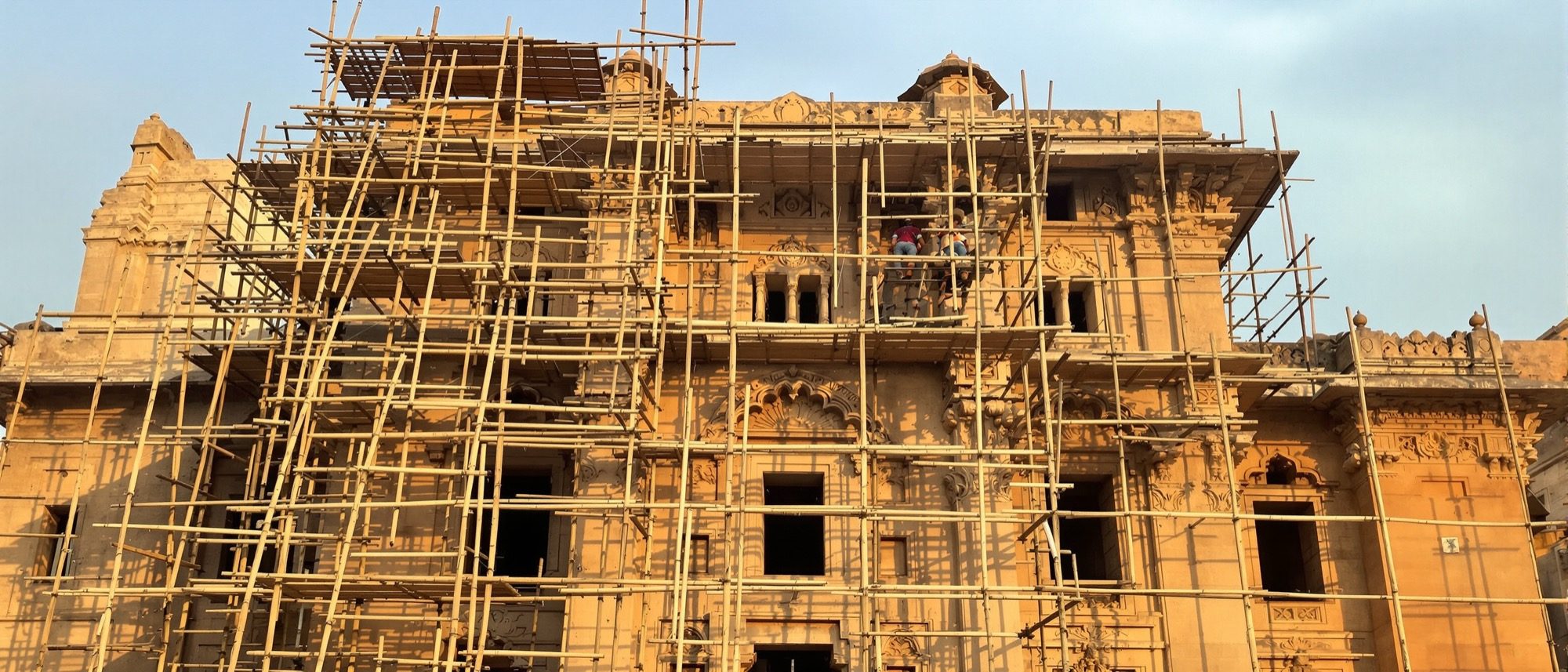
Conservation & Strengthening
Making old buildings stronger — and keeping them honest.
Sometimes a building must not only be repaired but made stronger — for a new use or an earthquake — and sometimes it must be conserved as heritage, with a lighter hand. Learn the strengthening techniques, the principles of conservation (the Venice and INTACH charters), and the sustainability case — because reusing a building saves the embodied carbon of building anew.
Learning objectives
By the end of this lesson, you will be able to — mapped to the course outcomes for Building Maintenance & Repair:
Apply strengthening techniques — jacketing, plate bonding, FRP, seismic retrofit.
Apply heritage conservation principles and charters.
Explain adaptive reuse and the embodied-carbon case for reuse.
Weigh repair-and-strengthen against rebuild.
Strengthening & conservation
Strengthen with jacketing, plate bonding or the lightweight FRP wrap (favoured for seismic work); conserve heritage with minimal intervention and reversibility.[2, 8]
Adding capacity
When a structure must carry more — a new use, a code update, an earthquake — it is STRENGTHENED. RC JACKETING wraps a column or beam in a new reinforced-concrete layer to add section and capacity. STEEL PLATE BONDING epoxy-bonds plates to a beam soffit for flexural strength. FRP WRAPPING (carbon or glass fibre fabric, epoxy-bonded) is lightweight and very strong, adding flexural and shear strength and CONFINEMENT — now the favoured tool for SEISMIC retrofit of columns. External post-tensioning and added bracing or shear walls complete the kit.[2]
Reuse & carbon
Conserve with the charters, and reuse to save embodied carbon — making maintenance and repair a form of climate action.[9, 1]
A careful hand
Heritage demands a lighter touch. The principles (the VENICE CHARTER, 1964, and India's INTACH CHARTER, 2004): MINIMAL INTERVENTION (keep as much, change as little as possible); REVERSIBILITY (interventions should be undoable as better methods emerge); DISTINGUISHABILITY (new work discernible yet harmonious); respect for every historic phase; full DOCUMENTATION; and like-for-like, compatible materials. India's INTACH charter adds the vast UNPROTECTED heritage and its living, traditional repair practices. Conservation repairs to keep the building's authenticity, not to make it new.[8, 9]
At a glance
| Aspect | One | The other |
|---|---|---|
| Strengthen by | Jacketing / plate bonding: add section | FRP wrap: lightweight, seismic confinement |
| Seismic key | Strength & stiffness | + ductility & a continuous load path |
| Conservation | Minimal intervention, reversibility | Like-for-like, distinguishable new work |
| Charters | Venice (1964): international | INTACH (2004): India's unprotected heritage |
| The carbon case | Rebuild: spends new embodied carbon | Reuse: saves it — the greenest building |
Key terms
Wrapping a column or beam in a new reinforced-concrete layer to add capacity.
Epoxy-bonding steel plates to a member to add flexural strength.
Lightweight carbon/glass-fibre fabric bonded on for strength and confinement — favoured for seismic work.
Adding strength, stiffness, ductility and a continuous load path so a building survives an earthquake.
The conservation principle of keeping as much and changing as little as possible.
Designing interventions to be undoable as better techniques emerge.
The international (1964) and Indian (2004) charters of conservation principle.
Giving a heritage building a viable new function while keeping its significance — and saving embodied carbon.
Studio task
Pick a tired old building near you and argue, in a page, for repair-and-reuse over demolition — name a strengthening method it would need, the conservation principles you would follow, and the embodied carbon you would save.
Self-assessment
1. The lightweight strengthening method now favoured for the seismic retrofit of columns is —
2. A core principle of heritage conservation is —
3. The sustainability case for reusing an existing building is that it —
Recap
References & further reading
- [1]Barry A. Richardson, Defects and Deterioration in Buildings. Spon/Routledge, 2001.
- [2]Peter H. Emmons, Concrete Repair and Maintenance Illustrated. RSMeans/Wiley, 1993.
- [8]ICOMOS — The Venice Charter (1964); and the INTACH Charter for Unprotected Heritage in India (2004). https://www.icomos.org/images/DOCUMENTS/Charters/venice_e.pdf
- [9]INTACH — Charter for the Conservation of Unprotected Architectural Heritage and Sites in India, 2004. https://www.intach.org/about-charter.php
Further reading
- Peter Emmons, Concrete Repair and Maintenance Illustrated. Wiley.
- Bernard Feilden, Conservation of Historic Buildings. Architectural Press.
- INTACH Charter (2004); ICOMOS Venice Charter (1964).
Sources gathered and fact-checked June 2026. Published values vary by source, sample and method — treat as indicative and confirm against the cited standard before structural use.
The author
Amogh N P
Architect, interior designer, and creative polymath. Studio Matrx began in his notebooks — his vision of design made honest, useful, and open to everyone. Its Academy is written and taught in his memory, and free, forever.
More about Amogh →