
Soil test, site survey & Vastu
What's under the soil decides your foundation — and your foundation decides your budget.
Lesson byAmogh N P· Architect & interior designer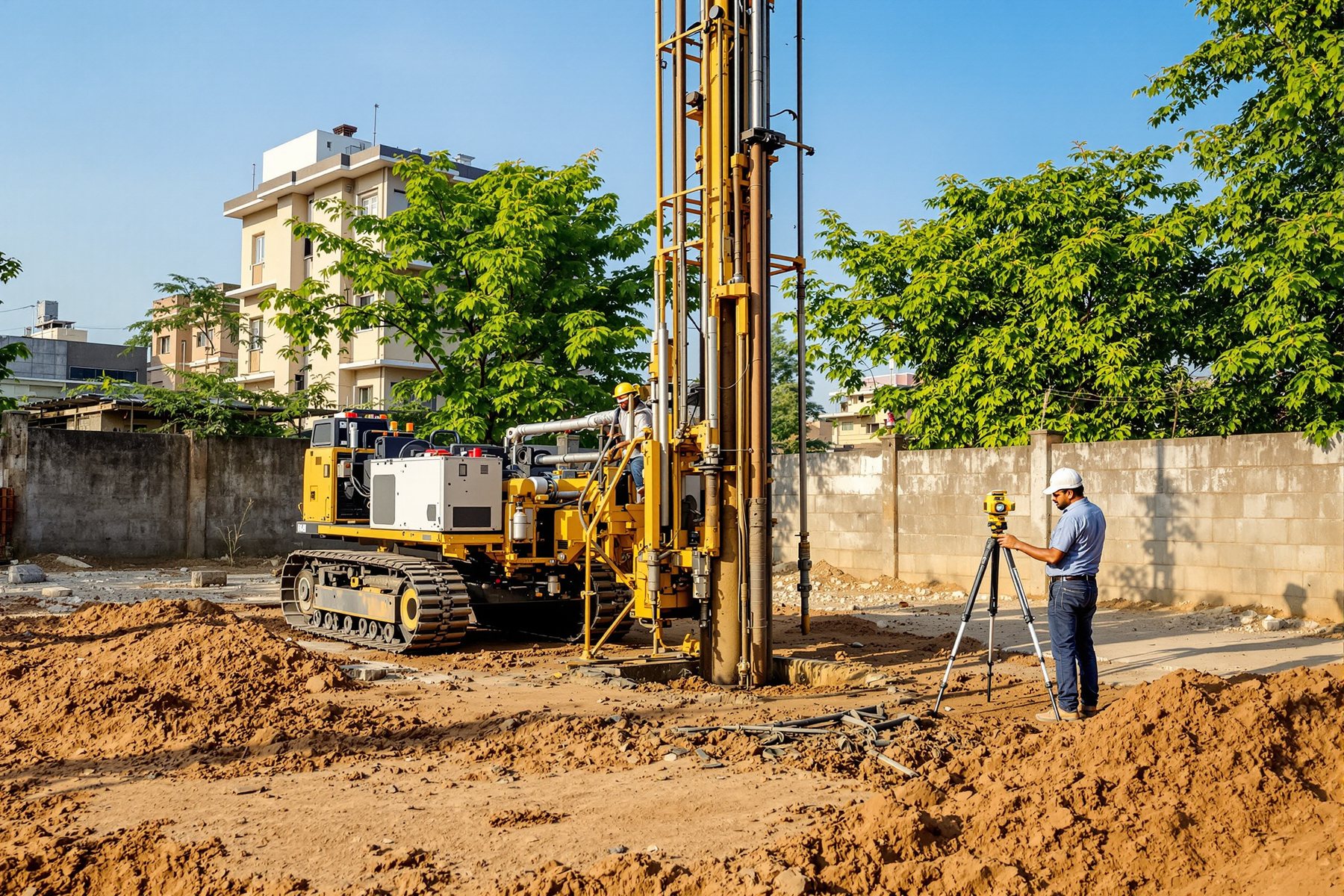
The house was beautiful. The soil under it was black cotton, and nobody checked.
You can't see what your house will stand on. Black cotton soil swells in the monsoon and shrinks in summer, cracking foundations that weren't designed for it. A high water table needs waterproofing from day one. A sloping site needs retaining walls. Each of these can add lakhs — but only if you find out after you've designed. A soil test and a proper survey, done first, turn nasty surprises into line items you planned for.
Three things to test before you design: the soil, the survey and the site's nature
A soil test tells your engineer what foundation the ground can actually carry
A soil test (geotechnical or soil-bearing investigation) drills boreholes and measures the soil's safe bearing capacity (SBC) — how much load each square metre can hold — plus the soil type and the water table (how high underground water sits). It typically costs ₹15,000–40,000 for a house plot, and it's the cheapest insurance against the most expensive mistake in building.
Why it matters: the foundation is sized from the SBC. Strong, gravelly soil with a high SBC takes a simple, cheap footing. Weak or expansive soil needs a deeper, wider or raft foundation — sometimes lakhs more. The notorious one is black cotton soil, common across central and southern India, which swells and shrinks with moisture and cracks the wrong foundation.
Your structural engineer designs the foundation from this report. Skipping it means they guess — and you pay for the guess either way: in over-engineering, or in cracks.
₹15,000–40,000 now, or lakhs of remedial underpinning later. The soil test is the easiest 'yes' in the whole build.
Map the slope and levels, and treat Vastu as building science
A topographic (contour) survey maps the plot's exact boundaries, levels and slope, and marks trees, drains and existing features. It tells your architect where water flows, how much earth must be cut or filled, and whether you'll need retaining walls — all of which shift the budget. On a flat city plot it's modest; on a sloping or large plot it's essential.
Then there's Vastu, which many Indian families weigh heavily in plot choice. Read through a building-science lens, several traditional Vastu plot preferences are simply good site sense for the Indian climate: a plot sloping gently towards the north-east drains monsoon water away from the house; keeping heavy built mass to the south-west shades the home from harsh afternoon sun; openings to the north and east capture cooler morning light. You don't have to follow Vastu as belief to benefit from the climate logic underneath it — and where it matters to your family or resale, design with it rather than fight it.
Budget **₹15,000–40,000** for a soil test and a survey before you finalise the design — not after. Ask the lab for the SBC, the soil type and the water-table depth in plain language, and hand the full report to your structural engineer. If the soil is black cotton or the water table is high, don't panic: it's a known, solvable condition, and knowing now means it's a planned cost, not a crisis.
Make a geotechnical report a precondition for foundation design — never size footings from assumption on anything but the most uniform ground. Use the SBC, soil classification and water table to choose the foundation system and waterproofing strategy, and let the contour survey drive cut-and-fill, drainage and retaining-wall decisions before the concept freezes.
Geotechnics is where design meets physics. Safe bearing capacity, soil classification and the water table determine the foundation system long before aesthetics enter. Learn to read a soil report and relate SBC to footing type, and to frame Vastu's plot preferences as climate-responsive site planning — slope, orientation, mass placement — so you can serve the belief and the building science at once.
“Soil tests are only for tall buildings — a normal house can skip them.”
Even a G+1 house transfers serious load to the ground, and weak or expansive soil cracks a foundation regardless of height. A ₹15,000–40,000 soil test sizes the foundation correctly and flags black cotton soil or a high water table before they become structural failures. It's standard practice for any built home, not a luxury for towers.
Test the ground before you commit the design:
- 01Commission a soil-bearing test (₹15,000–40,000) and ask for the safe bearing capacity, soil type and water-table depth in plain language.
- 02Get a topographic survey of the plot's boundaries, levels and slope, and give both reports to your structural engineer before foundation design.
- 03Map the plot's slope and orientation against Vastu's climate logic — north-east drainage, south-west mass, north/east openings — and design with it where it helps.
Your house is only as sound as what it stands on, and you can't see that from the surface. A soil test fixes the foundation to reality, a survey fixes the design to the actual slope and levels, and a building-science reading of Vastu turns tradition into climate-smart site planning. All three are cheap, all three come before design — and together they convert the scariest unknowns in a build into planned, costed decisions.
Before you design, test the ground: a soil-bearing test (₹15,000–40,000) gives the SBC, soil type and water table that size your foundation; a topographic survey maps slope and levels; and Vastu plot factors, read as building science, guide drainage, mass and openings for the Indian climate. Black cotton soil and a high water table are solvable — if found now.
How much does a soil test cost for house construction in India?
A soil-bearing (geotechnical) test for a house plot typically costs ₹15,000–40,000, depending on the city, number of boreholes and depth. It returns the safe bearing capacity, soil classification and water-table depth — the data your structural engineer needs to size the foundation correctly rather than guess.
Why is black cotton soil a problem for building?
Black cotton soil, common across central and southern India, swells when wet and shrinks when dry, exerting forces that crack foundations not designed for it. It's entirely solvable — with deeper footings, soil replacement or a raft foundation — but only if a soil test identifies it before the foundation is designed.
Do I need a site survey before building a house?
Yes. A topographic (contour) survey maps your plot's exact boundaries, levels and slope, and flags drainage and existing features. It tells your architect how much earth to cut or fill, where water flows and whether retaining walls are needed — all of which affect the budget and should be known before the design freezes.
The author
Amogh N P
Architect, interior designer, and creative polymath. Studio Matrx began in his notebooks — his vision of design made honest, useful, and open to everyone. Its Academy is written and taught in his memory, and free, forever.
More about Amogh →You've chosen the plot, cleared its title and tested its ground. The last land question is the one your bank account asks: what will it all cost to actually own?