
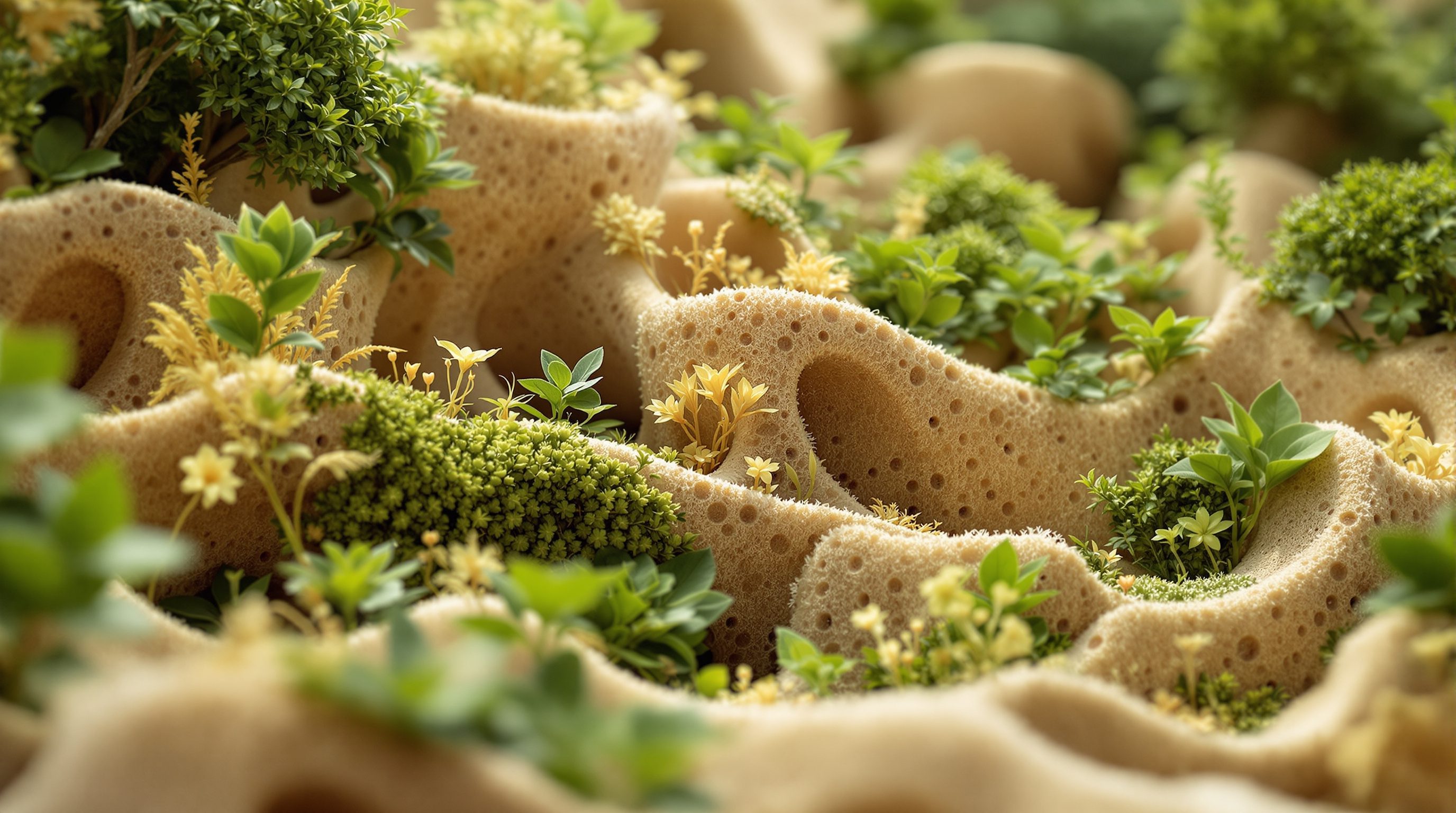
 Lesson 5.3
Lesson 5.3 · Living & Grown Materials
Bio-cement & Bacterial Materials
Bacteria that grow mineral to bind particles into cement, and dormant microbes that wake to seal a crack in concrete - a genuinely exciting route toward lower-carbon, self-maintaining construction, and still firmly lab and pilot stage
Cement is normally cooked from limestone at around 1450 degrees, releasing huge amounts of carbon. What if a bacterium could grow the cement instead - at room temperature, and even heal its own cracks?
Cement is the quiet giant of construction's carbon problem. Making ordinary Portland cement means heating limestone in a kiln to roughly 1450 degrees Celsius, which both burns fuel and drives a chemical reaction that releases carbon dioxide from the stone itself - so cement production alone is one of the largest single sources of global emissions. Any credible path to lower-carbon building has to reckon with cement, and one of the most imaginative ideas is to stop cooking it and start growing it.
Bacterial materials do exactly that in the laboratory. Some microbes, as they go about their metabolism, cause hard mineral - calcite, the stuff of limestone - to precipitate around themselves, and that mineral can cement loose sand or soil into a solid. Push the idea further and you can seal bacteria and their food inside ordinary concrete, dormant, so that when a crack later lets in water they wake, precipitate mineral, and seal the crack from within. The promise is enormous: cement grown without a kiln, and concrete that maintains itself. The honesty required is equally large: this is genuinely thrilling and genuinely early - mostly laboratory and pilot work, slow, hard to scale, and far from replacing the cement in a real structure.
Bio-cement: bacteria grow calcite -> cements sand, no kiln. Self-healing concrete: dormant microbes wake on a crack -> seal it. Real + exciting, but lab/pilot. Never relax structural design.
MICP: how microbes make cement
The engine behind bacterial bio-cement is a natural process with a precise name: microbially induced calcite precipitation, or MICP. It sounds exotic but the underlying idea is one nature uses everywhere - the same biomineralization that builds seashells, corals and limestone. Certain bacteria, as a by-product of their metabolism, change the chemistry of their immediate surroundings in a way that makes dissolved calcium precipitate out as solid calcite crystals. Those crystals grow on and around the bacteria and, crucially, bridge the gaps between nearby particles.
To make bio-cement, you supply three things to loose granular material such as sand or soil: the right bacteria, a calcium source, and nutrients to feed the metabolism. As the bacteria work, calcite crystals precipitate throughout the mass and knit the loose grains together, growing a cemented solid - a bio-cemented sand block, a stabilised soil, a bound aggregate - all at ambient temperature, with no kiln and no clinker. In effect, the bacteria grow the glue that a cement kiln would otherwise cook.
The appeal is immediate and real. The process needs no firing to 1450 degrees, so it sidesteps both the fuel-burning and, potentially, some of the process emissions that make Portland cement so carbon-heavy - the central reason the field is exciting. It works at room temperature from relatively simple inputs, and it can bind materials in place, which opens uses like stabilising sandy ground, making bricks without firing, sealing porous rock, or consolidating soil.
But the honest limits arrive just as fast, and they are the reason MICP is not on a building site near you. The process is slow - cementation can take days and often needs repeated treatment. Achieving uniform, reliable strength through a thick or large element is difficult, since the bacteria and nutrients must reach everywhere evenly. Scaling from a laboratory sample or a small block to structural volumes is a major unsolved challenge, as are cost, supplying and managing the bacteria and nutrients, and by-products of the reaction. And the strength and durability achieved so far, while genuinely useful for some ground and non-structural uses, are generally well below structural concrete and still being characterised. MICP is a beautiful, real process with narrow, early applications - not yet a cement replacement.
MICP: bacteria + calcium + food -> calcite precipitates -> cements loose grains. Grows cement, no kiln. But slow, hard to scale, early.
Self-healing bio-concrete: dormant bacteria that seal cracks
The second, and perhaps most captivating, bacterial idea does not replace cement at all - it makes ordinary concrete last longer by letting it heal its own cracks. Concrete cracks; that is normal, and fine cracks are usually not a structural problem in themselves, but they let in water and aggressive agents that can corrode reinforcement and shorten a structure's life. Self-healing bio-concrete attacks this at the source.
The mechanism is elegant. During mixing, dormant bacteria - species that can survive for years in a spore-like state - are added along with a food source (often a calcium-based nutrient), usually protected inside tiny capsules or porous particles so they survive the harsh, dry, alkaline concrete. There they sit, asleep, doing nothing. When a crack later forms and water seeps in, it wakes the bacteria; they consume their food and, by the same MICP process, precipitate calcite that grows into and seals the crack from the inside - closing the pathway for water before it can reach and corrode the steel.
The promise is genuinely important: structures that maintain themselves, with fewer cracks left open to admit water, less corrosion of reinforcement, longer service life, and lower repair and maintenance costs over decades. Because durability is itself a carbon strategy - a structure that lasts twice as long defers the carbon of replacing it - self-healing concrete matters for the climate as well as for maintenance.
The honesty is equally important and specific. Self-healing bio-concrete is a research and pilot-scale technology: it has been demonstrated in laboratories and a small number of trial structures, and it works best on fine cracks within a limited width - it is not a cure for large structural cracks or a substitute for proper design, reinforcement and crack-control detailing. Getting the bacteria to survive mixing and years of dormancy, to activate reliably, to heal cracks of practical width deep in real elements, and to do so at acceptable cost and scale, are open challenges. It is one of the most tangible and appealing living-material ideas, precisely because it augments the material we build most with - and it is still early. A designer should be excited, follow it closely, and never treat it as a licence to relax structural design or crack limits.
The carbon promise - real, and easy to overstate
Because cement is such a large source of emissions, bacterial materials are often presented as a climate breakthrough, and it is worth being precise about where the carbon benefit is real and where the claim runs ahead of the evidence - this is exactly the kind of field where honest accounting matters most.
There are two distinct carbon stories, and they should not be blurred. The first is bio-cement replacing kiln-fired cement: if you can grow a binder at room temperature via MICP instead of calcining limestone at 1450 degrees, you avoid the fuel-burning and potentially some of the process emissions of Portland cement, which is a genuine and significant prize given cement's footprint. The second is self-healing concrete extending life: here the carbon saving is not in making the concrete but in making it last, deferring or avoiding the substantial embodied carbon of repairs and replacement - durability as a low-carbon strategy.
Both are real in principle, and both are easy to overstate. For bio-cement, the honest picture must count the whole process: producing and supplying the bacteria, the calcium source and nutrients; the energy and water of the treatment cycles; the by-products of the reaction; and the fact that current strengths suit narrow, mostly non-structural or ground-stabilisation uses rather than replacing the vast tonnage of structural concrete. A room-temperature process is not automatically low-carbon once its full inputs are counted, and MICP is nowhere near displacing cement at scale. For self-healing concrete, the added materials, capsules and complexity carry their own carbon and cost, which must be weighed against the repairs actually avoided - a benefit that depends on the technology performing over decades in the real structure.
The balanced position is the one this whole course teaches: bacterial materials point at two genuinely valuable carbon prizes - a grown binder that skips the kiln, and self-maintaining structures that last longer - and both are worth real excitement and investment. But the figures are illustrative and the technologies early, so any specific carbon claim must be established by verified data, proper whole-life accounting and Environmental Product Declarations, cross-checked against the methods taught in the Embodied Carbon course, and never accepted from a headline. Defer the binding carbon numbers, as always, to qualified specialists and verified evidence.
Honest status and where to watch it
Placing bacterial materials correctly on the maturity map is the practical skill, because few fields attract more breathless coverage. The honest status is clear: microbially induced calcite precipitation and self-healing bio-concrete are largely laboratory and pilot-scale technologies. There are real demonstrations - bio-cemented bricks and sand columns, soil and ground stabilisation trials, and a small number of self-healing concrete pilots in real structures - and these are genuinely encouraging. But neither is a mainstream, code-approved, widely-available construction product, and the questions that decide buildability remain substantially open.
The open questions are worth naming so you can watch for real progress rather than marketing. For bio-cement: can it achieve reliable, uniform strength through large elements; can it be scaled and made cost-competitive; is it durable over the long term; and what are its safe, verified uses? For self-healing concrete: do the bacteria reliably survive mixing and years of dormancy; do they heal cracks of practical width deep in real elements; does the healing last; and is the added cost and complexity justified by repairs genuinely avoided? Progress on any of these - especially independent, long-term field data and movement toward standards and code recognition - is the signal that a use is maturing.
Where should a designer watch first? The nearest-term, lowest-risk uses tend to be ground and soil stabilisation, non-structural or repair applications, and durability enhancement of concrete rather than replacing structural cement outright - uses where modest strengths and gradual processes are acceptable and the consequences of imperfection are limited. Fire and structural-critical roles are the furthest off.
For India, the interest is real: enormous concrete consumption makes cement's carbon a first-order national problem, and durability in a harsh, humid, corrosive climate makes self-maintaining concrete attractive - so bacterial materials are worth close attention here. But the same caution applies with extra force: developing codes and testing infrastructure, cost pressure against very cheap conventional cement, and the need for climate-specific validation all mean these remain research and pilot technologies in the Indian context too. The stance to carry: be genuinely excited by microbes that grow cement and heal concrete, follow the pilots and the emerging standards closely, and defer every binding strength, durability and carbon result to qualified structural and materials engineers, verified test data and Environmental Product Declarations, and the governing codes, including the National Building Code of India and relevant IS standards.
MICP / bio-cement
Growing a binder without a kiln
Microbially induced calcite precipitation cements loose grains at room temperature - real, but slow, hard to scale, and suited to narrow non-structural / ground uses so far. Not a structural cement replacement. Modules 5.1, 8.4.
Self-healing bio-concrete
What crack healing does and does not replace
Dormant bacteria seal fine cracks when water enters - it extends durability, it does NOT replace proper structural design, reinforcement or crack-control detailing. Pilot stage. Module 7.
Carbon claims
The real climate value
Two prizes - a kiln-free binder and longer service life - both real and easy to overstate. Count the whole process; use verified data, whole-life accounting and EPDs, not headlines. Cross-link Embodied Carbon. Module 8.4.
Binding results
Strength, durability and safety
Every binding strength, durability, structural and carbon result belongs to qualified structural and materials engineers, verified test data and the codes (NBC India, IS). Treat all figures as illustrative.
Workshop - reason about a bacterial-materials claim honestly
The skill with bacterial materials is separating a real mechanism from an overstated readiness, and knowing which carbon story is being claimed. In this workshop you dissect one claim rigorously.
A real claim from the web and a notebook. No lab work - this is about literacy and honest accounting; binding strength, durability and carbon belong to engineers, verified data, EPDs and the codes.
Goal: a calibrated read of a bio-cement or self-healing-concrete claim
Inputs: one article/product/render about bio-cement or self-healing concrete + this lesson + a notebook
Time: ~40 minutes
- 1Identify the mechanism: is the claim about bio-cement (MICP growing a binder) or self-healing concrete (dormant bacteria sealing cracks)? Describe how it is supposed to work in one or two sentences.
- 2Locate the maturity: from the evidence given, is this a laboratory result, a pilot in a real structure, or a code-approved product? Note what evidence would move it up a stage.
- 3Name the carbon story: is the claimed benefit a kiln-free binder, longer service life, or both? List what an honest whole-life carbon read must include for that story.
- 4Find the overstatement: identify where the claim runs ahead of the evidence - e.g. treating fine-crack healing as replacing structural design, or a room-temperature process as automatically low-carbon.
- 5Write a one-paragraph verdict: what is genuinely promising, what remains open, and what you would need engineers, verified data and codes to confirm before believing a specific figure. Flag as reasoning.
You’ll walk away with
A one-page honest read of a bacterial-materials claim: mechanism, maturity, which carbon story, the overstatement, and what needs verifying - framed as reasoning, not specification.
Three altitudes on the same idea
Read the band that fits you — or all three.
Bacterial materials aim at the biggest carbon target in construction - cement - and at self-maintaining structures, which makes them worth close attention and careful expectation-setting. Two ideas matter: bio-cement grown by microbially induced calcite precipitation, skipping the kiln; and self-healing bio-concrete, where dormant bacteria seal fine cracks and extend service life. Both are genuinely exciting and both are laboratory and pilot stage - not code-approved cement replacements. Treat them as a frontier: watch the nearest-term uses (ground and soil stabilisation, durability enhancement, non-structural and repair applications) rather than structural cement replacement, and never let a self-healing claim relax your structural design, crack limits or reinforcement strategy. Where you pilot, do it with structural and materials engineers, research partners and verified testing. Defer every binding strength, durability and carbon result to qualified specialists, verified data and EPDs, and the codes (NBC India, IS); cross-check carbon against the Embodied Carbon methods.
Bacterial materials are mostly a structural and civil-engineering frontier rather than an interiors palette, but the ideas are worth understanding and the story is powerful. Bio-cement and self-healing concrete work on the fabric and structure of buildings - grown binders, self-sealing concrete, stabilised ground - not on finishes or interior surfaces, so you are unlikely to specify them directly. What matters for you is literacy: understanding that these are early, laboratory and pilot-stage technologies so you neither oversell them in a sustainability narrative nor dismiss a genuinely promising field, and recognising the honest line between a grown binder in a lab and a code-approved product. If a project team or client raises self-healing or bacterial materials, you can place them correctly - exciting, real in the lab, not yet a buildable interior product - and point binding questions to the structural and materials engineers, verified data and codes where they belong.
Bacterial materials are the purest example of the living-frontier promise - biology doing a job we normally do with a furnace - and a superb test of honest thinking. Learn the mechanism: microbially induced calcite precipitation, the same biomineralization that grows seashells and limestone, where bacteria precipitate calcite that cements loose grains, so you can grow a binder at room temperature with no kiln. Learn its most captivating application: self-healing bio-concrete, where dormant bacteria wake when a crack admits water and seal it from within, extending a structure's life. Then hold the honesty firmly: both are largely laboratory and pilot stage, slow, hard to scale, working best for fine cracks and non-structural or ground uses, and far from replacing structural cement. The carbon prizes - a kiln-free binder and longer-lasting structures - are real and easy to overstate. You are not certifying these materials; you are learning to place them precisely, watch for real progress, and defer binding results to engineers, verified data and codes.
“Bacteria can already replace cement and give us self-healing concrete - we can build lower-carbon structures now with bio-cement, and concrete that repairs its own cracks is a solved, available technology.”
Do it yourself
No tools needed - reason it through.
- 1Explain microbially induced calcite precipitation and how it grows a bio-cement without a kiln.
- 2Describe how self-healing bio-concrete uses dormant bacteria to seal a crack, and what triggers it.
- 3Distinguish the two carbon stories - a kiln-free binder versus longer service life - and why each is easy to overstate.
- 4Why is self-healing concrete not a substitute for proper structural design, reinforcement and crack control?
- 5Where are the nearest-term, lowest-risk uses for bacterial materials, and why not structural cement replacement first?
The one line to carry out
Peer-reviewed journals & authoritative standards
- 01Biocement — Wikipedia - Biocement, 2026.
- 02Microbially induced calcite precipitation — Wikipedia - Microbially induced calcite precipitation, 2026.
- 03Bioconcrete — Wikipedia - Bioconcrete, 2026.
- 04Self-healing material — Wikipedia - Self-healing material, 2026.
From microbes that grow cement we move to the widest, most speculative edge of the field: algae farmed in facades, bioplastics grown from biology, and the synthetic-biology frontier - genuine potential mixed with the most hype of all.
The author
Amogh N P
Architect, interior designer, and creative polymath. Studio Matrx began in his notebooks — his vision of design made honest, useful, and open to everyone. Its Academy is written and taught in his memory, and free, forever.
More about Amogh →