
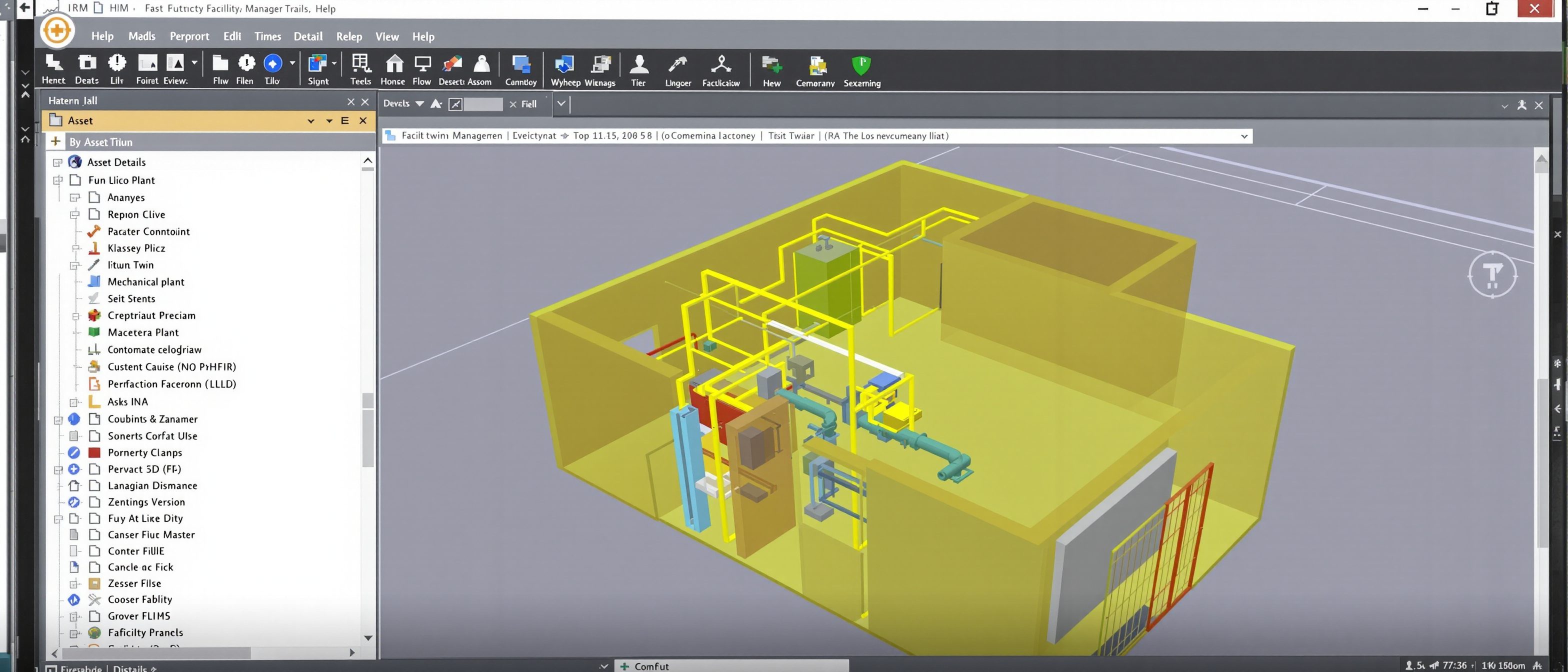
Facility Management with BIM
The model lives on — a digital twin for operation.
A building's design and construction take a few years; its operation lasts decades and costs far more — and BIM's longest-running value is here. Learn facility management with BIM — carrying the model into operation as a living digital twin for maintenance, assets and space; the structured handover of asset data (COBie); and the integrated, multi-disciplinary approach that lets one model serve design, analysis, construction and FM across the whole life.
Learning objectives
By the end of this lesson, you will be able to — mapped to the course outcomes for BIM-Based Construction Management:
Explain facility management with BIM and the digital twin.
Explain the structured handover of asset data (COBie).
Explain the integrated, multi-disciplinary, whole-life approach.
Judge why operation is BIM's longest-running value.
The model lives on
FM with BIM is a digital twin — click an asset and see its make, warranty, maintenance and manual; structured handover (COBie) delivers that asset data, built in along the way rather than scrambled late.[1, 2]
A digital twin for operation
Most of a building's cost and life are in OPERATION, not construction — and that is where BIM's data pays off longest. FACILITY MANAGEMENT with BIM carries the model and its ASSET data into operation as a DIGITAL TWIN: the facility manager can click a pump and see its make, warranty, maintenance schedule and manual; find every fire damper; plan a churn of offices on the real model; and plan a renovation from an accurate record. MISCONCEPTION→correct: 'the model is finished at handover' — for the owner the model is just BEGINNING its most valuable life; the design/build model becomes the operating record.[1]
One model, whole life
The deepest idea of BIM is integration — one model serving design, analysis, construction and FM across the whole life, instead of information being re-created and lost at each handover.[1, 3]
The integrated approach
The deepest idea of BIM is INTEGRATION: a single, multi-disciplinary model that serves DESIGN, ANALYSIS, CONSTRUCTION and FACILITY MANAGEMENT across the building's WHOLE LIFE, rather than information being re-created and lost at each handover between phases and parties. The architect's model feeds the engineer's analysis, the builder's 4D/5D, and the owner's FM — each adding to one evolving information asset. MISCONCEPTION→correct: 'each phase starts its information fresh' — the waste of traditional delivery is re-drawing and re-keying at every handover; BIM's promise is ONE continuous information thread from concept to demolition.[1, 3]
At a glance
| Aspect | Detail | Note |
|---|---|---|
| Design/build | A few years | Where BIM is usually thought to end |
| Operation | Decades, most of the cost | Where BIM's data pays off longest |
| FM with BIM | A digital twin | Click an asset → its full data |
| Handover | Structured data (COBie) | Not a box of PDFs, not late |
| Integration | One model, whole life | No re-drawing at each handover |
Key terms
Running and maintaining the building over its operating life.
The model + live data used to operate and maintain the real building.
The model and data the owner uses to manage the asset in operation.
A standard for handing over structured asset data for FM.
One model serving design, analysis, construction and FM, whole-life.
One continuous information thread from concept to demolition.
Studio task
Imagine you manage a finished hospital. List five pieces of asset data you would want attached to each air-handling unit in the BIM model, and explain why collecting them at handover (COBie) beats hunting for them later. Then describe one way the model helps you plan a future renovation.
Self-assessment
1. For a building owner, the BIM model's most valuable life —
2. COBie is —
3. The integrated BIM approach aims to —
Recap
References & further reading
- [1]Sacks, Eastman, Lee & Teicholz, BIM Handbook — BIM for facility/operations and whole-life integration.
- [2]COBie / buildingSMART — structured asset-information handover for facility management.
- [3]ISO 19650 — whole-life information management and the asset information model.
Further reading
- Sacks, Eastman, Lee & Teicholz — BIM Handbook (operations chapters).
- IFMA / BIFM — BIM for facility management guidance.
- ISO 19650 (part 3) — operational phase of assets.
Sources gathered and fact-checked June 2026. Published values vary by source, sample and method — treat as indicative and confirm against the cited standard before structural use.
The author
Amogh N P
Architect, interior designer, and creative polymath. Studio Matrx began in his notebooks — his vision of design made honest, useful, and open to everyone. Its Academy is written and taught in his memory, and free, forever.
More about Amogh →