
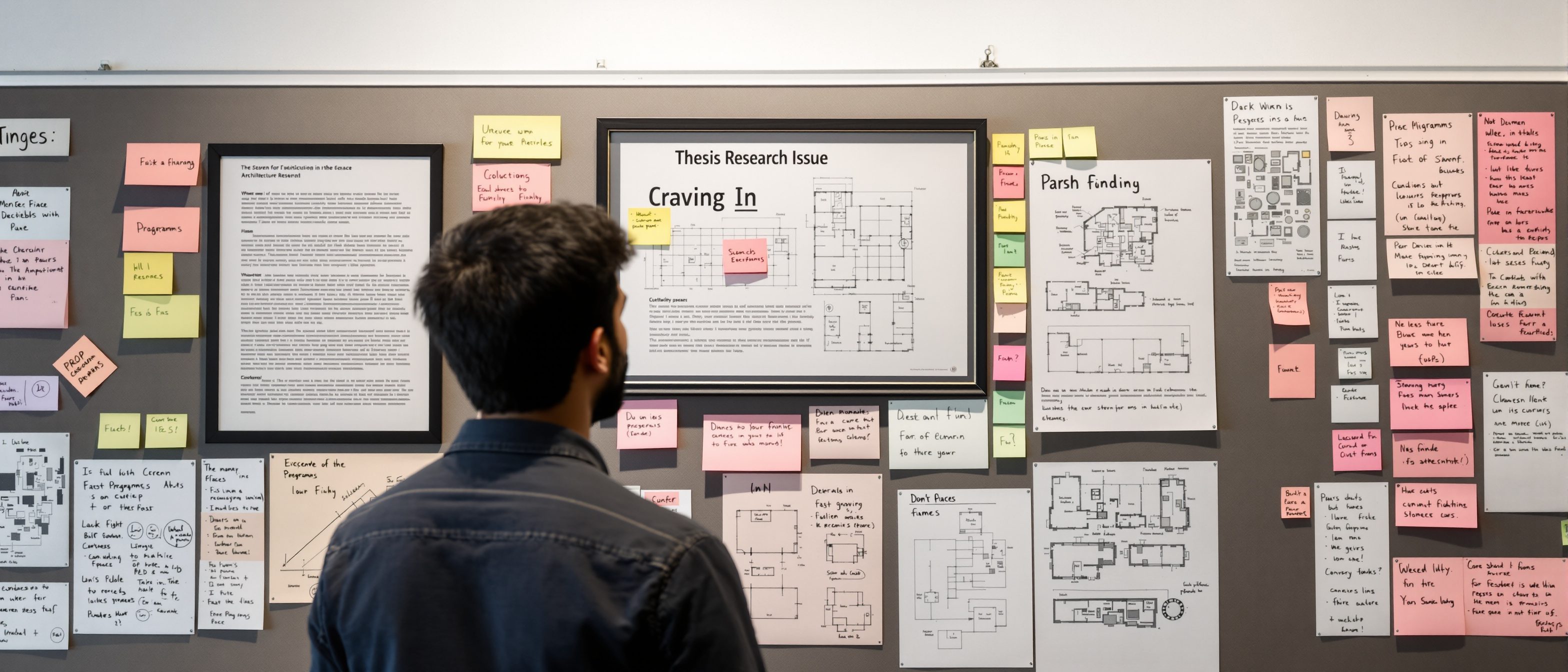
Topic, Issue & Programme
Choosing well, and giving the thesis a spine.
More theses are won or lost in the first month than in the last — in the choice of topic and the framing of the issue. Learn how to choose a topic you can sustain and resource; how to frame the issue, aim, hypothesis and objectives that give the thesis a spine; how to test a topic's viability before you commit; and how to define the programme and brief that bridge research to design. Try the topic-viability checker.
Learning objectives
By the end of this lesson, you will be able to — mapped to the course outcomes for the Architecture Thesis:
Choose a topic and area you can sustain and resource.
Frame the issue, aim, hypothesis and objectives.
Test a topic's viability before committing.
Define the programme and design brief.
Choosing a topic & framing the issue
A good topic sits where passion, feasibility and significance overlap; and a topic becomes a thesis when you frame its issue — a sharp, answerable question every later decision answers to.[1, 2]
Passion, feasibility, significance
The right thesis TOPIC sits where three things meet: PASSION (you will live with it for a year — it must genuinely interest you), FEASIBILITY (you can resource it — site, data, case studies, time and scope all reachable), and SIGNIFICANCE (it matters — addresses a real issue, not a vanity). Lean too far to passion and you may pick something un-researchable; too far to safety and you bore yourself; the art is the overlap. MISCONCEPTION→correct: 'pick the most ambitious or exotic topic to impress' — an over-ambitious, un-resourceable topic produces a weak, thin thesis; a feasible topic done deeply impresses far more. Choose what you can do WELL.[1]
Test your topic
Rate a topic on interest, feasibility, data access, design potential and significance — and see whether it is a strong topic, workable, or one to reframe before you commit a year.
Test your thesis topic · rate each 1–5
Weakest on "feasible scope". Reframe to shore that up before you commit a year.
Better to reframe a weak topic in month one than to discover the problem in month six.
Viability & the programme
Test a topic's viability early and reframe if weak; and the programme — your justified design brief — bridges research to design, with every space defended by research and the issue.[1, 2]
Before you commit
Before you commit a year, TEST the topic honestly against a few criteria: your genuine INTEREST, the FEASIBILITY of the scope in the time, whether you can ACCESS the data and a site to research it, its DESIGN potential (is it rich enough to make an interesting building?), and its SIGNIFICANCE. A topic weak on several should be reframed or dropped now, cheaply, not in month six. MISCONCEPTION→correct: 'commit fast and push through any problems' — a topic that fails viability does not improve by effort; the cheapest, wisest move is to test and reframe early. The checker below scores a topic against these criteria.[1]
At a glance
| Aspect | Detail | Note |
|---|---|---|
| Right topic | Passion ∩ feasibility ∩ significance | The overlap |
| Over-ambitious topic | Un-resourceable | Thin, weak thesis |
| Topic vs issue | 'A museum' | vs 'how can a museum survive floods?' |
| Test viability | Early, cheaply | Not in month six |
| Programme | Justified by research | Not invented intuitively |
Key terms
The project type and area — chosen for passion, feasibility and significance.
The specific question or problem the thesis addresses — its spine.
What you want to achieve, your proposed answer, the steps to it.
Whether a topic is interesting, feasible, researchable, designable and significant.
What the project contains — spaces, areas, users — derived from research.
Every space and area defended by research, standards and the issue.
Thesis task
Take a topic you are considering and run it through the checker; note your weakest criterion and how you would reframe to strengthen it. Then write your thesis ISSUE as a single sharp, answerable question, and sketch a one-page outline programme of the main spaces your project would need — each with a one-line justification.
Self-assessment
1. A good thesis topic sits at the meeting of —
2. The difference between a topic and an ISSUE is that an issue —
3. Every space and area in the thesis programme should be —
Recap
References & further reading
- [1]Groat & Wang, Architectural Research Methods — framing a research question and design issue.
- [2]Architectural programming texts (e.g. Pena, Problem Seeking) — the design brief and programme.
- [3]Institutional thesis guidelines — synopsis, issue and objectives.
Further reading
- William Pena & Steven Parshall — Problem Seeking: An Architectural Programming Primer.
- Groat & Wang — Architectural Research Methods.
- Borden & Rüedi — The Dissertation: An Architecture Student's Handbook.
Sources gathered and fact-checked June 2026. Published values vary by source, sample and method — treat as indicative and confirm against the cited standard before structural use.
The author
Amogh N P
Architect, interior designer, and creative polymath. Studio Matrx began in his notebooks — his vision of design made honest, useful, and open to everyone. Its Academy is written and taught in his memory, and free, forever.
More about Amogh →