
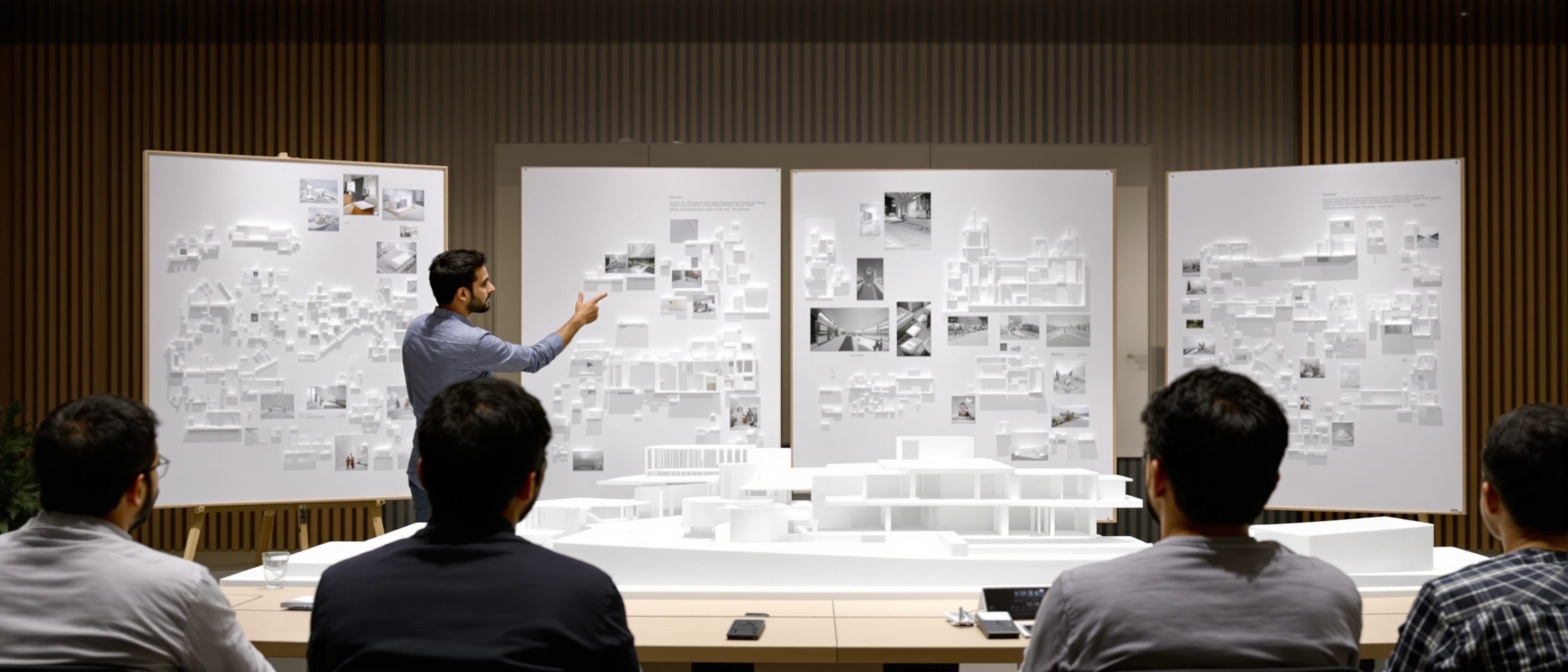
Deliverables & the Jury
Telling the story — and defending it.
A year of work is judged in a few hours — so how you present and defend the thesis matters enormously. Learn the deliverables — drawings, report, model and presentation — and how to make them communicate; how to tell a clear story from issue → research → response; and how to handle the jury / viva, where your thinking, not a perfect building, is assessed.
Learning objectives
By the end of this lesson, you will be able to — mapped to the course outcomes for the Architecture Thesis:
Produce the drawings, report, model and presentation.
Tell a clear story from issue to response.
Present and defend the project at the jury.
Judge what the jury actually assesses.
Deliverables & the story
The deliverables must communicate the argument — clarity beats volume; and a jury must be able to follow your thesis as a story: issue → research → site → design response.[1]
Make them communicate
The thesis is delivered as DRAWINGS (plans, sections, elevations, details, 3D), a project REPORT (the research, the issue, the analysis, the rationale), a MODEL, and a PRESENTATION. Their job is to COMMUNICATE your argument and design clearly — a brilliant thesis presented in cluttered, illegible boards fails to land. Plan them as a SET that tells one story, with clear hierarchy and consistent graphics. MISCONCEPTION→correct: 'more drawings and a thicker report are better' — clarity beats volume; a jury would rather follow ten clear, well-chosen drawings than drown in forty cluttered ones. Curate ruthlessly.[1]
The jury — and owning it
At the jury you present and defend your thinking — they assess how you framed the issue, used research and can justify decisions, not a perfect building; and the real product is the architect you have become.[1, 2]
Defend your thinking
At the JURY (or viva), you PRESENT the thesis and then DEFEND it under questions. Present with structure and confidence; then LISTEN to questions, answer HONESTLY (including 'I considered that and chose this because…' or even 'that is a fair limitation'), and defend your DECISIONS with your reasoning. The jury is not the enemy; they test whether you OWN and understand your project. MISCONCEPTION→correct: 'the jury wants a flawless building' — they assess your THINKING — how you framed the issue, used research, made and can justify decisions, and respond to challenge; a thoughtful thesis with honest limitations, well defended, beats a slick one its author cannot explain.[1, 2]
At a glance
| Aspect | Detail | Note |
|---|---|---|
| Deliverables | Communicate the argument | Not just exist |
| Volume | 10 clear drawings | > 40 cluttered ones |
| Boards & talk | Tell a story | Issue → research → response |
| The jury assesses | Your thinking | Not a perfect building |
| The real product | The architect you became | Not just the thesis |
Key terms
The drawings, report, model and presentation that communicate the thesis.
Ten clear drawings beat forty cluttered ones — curate ruthlessly.
Issue → research → site → design response, made explicit and followable.
Presenting and defending the thesis under questions.
Answer honestly with your reasoning — the jury tests your thinking.
Show you can carry a major project independently — the real graduation.
Thesis task — the final
Outline the SET of boards you would present, in order, so they tell one story from issue to design response — what goes on each, and which ten drawings you would choose if forced to cut to ten. Then write a 90-second spoken opening for your jury that states the issue, the research insight, and the design response. Finally, anticipate one hard jury question and your honest answer.
Self-assessment
1. In the thesis deliverables, the priority is —
2. At the jury, what is primarily assessed is —
3. Your boards and presentation should tell —
Recap
References & further reading
- [1]Institutional thesis-presentation and jury guidance — deliverables, communication and defence.
- [2]Presentation and critique literature (cross-link the Design Communication / Drawing courses).
- [3]Groat & Wang — communicating architectural research.
Further reading
- Borden & Rüedi — The Dissertation: An Architecture Student's Handbook.
- Groat & Wang — Architectural Research Methods (communicating research).
- Your institution's thesis presentation and jury guidelines.
Sources gathered and fact-checked June 2026. Published values vary by source, sample and method — treat as indicative and confirm against the cited standard before structural use.
The author
Amogh N P
Architect, interior designer, and creative polymath. Studio Matrx began in his notebooks — his vision of design made honest, useful, and open to everyone. Its Academy is written and taught in his memory, and free, forever.
More about Amogh →