
Architectural Writing & Criticism
Reporting, the feature, and the craft of architectural criticism.
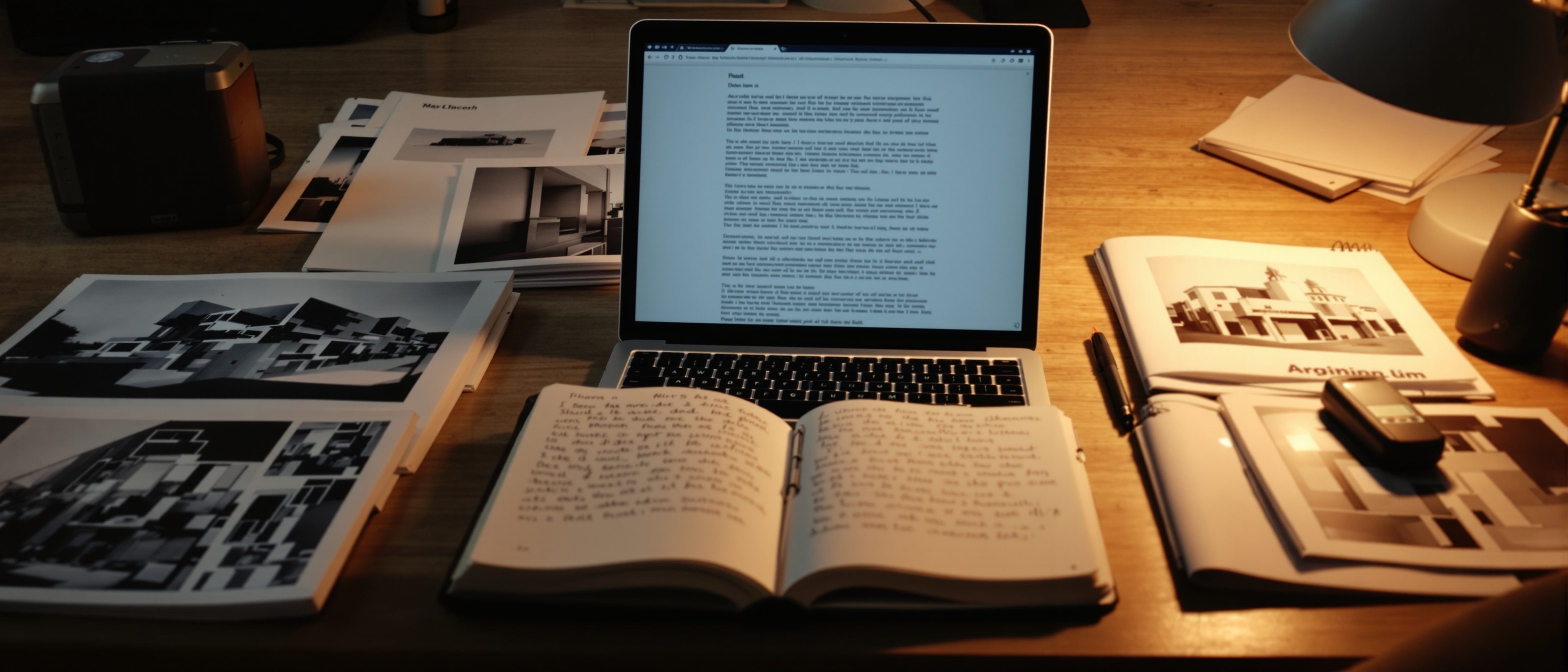
Writing well about architecture is a craft with rules. This unit covers the principles of journalistic writing — clarity, structure, the strong lead, the human angle — and the techniques of researching, interviewing and reporting. It teaches how to craft a compelling FEATURE. And it introduces architectural criticism — the disciplined analysis, interpretation and evaluation of buildings and urban spaces that separates real criticism from mere opinion or PR. To write about architecture is to learn to see it more clearly.
Learning objectives
By the end of this unit, you will be able to — mapped to the course outcomes for Architecture Journalism & Photography:
Apply the principles of journalistic writing and storytelling to an architectural topic.
Research, interview and report on a building or urban space.
Craft a compelling architectural feature and understand how journals compose content.
Apply the methods of architectural criticism — analysis, interpretation and evaluation.
Writing & reporting
Good writing is clear, structured and human; the feature is earned by research and interviewing — write to be read, not to impress.[1, 3]
Clear, structured, human
Good journalistic writing is CLEAR (plain, jargon-free language a general reader can follow — hard for architects trained in dense theory), STRUCTURED (a strong LEAD that hooks the reader, an organised body, a satisfying close), and HUMAN (it tells the story through people, scenes and stakes, not just facts). The 'inverted pyramid' puts the most important thing first; a FEATURE can be more narrative, but it still needs a spine. Write to be read, not to impress.[1]
Architectural criticism
Criticism is informed, argued, fair judgement — distinct from opinion and PR — working through analysis, interpretation and then evaluation; the critic's first duty is to look.[2, 11, 13]
Beyond opinion and PR
Architectural CRITICISM is the disciplined assessment of buildings and urban spaces — distinct from mere OPINION ('I like it') and from PR ('isn't it wonderful'). Real criticism is informed, argued, fair and based on the work itself. The great critics — Ada Louise Huxtable, Reyner Banham, Jane Jacobs, Alexandra Lange — taught the public to see and judge architecture, and held it to account. Criticism is not destruction; it is serious, evidence-based judgement in the public interest.[2, 11]
At a glance
| Aspect | One | The other |
|---|---|---|
| Good writing | Dense theory to impress | Clear, structured, human — to be read |
| The feature | Rewritten press release | Earned by research and interview |
| Criticism vs opinion | 'I like it' / PR | Informed, argued, fair, building-based |
| Order of criticism | Judge first | Analyse → interpret → THEN evaluate |
| Critic's first duty | Have a strong opinion | Look — honestly and for a long time |
Key terms
The opening of an article that hooks the reader and signals what it is about.
A news structure putting the most important information first.
A longer, more narrative article that tells a building or city as a story.
The specific way into a story — what makes it worth telling now.
Informed, argued, fair assessment of buildings — distinct from opinion and PR.
Describing and breaking down what a building is — form, space, structure, context.
Explaining what a building means and how it works and affects people.
Judging how good a building is against appropriate criteria — last, after looking.
Studio task
Visit a building you can access and write a 400-word critical piece on it: open with a strong lead, then ANALYSE what it is (form, space, materials, context), INTERPRET what it means and how it works for its users, and EVALUATE how good it is against fair criteria — looking closely before you judge. Note one question you would put to its architect in an interview.
Self-assessment
1. The three methods of architectural criticism, in order, are —
2. What most distinguishes real architectural criticism from mere opinion or PR?
3. A strong journalistic 'lead' is —
Recap
References & further reading
- [1]Friedlander, Edward Jay & Lee, John — Feature Writing for Newspapers and Magazines (4th ed., Longman, 2000).
- [2]Fuller, David & Waugh, Patricia (eds.) — The Arts and Sciences of Criticism (Oxford University Press, 1999).
- [3]Foust, James — Online Journalism (Holcomb Hathaway, 2005); Huckerby, Martin — The Net for Journalists (UNESCO, 2005).
- [7]Ward, S.J. — Philosophical Foundations of Global Journalism Ethics (2005).
- [11]Lange, Alexandra — Writing About Architecture (Princeton Architectural Press).
- [13]Pallasmaa, Juhani — The Architecture of Image: Existential Space in Cinema.
Further reading
- Edward Jay Friedlander & John Lee — Feature Writing for Newspapers and Magazines (2000).
- Alexandra Lange — Writing About Architecture.
- David Fuller & Patricia Waugh (eds.) — The Arts and Sciences of Criticism (1999).
Sources gathered and fact-checked June 2026. Published values vary by source, sample and method — treat as indicative and confirm against the cited standard before structural use.
The author
Amogh N P
Architect, interior designer, and creative polymath. Studio Matrx began in his notebooks — his vision of design made honest, useful, and open to everyone. Its Academy is written and taught in his memory, and free, forever.
More about Amogh →