
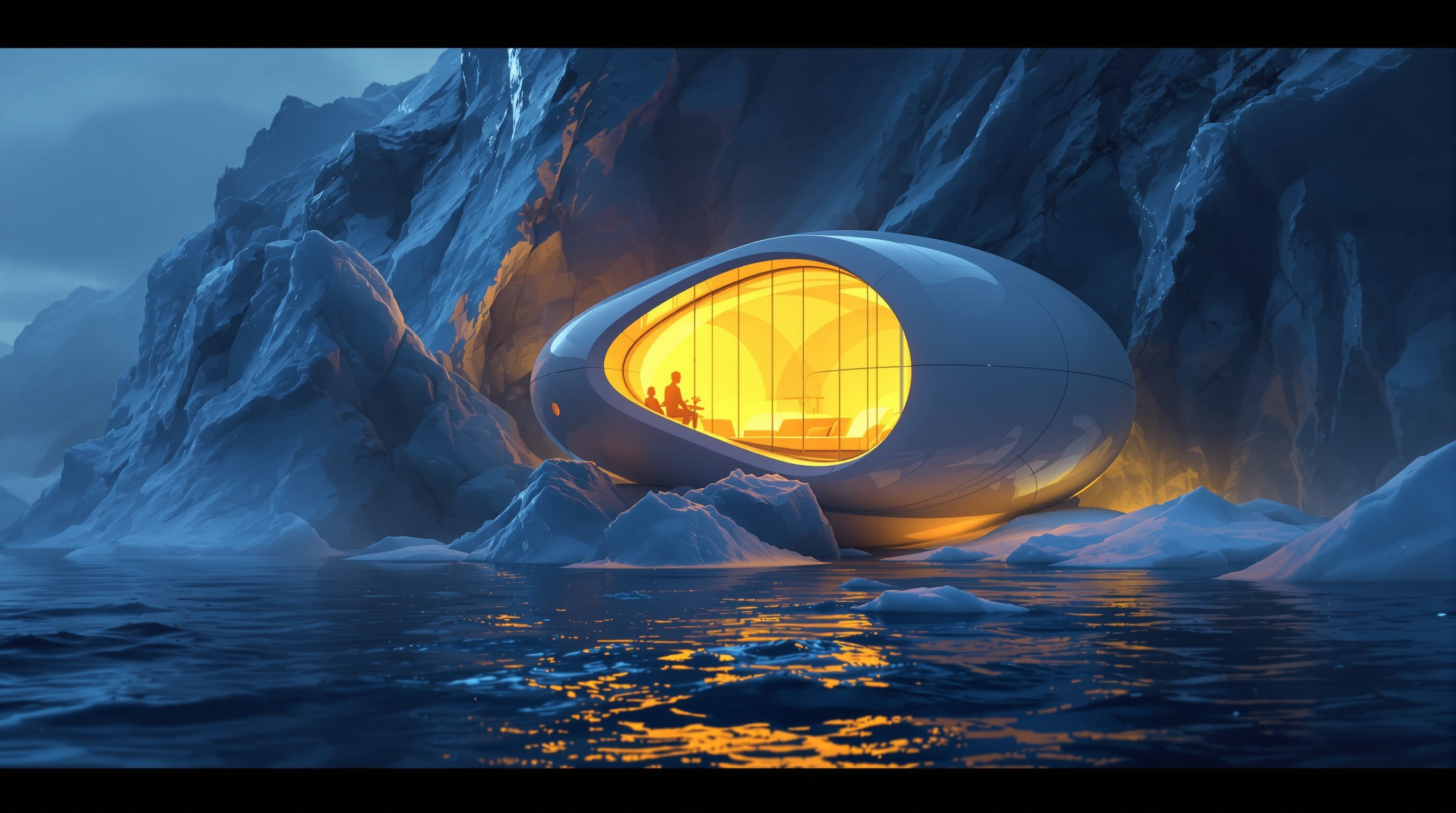
 Lesson 8.4
Lesson 8.4 · Leaving Earth I — Orbit & the Journey
The Human in the Capsule
The hardest problem in a sealed volume is not the machinery but the mind - isolation, confinement, monotony, danger and no way out grind on a crew over months, so the habitability of the interior (light, variety, privacy, a real view of Earth, a sense of the human) becomes a genuine survival system, tying space back to everything this whole program has taught about designing for people
The life-support machinery can keep a body breathing for a year. Keeping the mind intact for that year is a different problem - and it is the architect's.
Suppose every engineered system works flawlessly: the air is clean, the water recycles, the pressure holds, the temperature is right. The body is kept alive. And yet the crew is not safe, because there is another way a sealed, isolated, dangerous volume can break a human being, and it has nothing to do with the machinery. It is the mind. Months locked inside a small metal world, cut off from home, from weather, from privacy, from nature, from the ordinary flow of life; the same few faces, the same walls, the same tasks, day after identical day; a constant background of danger with no door to walk out of; a horizon that never changes. This is a psychological ordeal that the best life-support system in the world does nothing to touch.
And here is the turn this lesson makes, the one that brings the whole course home. The habitability of the interior - whether it has light and a sense of time, variety against monotony, somewhere to be alone, a real view of Earth, and the warmth of a place that feels human rather than mechanical - is not decoration laid over the survival systems. It is itself a survival system. A crew that comes apart psychologically is a crew in mortal danger, because in an environment this unforgiving, judgement, morale and cooperation are safety-critical. So the qualities that keep people well - exactly the qualities this program has argued matter in every building, for every human being - become, in the capsule, requirements as real as oxygen. Space, having stripped architecture down to survival, arrives at last at the most human conclusion of all.
The body can be kept alive by machinery - the MIND is the harder problem. 5 pressures compound: ISOLATION + CONFINEMENT + MONOTONY + DANGER + NO ESCAPE. So habitability = a SURVIVAL SYSTEM, not decoration: light/day-night rhythm, variety, privacy, a HUMAN feel, and above all a VIEW OF EARTH (crews treasure it most). Proof: a window is a dangerous hole in the pressure shell - included anyway, because seeing out = survival. Course comes FULL CIRCLE: keeping people alive means keeping people WELL. Clinical -> health pros. Engineering -> agencies. The human -> the designer.
Isolation, confinement, monotony, danger, no escape
To design for the human in the capsule you first have to name honestly what the capsule does to a human. Five pressures act at once, and they compound. Isolation: the crew is cut off from everyone and everything they know - family, friends, the whole living world - with communication that can be delayed or limited, and no possibility of going home early. Confinement: the habitable volume is small and fixed; there is nowhere new to go, no fresh room to walk into, no outside to step out to, and the same boundaries press in for months. Monotony: with an unchanging environment, a fixed routine, the same faces and the same view, the sensory and social variety a human mind depends on to stay well simply drains away, and days blur into one another. Danger: beneath everything runs the knowledge that the environment outside kills, that a serious failure could be fatal, and that there is no rescue close at hand - a low, constant stress that never fully lifts. And no escape: unlike almost any hard situation on Earth, you cannot leave, cannot take a break outside, cannot resign; you are committed to the volume and the crew for the whole mission.
Each of these is hard; together, over long durations, they are a genuine threat. The precise clinical toll they take - on sleep, mood, cognition, relationships and health - is real medicine, and this course defers all of it firmly to qualified health professionals and to the space agencies and researchers who study it; nothing here diagnoses or prescribes. But a designer does not need to be a clinician to grasp the architectural fact that follows: these pressures are, in significant part, shaped by the environment the crew lives in, and the environment is design. A volume that offers no variety deepens monotony; one with no private corner sharpens the strain of confinement and forced togetherness; one with no window to the world outside intensifies isolation; one that feels like a cold machine amplifies the sense of a hostile, alien place. Which means the interior is not a neutral backdrop to the psychological ordeal - it is one of the few things that can either worsen it or genuinely relieve it. Recognising that is the whole basis of treating habitability as survival, and it is where the architect's contribution to keeping a crew alive actually lies.
Why the interior is a survival system
It is tempting, in a life-and-death environment, to treat everything about the interior beyond bare function as an indulgence - to think that when survival is at stake, how a place looks or feels is a luxury you cannot afford. This lesson argues the exact reverse, and it is one of the most important ideas in the whole program. In a sealed, isolated, dangerous volume, the psychological wellbeing of the crew is safety-critical, so the qualities of the interior that protect that wellbeing are not luxuries but part of the life-support system. The logic is direct: a mission depends on the crew's judgement, alertness, morale and ability to cooperate under stress; those depend on the crew staying psychologically well over months; and staying well depends, in part, on living in an environment that supplies what the mind needs. A crew ground down by monotony, robbed of privacy, or sinking under isolation is not merely unhappy - it is a crew whose performance and safety are degraded in a place where degraded performance kills. Habitability, in that setting, is a survival requirement.
Once you accept that, the designer's task becomes clear and serious. The interior must actively provide the psychological equivalents of the physical resources the life-support system provides: light and a sense of time to hold the day-night rhythm the body and mind depend on, since orbit has no natural cycle; variety and change - in texture, layout, activity and stimulus - to fight the flattening monotony; privacy alongside connection, a place to withdraw and be a person alone as well as spaces to be together, because forced, unbroken togetherness is its own strain; a view out, above all of Earth, which crews report as the single most valued and restorative feature of all; and a human feel - warmth, dignity, a sense of a place rather than an apparatus - so the volume reads as somewhere people live, not merely a machine they are stored in. None of this is soft or optional; each maps directly onto a known psychological pressure and works against it. This is the parallel life-support system - physical systems keeping the body alive, habitability keeping the mind alive - and the second is as much a survival system as the first. It is also, precisely, the architect's and interior designer's domain: the engineering keeps the volume breathable and safe; making it humanly survivable is design.
Light, variety, privacy and a window on Earth
Look closely at the habitability ingredients, because each is a design response to a specific pressure, and together they show how concrete this survival system is. Light and the day-night rhythm: without a natural cycle, the interior must supply one, using changing light to give the day a shape, mark waking and rest, and keep the body's clock from drifting - a direct answer to monotony and to the disorientation of a place with no morning or evening. Variety: because sameness is corrosive, good design builds in change - different spaces for different activities, texture and colour against sensory flatness, greenery where it can be grown (plants offer psychological relief far beyond any food they yield), and small opportunities for novelty in an environment that offers none by default. Privacy: in a volume where the crew cannot get away from one another, even a small private space - a place to sleep, to have a private word with family, to simply be unobserved - relieves the grinding strain of total, forced togetherness, and its absence is one of the sharpest stressors crews report.
And then the view. Of everything the interior can offer, a real view of Earth is consistently the most treasured and restorative - the reason a dedicated viewing cupola on the station is among the most beloved places human beings have ever built. It answers several pressures at once: it breaks monotony with the most beautiful and ever-changing sight imaginable; it restores a sense of orientation and connection to home against isolation; and it gives meaning, perspective and awe in a place otherwise defined by threat and confinement. A window is, in engineering terms, a dangerous puncture in the pressure boundary - and the fact that it is included anyway, at real cost and risk, is the strongest possible proof that the human need to see out is understood as a survival factor, not a nicety. This is the deepest tie back to the whole program. Everything this course has argued about designing for the human being - that light, nature, variety, privacy, a view and a sense of dignity are what make a place fit for people - is not softened in the harshest environment there is; it is confirmed and intensified, because there, more than anywhere, a place that fails the human mind fails at survival.
Space brings the course back to the human being
This is where the module, and in a real sense the whole course, comes full circle. We began by stripping architecture down to survival - naming the six assumptions ordinary building rests on, watching them fail across flood, cold, heat, the deep and finally space, and following the envelope as it became total life support. It would be easy to conclude that in the most extreme environment, only the engineering matters and the human, humane concerns of design fall away. The opposite is true. At the far end of the spectrum, having reduced building to the barest question of keeping people alive, we find that keeping people alive turns out to require, irreducibly, keeping people well - and that is the architect's oldest and most human task. Space does not leave the human behind; it arrives, by the hardest possible road, at the conclusion that the human is the point.
That is the note to carry out of the module and toward the end of the program. The habitability of the interior - light, variety, privacy, a view, a sense of the human - is a genuine survival system in the capsule, which means the designer's contribution to the most extreme building there is is not cosmetic but literally life-supporting, exercised in humble partnership with the engineering that keeps the volume breathable and safe. And the lesson runs straight back to ordinary ground. If a place that feels human is a survival requirement in orbit, then the same qualities - daylight, variety, privacy, a view, dignity, a sense of nature - are never merely nice on Earth; they are what make any building genuinely fit for the people inside it, and a warming, crowded, increasingly stressed world needs that understanding more, not less. For India, whose human-spaceflight programme will one day ask exactly how to keep its own crew well inside a sealed volume, the question is not distant. Learn the human in the capsule, and you learn the truth the whole course has been circling: that architecture, even at the airless edge of the possible, is finally and always about the human being it shelters - which is why designing for people, honestly and with care, is the most important thing a designer ever does. Keep the clinical judgements with the health professionals; keep the survival engineering with the engineers; and keep, as your own, the making of places where human beings can not only survive but remain themselves.
Five pressures act at once
What the sealed volume does to the mind
Isolation, confinement, monotony, danger and no escape compound over long durations into a genuine threat. The precise clinical toll is real medicine, deferred to health professionals and the agencies that study it; the architectural fact is that these pressures are shaped by the designed environment. Modules 8.4, 7.3.
Habitability is a survival system
Why the humane interior is not a luxury
Judgement, morale and cooperation are safety-critical where a failure kills, so the interior qualities that protect crew wellbeing - light, variety, privacy, a view, a human feel - are part of life support, running in parallel with the physical systems. Modules 8.4, 10.1.
The view is survival, not decoration
The strongest single piece of evidence
A viewing window is, in engineering terms, a dangerous puncture in the pressure boundary; it is included anyway, at cost and risk, because a real view of Earth is the feature crews treasure most and a genuine restorative - proof that seeing out is understood as a survival factor. Module 8.4.
Design, not clinical or survival engineering
The limits of a designer's claims
Clinical determinations about crew mental and physical health belong to qualified health professionals and the agencies and researchers who study them; the systems that keep the volume breathable and safe belong to engineers. The designer owns the human habitability inside those guarantees. Modules 8.1, 8.2.
Workshop - design habitability as life support
This workshop makes the lesson's central idea concrete: you will map the psychological pressures of a sealed volume and design interior responses to each, treating habitability as a survival system - without making any clinical or engineering claims.
A plan or images of a small sealed habitat and a notebook. No engineering, no specifications and no clinical claims - this is about designing habitability as a survival system and drawing the boundaries; all clinical determinations stay with health professionals and the agencies that study crew health, and all life-support and safety engineering stays with qualified engineers, agencies, tested systems and the governing standards.
Goal: internalise habitability as survival by matching interior design responses to psychological pressures
Inputs: a plan or images of a small sealed habitat (a space capsule, a submarine, or a polar-station interior) + a notebook
Time: ~55 minutes
- 1List the five pressures of the sealed volume - isolation, confinement, monotony, danger, no escape - and write one honest sentence on how each would act on a person living inside for months. Note that the clinical effects are for health professionals; you are mapping the design context.
- 2For each pressure, name one interior quality that works against it (for example: monotony answered by variety; forced togetherness answered by privacy; isolation answered by a view out). Build a two-column table: pressure, and the habitability response.
- 3Take your chosen habitat and assess it honestly against your table: where does it supply each quality, and where does it fail? Mark the weakest point - the pressure least relieved by the current design.
- 4Sketch one concrete design improvement for that weakest point (for example: a small private nook, a changing light scheme to give the day a rhythm, a place for greenery, a better-used view). Explain in two sentences how it works against the specific pressure and why it counts as survival, not decoration.
- 5Write a one-paragraph reflection carrying the idea home: name one ordinary building on Earth (a hospital ward, a small flat, a classroom) and one way its habitability could be treated more like a survival system, and note where the clinical and engineering boundaries lie.
You’ll walk away with
A one-to-two-page study: the five pressures mapped to habitability responses, an honest assessment of a real sealed habitat against them, one concrete improvement for its weakest point argued as survival not decoration, and a reflection carrying the idea to an ordinary building - with the clinical and engineering boundaries named. Keep it; it closes the module and points to Module 10.
Three altitudes on the same idea
Read the band that fits you — or all three.
In a sealed volume the mind is as much at risk as the body: isolation, confinement, monotony, danger and no way out grind on a crew for months, and because judgement, morale and cooperation are safety-critical where a failure kills, the habitability of the interior becomes a genuine survival system rather than a luxury. That is the architect's most consequential contribution to the most extreme building there is. Design the interior to actively supply the psychological equivalents of the physical resources: light and a legible day-night rhythm against a world with no natural cycle; variety and change against corrosive monotony; privacy alongside connection against forced, unbroken togetherness; and, above all, a real view of Earth, the feature crews treasure most - so valued that a window is justified even though it is a dangerous puncture in the pressure boundary, which is itself proof that seeing out is understood as survival, not decoration. Exercise this in humble partnership with the engineering that keeps the volume breathable and safe, and defer every clinical determination about crew health to qualified health professionals and the space agencies and researchers who study it. The truth to carry home: if a humane interior is survival in orbit, then daylight, variety, privacy, a view and dignity are never merely nice on Earth either - they are what make any building fit for people.
This is the lesson where the whole program's argument about designing for the human being reaches its sharpest possible form: in a capsule, the interior closest to the body and the mind is a survival system, because a crew ground down by monotony, robbed of privacy or sinking under isolation is a crew in real danger where degraded performance kills. Your domain here is life-supporting, not cosmetic. Learn to make the smallest, most sealed, most dangerous interior imaginable genuinely liveable over long, stressful months: supply light that gives the day a shape and holds the body's clock when there is no natural cycle; build in variety - different spaces, texture, colour, greenery where it can be grown - against sensory flatness; carve out privacy, even a small place to be unobserved and have a private word with home, against forced togetherness; and treat a real view of Earth as the single most restorative feature there is. Read the humble truth in the fact that a window, a dangerous breach of the pressure shell, is included anyway: the human need to see out is survival. But hold the boundary firmly - the systems that keep the interior breathable, pressurised, warm and safe belong to engineers and agencies, and the clinical care of the crew to health professionals; your domain is the human habitability wrapped around the survival they guarantee.
The most human idea in the whole course lives in its most extreme lesson: in a sealed volume the mind is as much at risk as the body, so the habitability of the interior - light, variety, privacy, a real view of Earth, a human feel - is not decoration on top of survival but a genuine survival system. Learn the five pressures the capsule imposes: isolation (cut off from everyone and everything), confinement (nowhere new to go, no outside to step into), monotony (the same faces, walls and view for months), danger (the outside kills, no rescue near), and no escape (you cannot leave). The clinical toll they take is real medicine - defer it to health professionals - but the architectural fact is plain: those pressures are shaped by the environment the crew lives in, and the environment is design. So the interior must actively provide the psychological equivalents of oxygen and water: a day-night rhythm, variety, privacy, and above all a view of Earth, the feature crews treasure most - so valued that a window is included even though it dangerously punctures the pressure shell. This is the course coming full circle: having stripped architecture down to survival, we find survival requires keeping people well, which is the architect's oldest task. Even at the airless edge of the possible, architecture is about the human being it shelters.
“When survival is on the line - in a space capsule, a submarine, a flood shelter - things like light quality, privacy, variety and a nice view are luxuries you deal with later. First you keep people alive with the engineering; comfort and psychology are soft concerns for calmer situations.”
Do it yourself
No tools needed - reason it through.
- 1Name the five psychological pressures of a sealed volume and explain how they compound over a long mission.
- 2Explain why the habitability of the interior is a survival system rather than a luxury, using the chain from wellbeing to performance to safety.
- 3Match at least four interior qualities (light, variety, privacy, a view, a human feel) to the specific pressures each works against.
- 4Why is the inclusion of a viewing window, despite the engineering risk, the strongest evidence that seeing out is a survival factor?
- 5How does this lesson bring the whole course full circle, and what does it say about designing for people in ordinary buildings on Earth?
The one line to carry out
Peer-reviewed journals & authoritative standards
- 01Effect of spaceflight on the human body — Wikipedia - Effect of spaceflight on the human body, 2026.
- 02Space architecture — Wikipedia - Space architecture, 2026.
- 03Human spaceflight — Wikipedia - Human spaceflight, 2026.
- 04Space habitat — Wikipedia - Space habitat, 2026.
Space has taught the course its purest lessons - the envelope as total life support, the closed loop, the most extreme building, and the human whose mind must be kept whole. Next, in Leaving Earth II, we take these lessons to the surfaces of other worlds: building on the Moon and Mars, using what is found there, and the honest timeline of settlement - held to the same excited literacy without credulity.
The author
Amogh N P
Architect, interior designer, and creative polymath. Studio Matrx began in his notebooks — his vision of design made honest, useful, and open to everyone. Its Academy is written and taught in his memory, and free, forever.
More about Amogh →