
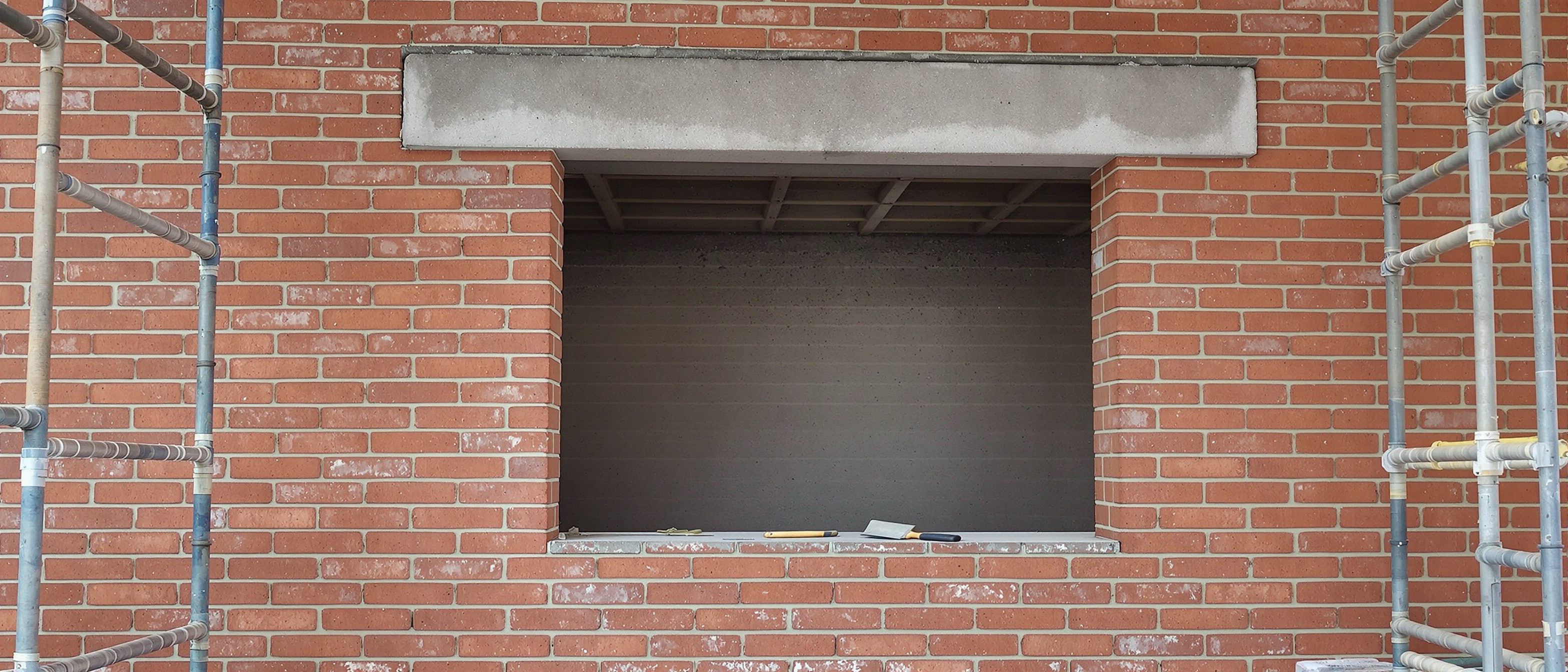
Walls, Floors, Roofs & Waterproofing
The wall section, the chajja drip, the parapet turn-up — keeping water out.
The vertical wall section, cut from footing to parapet, is the master detail that ties the whole building together — every other detail hangs off it. Learn masonry coursing and wall thickness, the lintel and the chajja with its essential drip groove, the sill, floor build-up layers, the slab and parapet junctions, and the RCC flat roof that must always slope to its outlets. The unifying lesson is the three waterproofing moves: every flat surface needs a fall, every junction a turn-up, every projection a drip.
Learning objectives
By the end of this lesson, you will be able to — mapped to the course outcomes for Architectural Detailing and Working Drawing:
Draw the wall section from footing to parapet as the master integrating detail.
Detail the lintel, chajja (with drip and slope) and sill correctly.
Detail floor build-up, slab-to-wall and parapet junctions, and the flat/pitched roof.
Apply the waterproofing principles — fall, turn-up and drip — at every junction.
The wall section
From footing to parapet on one drawing — coursing set on whole bricks, the lintel with its bearing, and the chajja with its top slope and underside drip.[2, 4]
Everything hangs off it
The wall section, cut footing-to-parapet at 1:20, ties the building together: footing, PCC, plinth beam, DPC, floor build-up, the wall and its plaster, each slab, the lintel and chajja, the sill, the upper slab, parapet and roof waterproofing. Draw it tall and narrow with a continuous RL stack on one side (FFL, lintel, slab soffit, roof, parapet top) and material notes on the other.[4]
Floors, roofs & waterproofing
Build floors up layer by layer; slope the “flat” roof to its outlets; and cove the waterproofing up the parapet — the principles that keep water out.[1, 4, 5]
Layer by layer
Ground floor (top down): finish (tile/marble/IPS) → bedding screed → PCC/RCC bed → compacted filling → DPC/anti-termite. Upper floor: finish → screed → RCC slab → plaster soffit. At flooring junctions show a divider/threshold strip and level transitions — account for finish thickness so the door doesn't foul a thick tile.[4]
At a glance
| Aspect | Flat roof | Pitched roof |
|---|---|---|
| Drainage | Flat roof: internal slope ~1:100 | Pitched roof: steep pitch to eaves/gutter |
| Covering | Flat: coba + waterproofing + wearing course | Pitched: tiles/sheets on battens |
| Edge | Flat: ~1.0 m parapet with coving | Pitched: eaves overhang + gutter |
| Usable terrace | Flat: yes | Pitched: generally no |
| Key risk | Flat: ponding at low points | Pitched: leaks at lap; soaked walls if no overhang |
Key terms
The vertical cut from footing to parapet — the master detail every other junction hangs off.
An RCC cantilever sunshade over an opening, top-sloped with an underside drip groove.
An underside groove on a projection that forces rainwater to drip off, not track back.
Waterproofing carried up a vertical face at a horizontal junction (e.g. up the parapet).
An Indian terrace layer of broken bricks + mortar giving slope and waterproofing.
A waterproofed rainwater-outlet mouth at a roof low point, leading to a downtake pipe.
Studio task
Draw a 1:20 wall section from footing to parapet for a single-storey room with one window: show the plinth and DPC, the coursing, the lintel (bearing ≥150 mm), the chajja with its top slope and drip groove, the sill, the floor build-up, the roof slab with a ~1:100 fall to an outlet, and the parapet with the waterproofing coved up and a dripped coping. Add the RL stack on one side.
Self-assessment
1. A chajja must be detailed with a drip groove and top slope primarily to —
2. The typical fall provided on an RCC 'flat' roof toward the outlets is about —
3. Cantilever reinforcement in a chajja or balcony slab is placed —
Recap
References & further reading
- [1]National Building Code of India 2016, Part 4 (parapet/railing) and Part 6 (Structural Design).
- [2]BIS, IS 2212 (Brickwork) and IS 1077 (common burnt-clay bricks).
- [3]R. Barry, The Construction of Buildings (walls, roofs, waterproofing).
- [4]W.B. McKay, Building Construction; Francis D.K. Ching, Building Construction Illustrated.
- [5]S.C. Rangwala, Building Construction (Indian roof, coba and waterproofing practice).
Further reading
- Francis D.K. Ching — Building Construction Illustrated.
- W.B. McKay — Building Construction.
- S.C. Rangwala — Building Construction.
Sources gathered and fact-checked June 2026. Published values vary by source, sample and method — treat as indicative and confirm against the cited standard before structural use.
The author
Amogh N P
Architect, interior designer, and creative polymath. Studio Matrx began in his notebooks — his vision of design made honest, useful, and open to everyone. Its Academy is written and taught in his memory, and free, forever.
More about Amogh →