
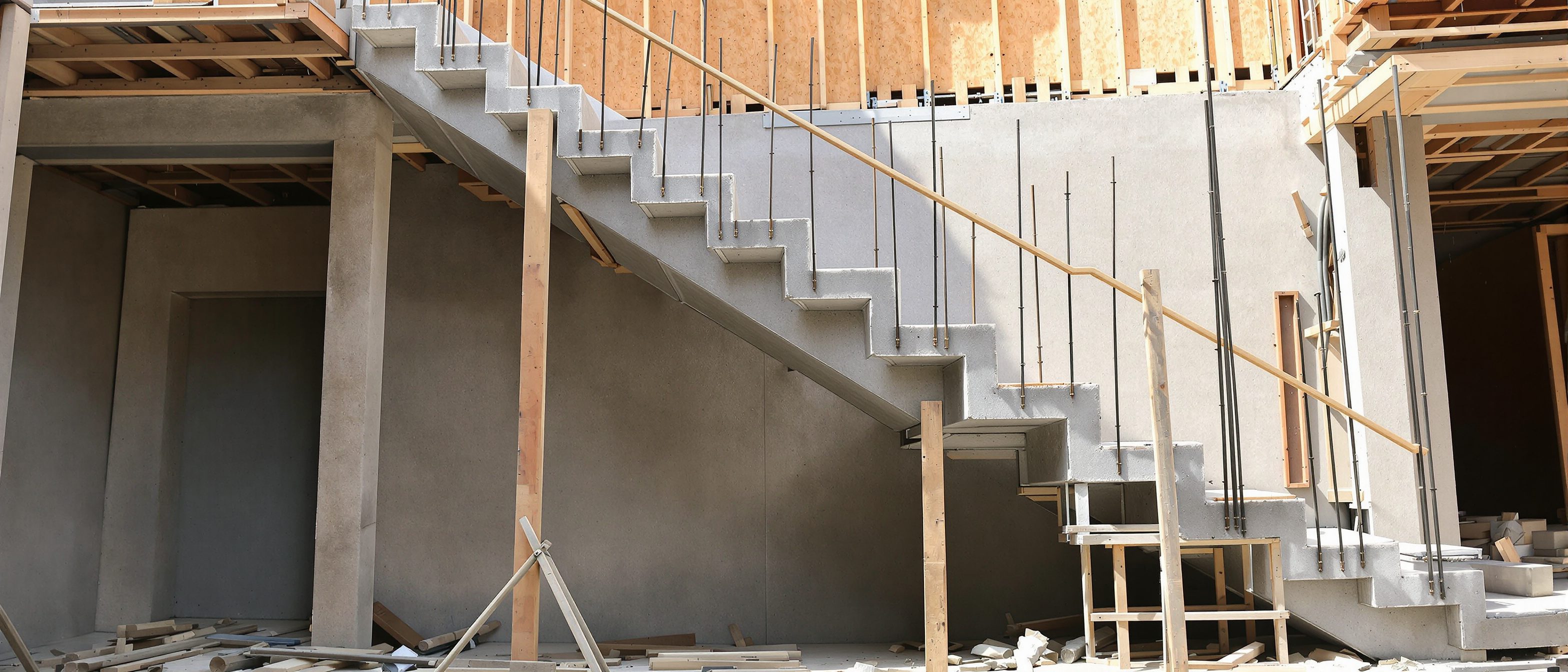
Staircase, Toilet & Services
The 2R+T rule, the sunk slab that drains, and coordinating the trades.
A comfortable stair obeys the 2R+T rule (2×riser + tread ≈ 600–640 mm) with headroom of at least 2.1 m — get this wrong and the stair is tiring or unsafe. Learn to set out a flight (treads = risers − 1), the dog-legged vs open-well stair, and how to represent waist-slab reinforcement. Then the wet areas: the sunk slab that conceals plumbing, the floor fall to the nahani trap, the waterproofing turn-up and ledge wall — and how to coordinate plumbing and electrical service runs across the whole drawing set.
Learning objectives
By the end of this lesson, you will be able to — mapped to the course outcomes for Architectural Detailing and Working Drawing:
Set out a staircase by the 2R+T rule with correct riser, going, headroom and width.
Detail dog-legged and open-well stairs and represent waist-slab reinforcement.
Detail a wet area — sunk slab, floor fall, nahani trap, waterproofing and ledge wall.
Coordinate plumbing and electrical service runs across the drawing set.
Staircase detailing
Set the riser and going to satisfy 2R+T with ≥2.1 m headroom; set out with treads = risers − 1; and anchor the waist-slab bars correctly at the re-entrant flight/landing corner.[1, 3]
The governing rules
A comfortable stair obeys 2R + T ≈ 600–640 mm (Blondel): going/tread 250–300 mm, riser 150–190 mm — a steeper riser pairs with a shorter going. Headroom (nosing line to the flight above) must be ≥2.1 m. Number of risers = floor-to-floor ÷ riser. A stair of 300 going + 175 riser (= 650) is too long-and-steep — recompute into range.[1]
Toilet, wet areas & services
Drop the slab in wet areas, slope the floor to a sealed nahani trap, turn the waterproofing up the walls with a ledge wall, and coordinate plumbing and electrical runs across the set.[2, 3, 5]
Drop the slab
Draw the enlarged toilet plan at 1:25/1:20 with fixtures (WC, basin, shower, floor trap) and clearance/tile-setting-out dimensions (WC needs ~600 mm clear width, ~600 mm in front). Wet areas need a SUNK SLAB — the structural slab dropped ~200–300 mm below the surrounding FFL — so plumbing and the fall fit and the finished floor matches the adjacent rooms.[2, 3]
At a glance
| Aspect | One | The other |
|---|---|---|
| Well space | Dog-legged: none (flights back-to-back) | Open-well: central well between flights |
| Area needed | Dog-legged: compact | Open-well: larger footprint |
| Handrail | Dog-legged: returns at landings | Open-well: can run continuously |
| Stair width | Residential: ≥ 1.0 m | Public egress: ≥ 1.2 m (NBC) |
| Wet-area floor | Myth: same level, flat | Reality: sunk slab + fall 1:80–1:100 to trap |
Key terms
The horizontal depth of a step walked on (250–300 mm).
The vertical height between treads (150–190 mm).
Blondel's comfort relation: 2×riser + tread ≈ 600–640 mm.
The inclined RCC slab forming the structural stair flight (~150–200 mm).
A floor drain with a ~50 mm water seal preventing sewer-gas entry.
A slab lowered ~200–300 mm in wet areas to conceal plumbing and provide the fall.
Studio task
For a floor-to-floor height of 3.0 m, design a dog-legged stair: choose a riser and going that satisfy 2R+T (≈600–640), compute the risers and treads, and draw the plan and section with the mid-landing, headroom and waist slab. Separately, draw an enlarged toilet plan and section showing the sunk slab, the fall (~1:80) to a nahani trap, the waterproofing turn-up and the ledge wall.
Self-assessment
1. Which combination satisfies the 2R+T comfort rule (≈ 600–640)?
2. The minimum clear headroom on a staircase is —
3. A toilet floor is sloped at ~1:80–1:100 in order to —
Recap
References & further reading
- [1]National Building Code of India 2016, Part 4 (stairs — going/riser, headroom, width, railings).
- [2]National Building Code of India 2016, Part 9 (Plumbing Services); IS 1742 / IS 2064 / IS 2065 (sanitation).
- [3]Francis D.K. Ching, Building Construction Illustrated (stairs, baths, plumbing details).
- [4]W.B. McKay, Building Construction (stair geometry and construction).
- [5]S.C. Rangwala, Building Construction & Water Supply and Sanitary Engineering (Indian toilet/plumbing detailing).
Further reading
- Francis D.K. Ching — Building Construction Illustrated.
- W.B. McKay — Building Construction.
- S.C. Rangwala — Building Construction; Water Supply and Sanitary Engineering.
Sources gathered and fact-checked June 2026. Published values vary by source, sample and method — treat as indicative and confirm against the cited standard before structural use.
The author
Amogh N P
Architect, interior designer, and creative polymath. Studio Matrx began in his notebooks — his vision of design made honest, useful, and open to everyone. Its Academy is written and taught in his memory, and free, forever.
More about Amogh →