
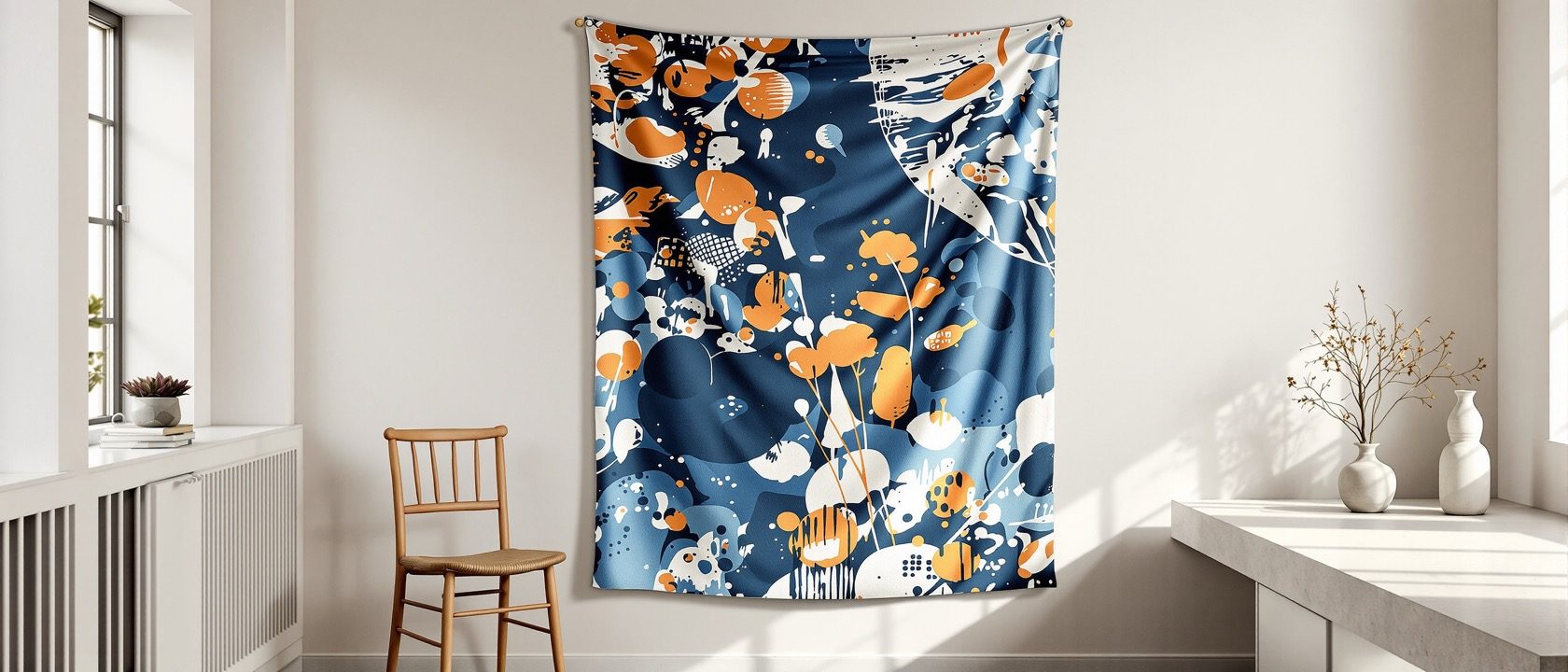
The Fabric Project
From concept to a live-scale piece — made, and coordinated
The capstone: a fabric design for furniture, a wall hanging or a wall covering, developed at live scale — from concept through motif and repeat to a chosen print method, a sample, and a full-scale piece made in workshop with an external craftsperson. A motif that reads well small can fail across a room, so test at scale. And the fabric is coordinated with wood, metal and stone, and specified to be beautiful and fit-for-purpose — safe and durable for its use.
Learning objectives
By the end of this lesson, you will be able to — mapped to the course outcomes for Advanced Workshop:
Develop a textile from concept through motif and repeat to a live-scale piece.
Coordinate the fabric with other materials in a multi-material composition.
Test a design at scale and specify it safely and durably for its interior use.
From concept to cloth
The project runs the whole arc: concept → motif → repeat → chosen print method → sample → live-scale piece, made in workshop with an external craftsperson. And ‘the small sample is the final look’ is a myth: a pattern can overwhelm or vanish at room scale, so test at scale before committing.[1]
The whole project, made
The course ends by MAKING: a fabric design concept for FURNITURE, a WALL HANGING or a WALL COVERING, developed at LIVE scale. The workflow runs the whole arc of everything learned. CONCEPT (the idea, the brief, the room it is for) leads to a MOTIF, which is built into a seamless REPEAT, in a chosen COLOURWAY. Then a PRINT METHOD is chosen — block for hand-mark character, screen for flat coverage and detail — and a SAMPLE is printed and judged. Finally the piece is made at FULL scale, often in workshop with an EXTERNAL craftsperson (a master block-printer or screen-printer), whose skill turns the design into real cloth. This is the point of the whole workshop: to take a textile from idea to made, understanding every step.[1]
Fabric with materials, specified safely
A textile never sits alone: the final skill is coordinating fabric with wood, metal and stone into a multi-material composition that works — developed through workshop, by making and judging real materials. And the finished cloth must be beautiful and fit-for-purpose: flame-retardant where required, durable for its traffic.[1, 4]
Multi-material composition
A textile in an interior never sits alone; it lives beside WOOD, METAL, STONE, glass and other fabrics. The final skill of this workshop is COORDINATING fabric with those other materials into a MULTI-MATERIAL composition that works — a printed cushion against a wooden chair and a stone floor; a wall hanging beside a metal frame. The designer weighs how colours, textures, weights and characters sit together: does the fabric complement or fight the wood; does its scale suit the room; does its warmth balance the hard materials? This is composition in three dimensions and many materials at once, and it is developed, as the course says, through WORKSHOP — by making, placing, judging and adjusting real materials together, not by theory alone.[1, 4]
At a glance
| Aspect | The fact | The folklore |
|---|---|---|
| The fabric project runs | Concept → motif → repeat → print method → sample → live-scale piece | Straight to a final print |
| It is made | In workshop, often with an external master craftsperson | Alone, on screen only |
| 'The small sample is the final look' | A myth — patterns change at room scale; test at scale | True — the swatch is enough |
| Fabric in a room | Is coordinated with wood, metal, stone — multi-material composition | Stands alone |
| Composition is developed | Through WORKSHOP — making, placing, judging real materials | By theory alone |
| The finished textile must be | Beautiful AND fit-for-purpose — safe and durable for its use | Only beautiful |
Key terms
The capstone — a textile concept for furniture, a wall hanging or wall covering, developed from concept through motif, repeat, print method and sample to a live-scale made piece.
The real, full size of the finished piece — where a design must finally be judged, because a pattern that reads well on a swatch can overwhelm or vanish across a room.
Making the piece with an external master craftsperson (block-printer or screen-printer), whose skill turns the design into real cloth — the designer collaborating with the maker.
Coordinating fabric with wood, metal, stone, glass and other fabrics so their colours, textures and weights work together — composition in three dimensions and many materials.
Printing a large sample or mocking a design up at real size in the real place and light before committing — because the eye judges a pattern by the whole surface, not the swatch.
A finished textile that is not only beautiful but safe (flame-retardant where required) and durable (a high rub count for busy use) for its real interior — the two halves of one job.
Study task
Design a complete fabric project for one real use — a cushion, a curtain, a wall hanging or a wall covering for a room you know. Run the whole arc: state the concept and the room; design a motif; build a seamless repeat in a chosen colourway; choose a print method (block for hand-mark character, screen for flat coverage) and justify it; and describe the sample you would print and how you would test it at live scale before committing. Then place it: how would this fabric be coordinated with the wood, metal and stone in the room? Finally, specify it responsibly — is the base cloth safe (flame-retardant where needed) and durable enough for the use? The goal is a textile that is beautiful and fit-for-purpose, taken from idea to a made, placed piece.
Self-assessment
1. What is the arc of the fabric project?
2. Why must a design be tested at scale?
3. What is multi-material composition?
4. When is a designed textile actually finished?
Recap
References & further reading
- [1]June Fish, Designing and Printing Textiles, The Crowood Press — developing a textile from concept to a finished, live-scale printed piece. https://www.crowood.com/
- [4]Corky Binggeli, Materials for Interior Environments, and Marypaul Yates, Fabrics — coordinating fabric with other materials and specifying it safely and durably for interior use. https://www.wiley.com/
Further reading
- June Fish, Designing and Printing Textiles, The Crowood Press.
- Corky Binggeli, Materials for Interior Environments.
- Marypaul Yates, Fabrics: A Guide for Architects and Interior Designers.
Sources gathered and fact-checked June 2026. Published values vary by source, sample and method — treat as indicative and confirm against the cited standard before structural use.
The author
Amogh N P
Architect, interior designer, and creative polymath. Studio Matrx began in his notebooks — his vision of design made honest, useful, and open to everyone. Its Academy is written and taught in his memory, and free, forever.
More about Amogh →