
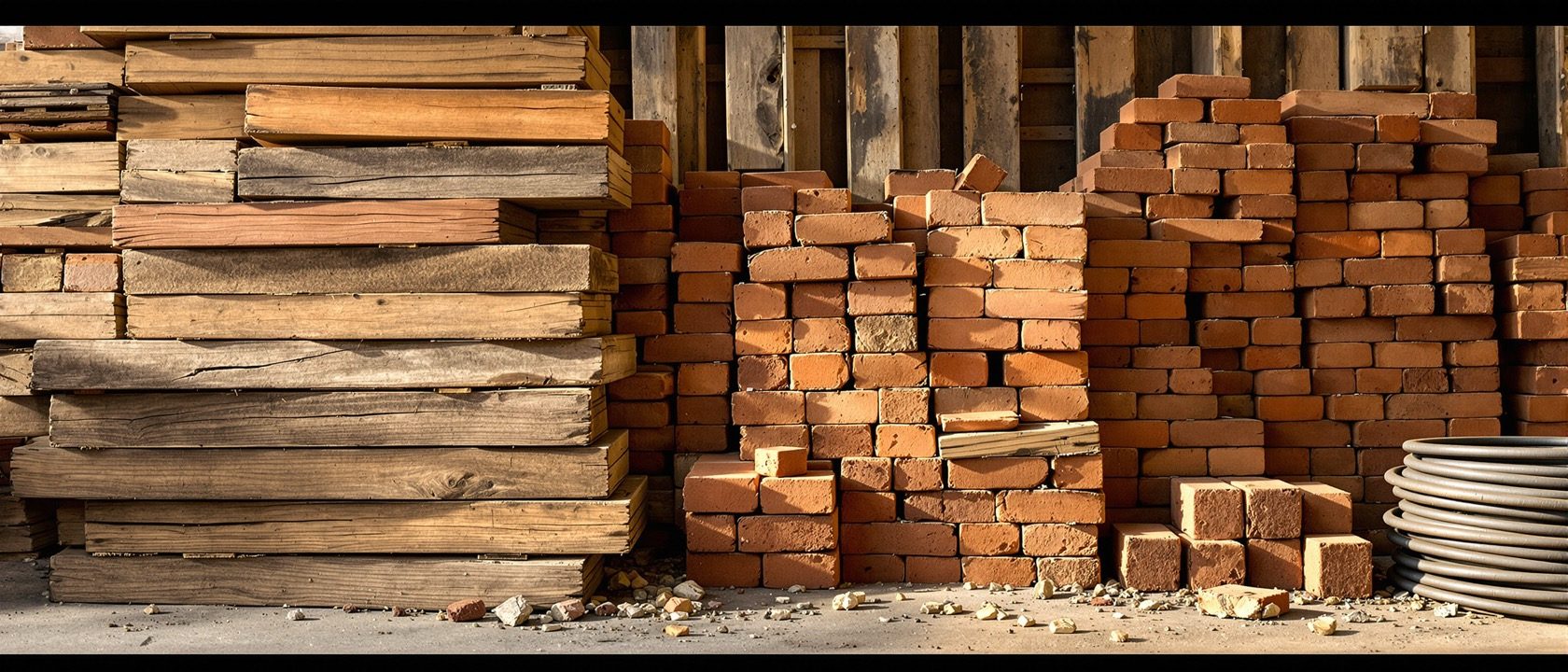
The Need for Recycling of Materials
What can be reused, what cannot — and the honest difference
The logic of recycling is simple: materials are finite and costly to make, so closing the loop keeps them in use and out of landfill — the circular economy. But the honest lessons matter more than the slogan. Reuse (keep a material as itself) beats recycling, which beats downcycling; steel and glass recycle almost infinitely while reclaimed timber is often finer than new; and — the key myth to clear — not everything is recyclable. This unit sorts the real from the wishful.
Learning objectives
By the end of this lesson, you will be able to — mapped to the course outcomes for Adaptive Reuse & Recycling:
Explain the logic behind recycling and the circular economy.
Differentiate the materials that can be recycled or reused from those that cannot.
Judge the quality of reclaimed timber and the criteria for recycling steel and glass.
The logic of recycling
Recycling closes the loop — recovering a used material and remaking it — so ‘waste’ becomes a resource again. The circular economy moves from take–make–throw to keeping materials at their highest value. But reuse, recycling and downcycling are not the same thing.[2, 3]
Waste is a resource in the wrong place
The LOGIC behind recycling is simple and powerful: the earth's materials are FINITE, extracting and making them costs huge energy and carbon and damages the land, and throwing them away wastes all of that and fills the ground with rubbish. RECYCLING closes the loop — it recovers a used material and remakes it into a new one, so 'waste' becomes a RESOURCE again. This is the heart of the CIRCULAR ECONOMY (the Ellen MacArthur Foundation's idea): move from the linear TAKE–MAKE–THROW model to one that keeps materials in use at their highest value for as long as possible. For a building, this means seeing it and its materials not as future waste but as a BANK of resources — steel, timber, glass, brick, stone — to be kept circulating. But (and this is the honest part) not all materials recycle equally, and recycling is not the same as reuse. The rest of this unit sorts the real from the wishful.[2, 3]
Steel, timber & glass
Steel recycles almost endlessly keeping its strength; glass recycles infinitely as ‘cullet’ if sorted and clean; and timber is best reused whole and is often denser and finer than new — but its quality must be estimated, not assumed.[2, 3]
The recyclable three
The syllabus names three materials, and each behaves differently. STEEL is recycling's success story: it can be melted and reformed almost ENDLESSLY without losing its strength — a beam from a demolished building becomes new steel — and most structural steel already is recycled; the criteria are sorting by grade and removing coatings and contaminants. GLASS is infinitely recyclable IN PRINCIPLE: crushed into 'cullet' and melted into new glass with the same clarity — but only if it is SORTED by colour and kept clean, because ceramics, laminated and tempered glass contaminate a batch. TIMBER is best REUSED whole: old reclaimed timber is often DENSER and finer than new (old-growth wood), a real prize — but its quality must be ESTIMATED, not assumed. Three materials, three honest stories: metal recycles beautifully, glass recycles fussily, and good old timber is often better reused than anything new.[2, 3]
What cannot be reused
Thermosets, laminates, composites, treated and contaminated materials, and mixed assemblies often cannot be economically recycled at all; concrete can essentially only be downcycled. Knowing what can and cannot be reused, and designing for disassembly, is real craft. Explore each material honestly below.[2, 3]
'Everything is recyclable' is a myth
The most important honest lesson of this unit: NOT everything is recyclable, and pretending otherwise is greenwashing. THERMOSET plastics, LAMINATES, COMPOSITES (like fibre-reinforced panels), TREATED and CONTAMINATED materials, and MIXED multi-material assemblies (a panel that is foam bonded to board bonded to foil) often cannot be economically recycled AT ALL — they are burned or buried. CONCRETE, the world's most-used material, can essentially only be DOWNCYCLED, crushed into aggregate; its cement's embodied carbon is spent and unrecoverable. Even 'recyclable' materials fail if they are dirty or mixed. So a real part of the craft is knowing what CAN and CANNOT be reused (the syllabus's differentiating the materials that cannot be reused), choosing materials that CAN be recycled, and DESIGNING FOR DISASSEMBLY — bolting rather than gluing, layering rather than bonding — so that a building's materials can actually be recovered one day. Explore each material honestly in the material-reuse explorer.[2, 3]
How reusable is it, really?
Recyclability is specific, not universal. Pick a material in the material-reuse explorer and see its honest verdict, the criteria to reuse it, and what limits it — from steel (almost infinite) to concrete and plastic (mostly not).
Material-reuse explorer · how reusable is it, really?
Steel
Circular — highVerdict: Recycle — almost infinitely
- To reuse it ·
- Sort by grade, remove coatings and contaminants; melt in an electric-arc furnace and re-cast. Retains its strength through many cycles.
- What limits it ·
- Little real limit — the main cost is the energy to melt it (still far less than making it from ore). Whole steel members can also be re-used directly if carefully de-constructed.
- Note:
- Recycling's success story: a beam can become new steel again and again with its properties intact. Reuse the whole member if you can; recycle the metal if you can't.
Not everything is recyclable — and reuse (keep it as itself) beats recycling, which beats downcycling. Keep each material at its highest use.
At a glance
| Aspect | The fact | The folklore |
|---|---|---|
| The logic of recycling is | Materials are FINITE — close the loop, keep them in use | There's plenty; throwing away is fine |
| The highest use of a material is | REUSE it as itself (a beam re-erected, a brick re-laid) | Recycle everything into something else |
| Most 'recycling' is really | DOWNCYCLING — a step DOWN to a lower use | Perfect closed-loop recovery |
| Steel and glass | Recycle almost infinitely (glass if sorted & clean) | Can only be used once |
| Reclaimed timber is | Often BETTER than new — but its quality must be graded | Always inferior and weak |
| 'Everything is recyclable' | A MYTH — laminates, composites, concrete, mixed materials often can't be | True — anything can be recycled |
Key terms
Recovering a used material and remaking it into a new one — steel melted into steel, glass into glass — closing the loop so waste becomes a resource again.
Keeping a material as itself for another life — a whole beam re-erected, a brick re-laid, a door rehung; the highest use, spending almost no new energy.
Recycling that drops a material to a LOWER value or use — concrete crushed to road gravel, mixed plastic to a bench; a one-way step down that only delays the landfill.
Recycling or repurposing a material into something of HIGHER value than before — the direction a truly circular design tries to move in.
Crushed waste glass, sorted by colour and cleaned, melted to make new glass — endlessly, with no loss of clarity or strength, if kept free of contaminants.
Designing a building so its parts can be taken apart and recovered — bolting not gluing, layering not bonding — so its materials can actually be reused one day.
Study task
Take one demolished or renovated building you know (or can imagine) and do a quick material audit. List its main materials — steel, timber, glass, brick, concrete, plastics, finishes — and for each, decide honestly: can it be reused whole (the highest use), recycled into new material, downcycled to a lower use, or only dumped? Use the material-reuse explorer to check yourself. For the timber, describe how you would estimate its quality — what you would inspect and re-grade — before trusting it structurally. Then identify the worst material in the building for reuse (often a laminate, composite or mixed assembly) and suggest a more reusable alternative that would have been chosen if the building were designed for disassembly. Finish with one line on why ‘everything is recyclable’ is a comfortable myth. The goal is to see materials as a bank of resources with very different honest futures.
Self-assessment
1. What is the logic behind recycling?
2. What is the difference between reuse, recycling and downcycling?
3. How should the quality of reclaimed timber be treated?
4. Is everything recyclable?
Recap
References & further reading
- [2]C.T. Lakshmanan (compiler), Waste Management and Recycling, SRM University — the logic and criteria of recycling steel, wood and glass. https://www.epa.gov/recycle
- [3]Recycling and the circular economy in construction; reuse, recycling and downcycling of building materials (Ellen MacArthur Foundation; William McDonough & Michael Braungart, Cradle to Cradle, 2002). https://ellenmacarthurfoundation.org/
Further reading
- C.T. Lakshmanan (compiler), Waste Management and Recycling, SRM University.
- William McDonough & Michael Braungart, Cradle to Cradle: Remaking the Way We Make Things, 2002.
- Sustainable Building Design Manual, TERI Publication, 2004 (materials and resources).
Sources gathered and fact-checked June 2026. Published values vary by source, sample and method — treat as indicative and confirm against the cited standard before structural use.
The author
Amogh N P
Architect, interior designer, and creative polymath. Studio Matrx began in his notebooks — his vision of design made honest, useful, and open to everyone. Its Academy is written and taught in his memory, and free, forever.
More about Amogh →