
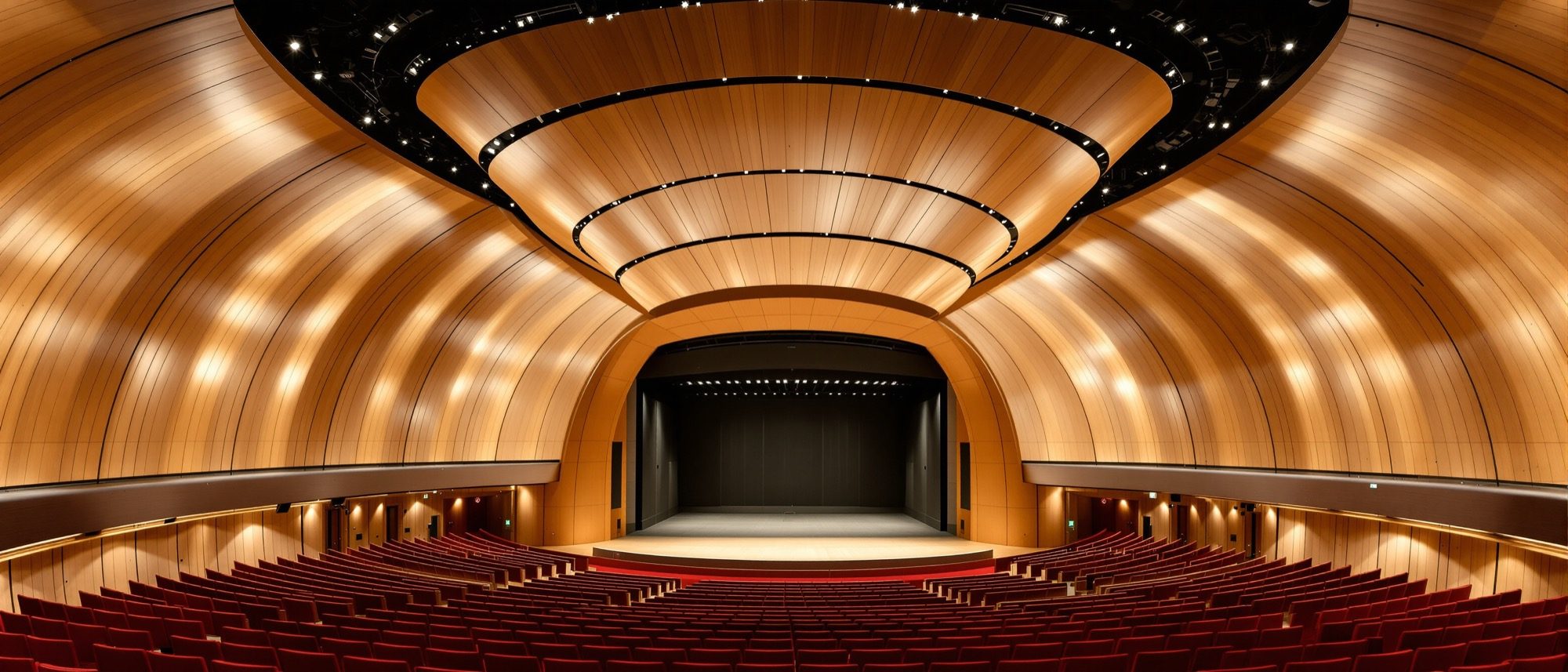
Auditorium Design
Where the whole art comes together — and the hall that started it.
The auditorium is acoustics' supreme test, where every principle of the course meets. Its design balances volume per seat (which sets the reverberation time), a raked floor for direct sound, a shape that distributes without focusing, and reflectors that deliver early reflections within 50 ms. A field born in 1900, when one young physicist made Boston Symphony Hall the first room designed by calculation.
Learning objectives
By the end of this lesson, you will be able to — mapped to the course outcomes for Acoustics in Architecture:
Apply volume per seat, rake and shape to an auditorium.
Use early reflections and reflectors, and set the RT target.
Apply acoustic principles to other building types.
Recount the origin of the field — Sabine and Boston Symphony Hall.
Designing the auditorium
Volume per seat sets the RT, a raked floor gives direct sound and sightlines, and the shape distributes sound — avoid concave walls that focus. Early reflections within 50 ms reinforce clarity.[2, 1]
The big moves
An auditorium's acoustics start with three decisions. VOLUME PER SEAT sets the achievable reverberation time — roughly 3.5–4.5 m³/seat for speech, up to ~7–10 m³/seat for a concert hall. A raked (sloped) FLOOR gives every listener line-of-sight to the source, strengthening the DIRECT sound and the view. And the SHAPE — a fan, rectangular 'shoebox' or horseshoe — distributes sound; FLAG: avoid concave rear walls and domes, which focus. The celebrated shoebox halls prize strong lateral reflections.[2, 1]
Other buildings & the first hall
Every building type has its own acoustic brief; and the field began in 1900 with Sabine and Boston Symphony Hall.[1, 3]
Each its own brief
Every space has an acoustic brief. LECTURE HALLS and CLASSROOMS want a short RT (~0.4–0.8 s) and low background noise for intelligibility. OPEN-PLAN OFFICES use 'absorb, block, cover' (sound masking) for speech privacy. RECORDING STUDIOS combine high isolation with controlled rooms. WORSHIP spaces want a long RT for music but struggle with speech — a compromise plus reinforcement. CINEMAS, LIBRARIES and HOSPITALS each set their own targets for RT, isolation and background noise.[1, 2]
At a glance
| Aspect | One | The other |
|---|---|---|
| Volume per seat | Speech: ~3.5–4.5 m³/seat | Concert: ~7–10 m³/seat |
| Shape | Fan / shoebox / horseshoe: good | Concave rear wall / dome: focuses (bad) |
| Reflections | Early (<50 ms): reinforce clarity | Late (>50 ms): become echoes |
| RT target | Speech hall: ~0.7–1.0 s | Concert hall: ~1.8–2.2 s |
| The first hall | Sabine's law (volume & absorption) | Boston Symphony Hall, 1900 |
Key terms
The room volume divided by seats — sets the achievable RT (~3.5–4.5 m³ speech, ~7–10 m³ concert).
The slope of the seating giving line-of-sight and stronger direct sound.
A rectangular auditorium prizing strong lateral reflections (e.g. Boston, Vienna).
Reflections arriving within ~50 ms of the direct sound — they reinforce clarity.
A surface (side wall, ceiling, stage canopy) shaped to deliver early reflections.
A delay-aligned PA system supplementing — not replacing — the natural acoustics.
Reverberation time depends only on volume and absorption — the foundation of the field.
1900 — the first auditorium designed by acoustic calculation (Sabine).
Studio task
Sketch the section and plan of a 500-seat hall — set the volume per seat for your use, rake the floor, place a ceiling reflector for early reflections, choose a non-focusing shape, and state your target reverberation time.
Self-assessment
1. Reflections that arrive within about 50 ms of the direct sound —
2. A symphonic concert hall typically needs more volume per seat than a speech hall because —
3. The first auditorium designed using scientific acoustic principles was —
Recap
References & further reading
- [1]Leslie L. Doelle, Environmental Acoustics. McGraw-Hill, 1972.
- [2]M. David Egan, Architectural Acoustics. McGraw-Hill / J. Ross Publishing.
- [3]Wallace Clement Sabine, Collected Papers on Acoustics. Harvard University Press, 1922. https://archive.org/details/collectedpaperso00sabiuoft
Further reading
- M. David Egan, Architectural Acoustics. J. Ross Publishing.
- Leo Beranek, Concert Halls and Opera Houses. Springer.
- Wallace Sabine, Collected Papers on Acoustics. Dover.
Sources gathered and fact-checked June 2026. Published values vary by source, sample and method — treat as indicative and confirm against the cited standard before structural use.
The author
Amogh N P
Architect, interior designer, and creative polymath. Studio Matrx began in his notebooks — his vision of design made honest, useful, and open to everyone. Its Academy is written and taught in his memory, and free, forever.
More about Amogh →