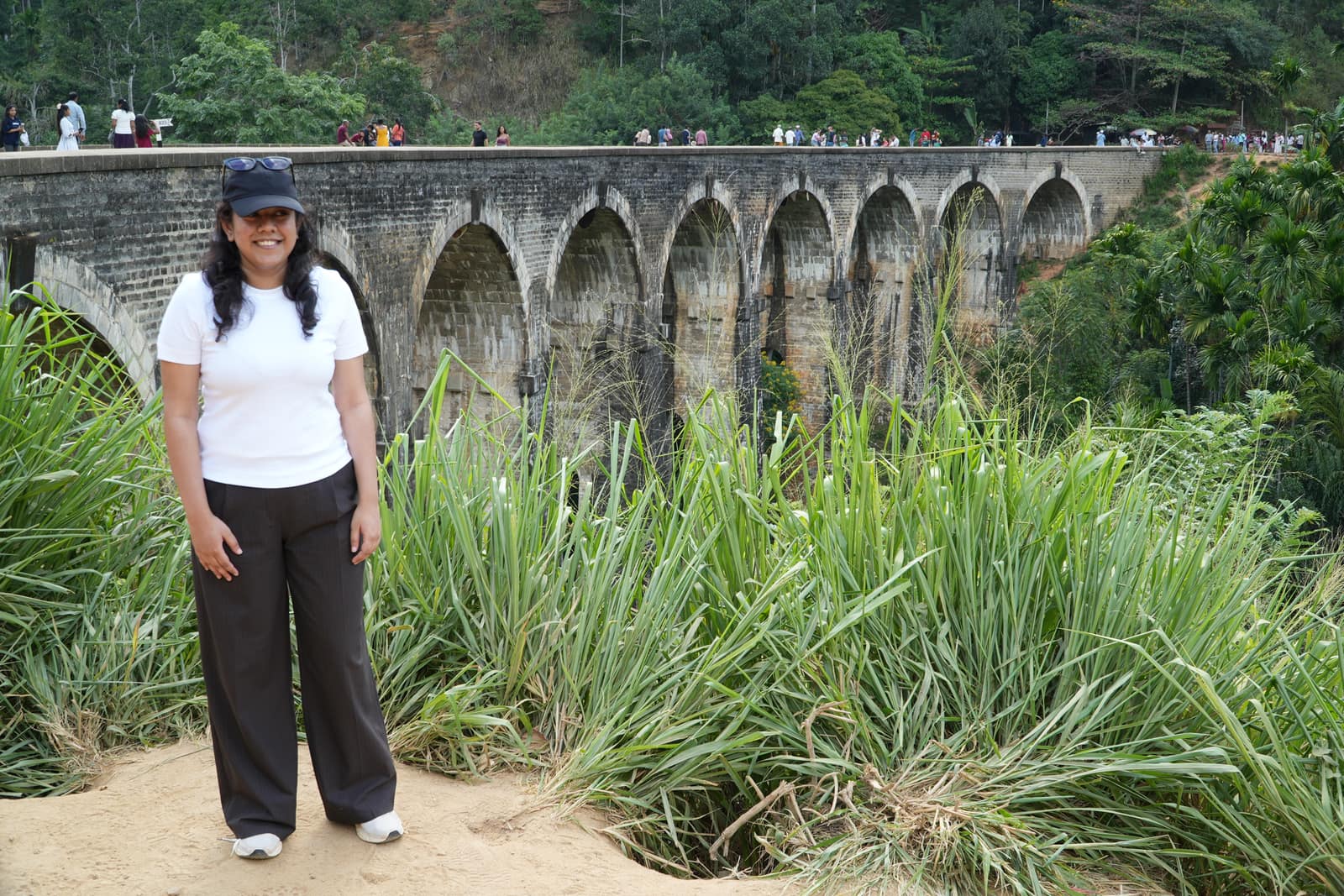
The Nine Arch Bridge, Ella — the Bridge in the Sky
A field note from Sri Lanka's hill country, where a curving, hundred-year-old railway viaduct crosses a gorge on nine stone arches — the story everyone tells, the record that survives, and why an all-masonry bridge still carries the morning train.
The train down from Nanu Oya — the little railway halt that serves Nuwara Eliya, high in the tea hills — is often called one of the most beautiful rail journeys in the world, and for the few hours it takes to reach Ella nobody on board argues. The windows fill with tea: pickers waist-deep in green, waterfalls that appear for a second and are gone, children waving from level crossings, the whole carriage leaning out to photograph a country that refuses to stop being photogenic. I got down at Ella still a little dazed by it — and the thing I had travelled all this way to see was a short walk beyond the town, on the very line I had just ridden.
People come to Ella, in the hill country of Sri Lanka, for the usual reasons — to walk, to drink far too much tea, and to see the one improbable structure that appears on every postcard of the island. What I did not expect was to spend a whole afternoon simply reading it, the way you read a building you cannot stop thinking about.
This is a field note, not a guide, and it belongs to no chapter of our Kitchen issue. I make no apology for that. Some buildings ask to be written about the moment you are standing in front of them.
The walk out from Ella
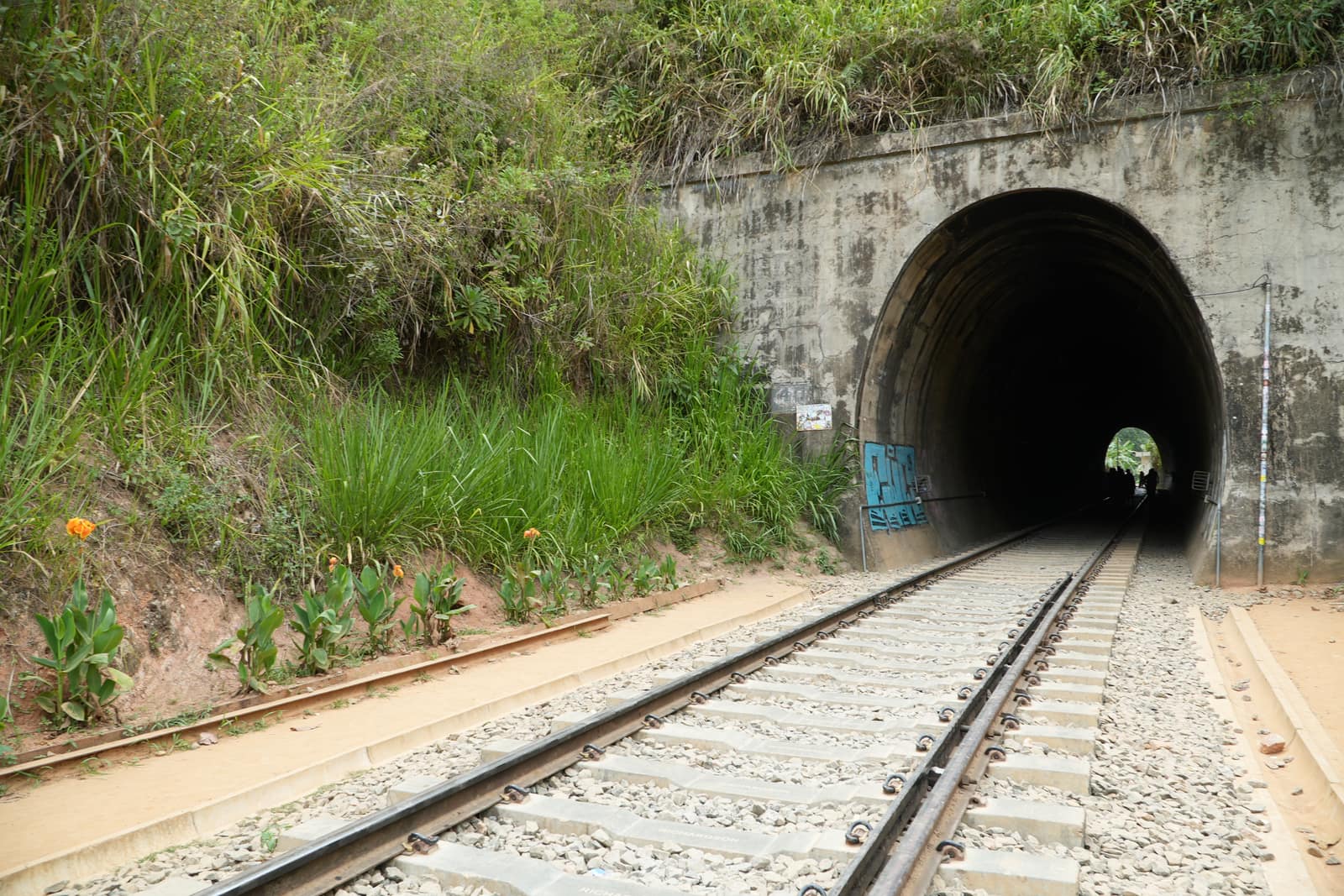
You reach the bridge on foot. From Ella town it is a gentle forty-minute walk — first along the road, then down a path between tea bushes and small houses, and finally along the railway track itself, which is the part every guidebook warns you against and everyone does anyway. The rails run through a short tunnel, bend, and then the trees drop away and the bridge is simply there, spanning a wide green gorge on the line between Ella and the next station, Demodara.
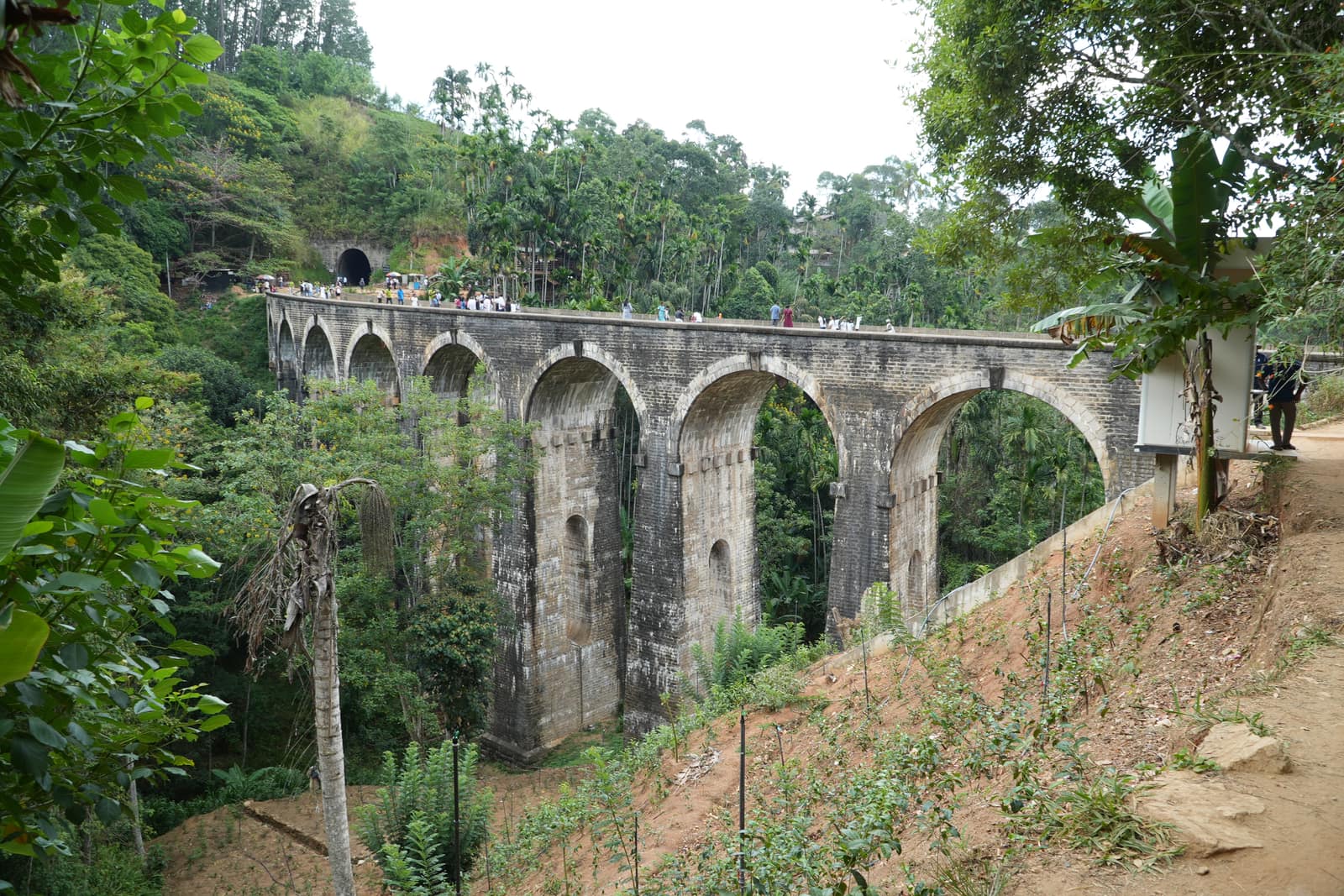
It sits at around 944 metres above sea level, in that cool, wet band of the hill country where the light is always a little silver and the clouds move through the valley rather than over it. People here call it Ahas Namaye Palama — the Bridge in the Sky — and on the mornings when the mist fills the gorge beneath it, the name stops being poetry and becomes plain description. The arches rise out of the cloud with nothing visible holding them up.
What you are actually looking at
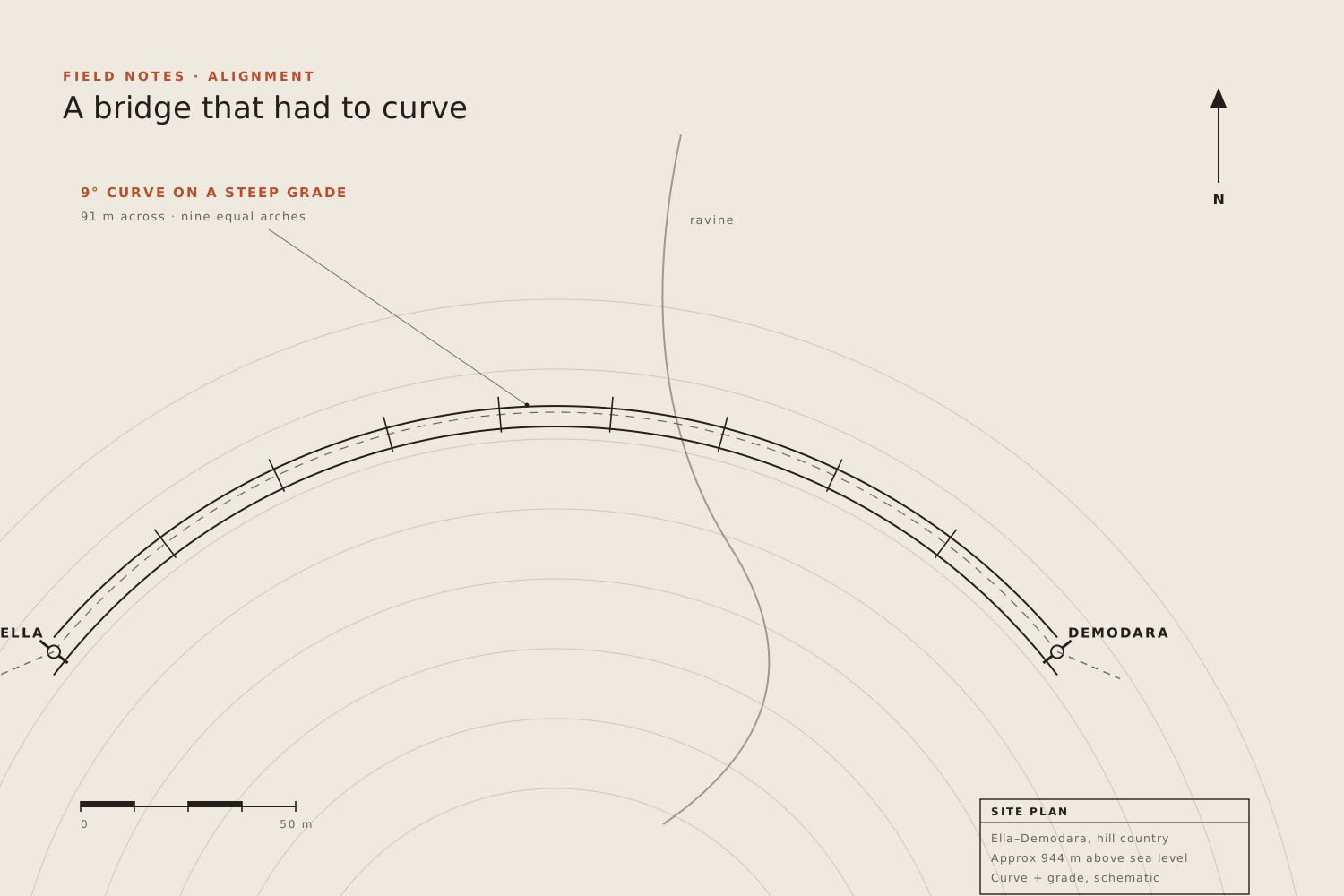
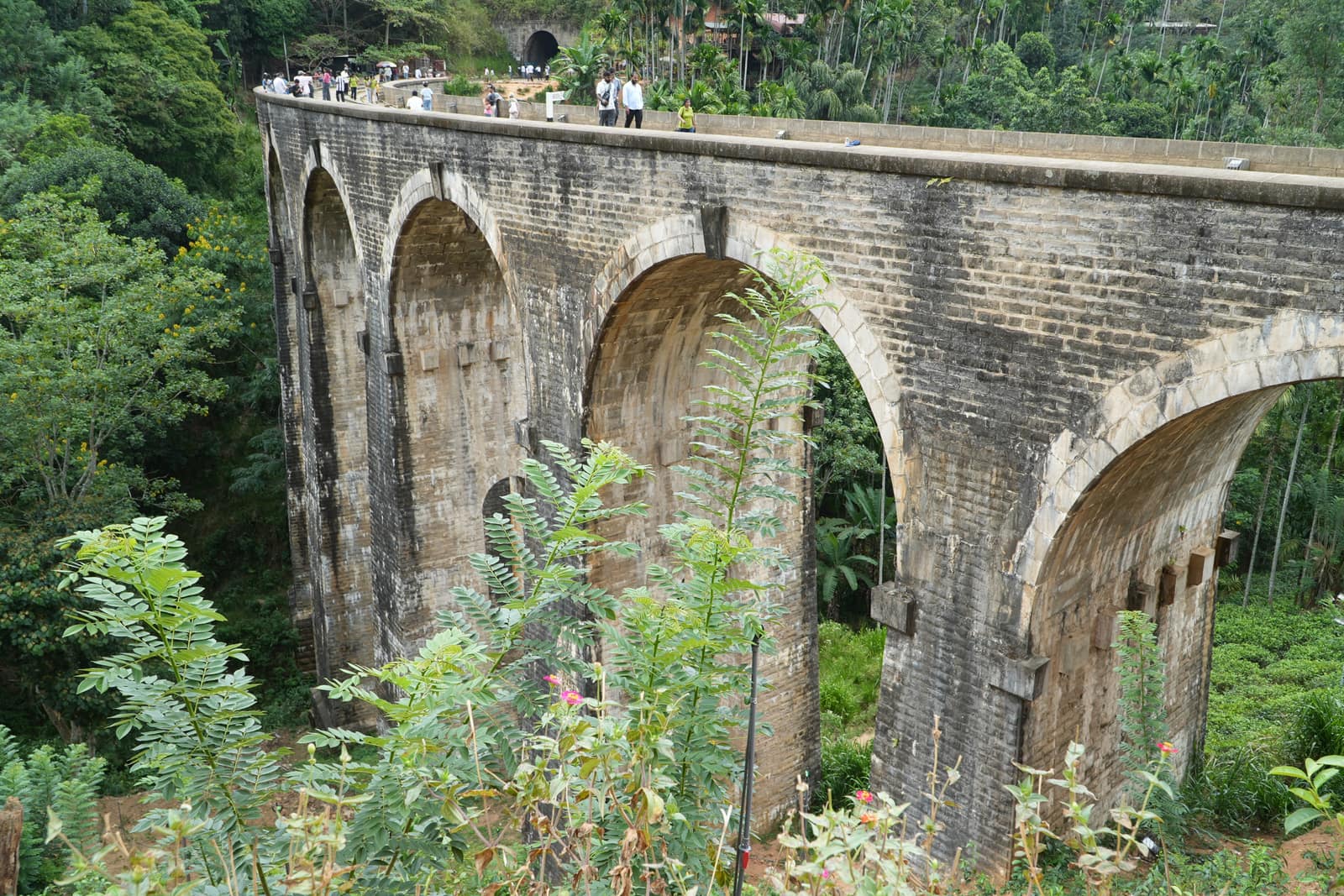
Set aside the postcards and the drone footage and the couples in matching outfits waiting for the train, and what remains is a very disciplined piece of engineering. Nine semicircular arches, each of the same span, carry a single railway track ninety-one metres across the gorge. The deck stands about twenty-four metres above the valley floor at its highest point, and is a little over seven and a half metres wide — just enough for the track and its two parapets.
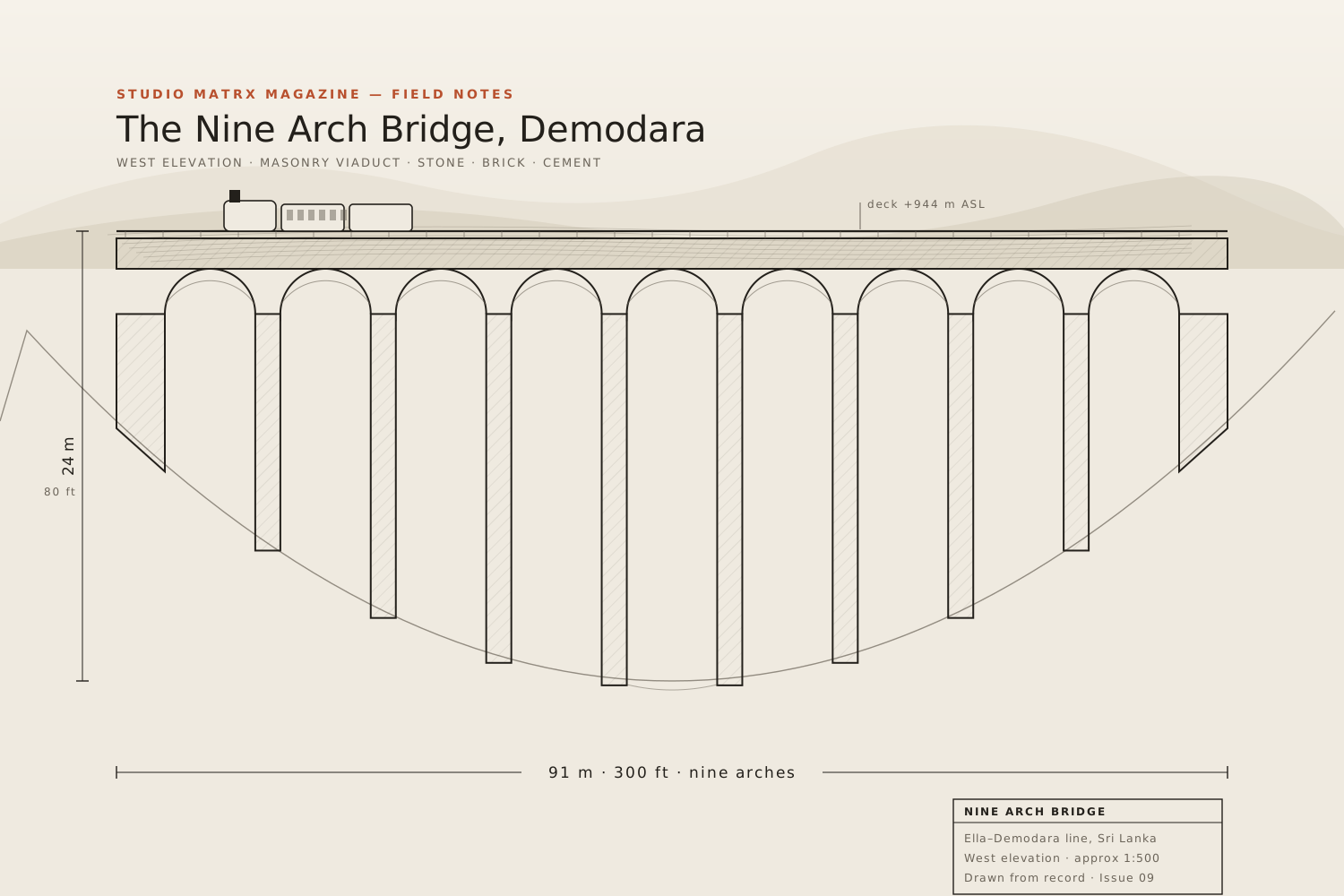
The arches are not there for beauty, though they are beautiful. An arch is simply the most economical way to carry a load across a gap using a material that is strong when squeezed and weak when stretched — which is to say, using stone and brick. Nine smaller arches, rather than one heroic span, meant shorter timber centring to build over, smaller stones to lift by hand, and piers that could step down comfortably onto an uneven valley floor. It is a solution arrived at by arithmetic as much as by imagination.
And it curves. The line does not cross the gorge in a straight dash; it swings through it on a tight bend — a curve of roughly nine degrees — while at the same time climbing a steep grade toward Demodara. Building a masonry viaduct that is simultaneously curving and rising is a great deal harder than building a straight, level one, and the fact that it was done at all, by hand, on the side of a mountain, is the first thing that makes you take the structure seriously.
The story everyone tells
Every visitor is told the same story, usually by someone selling tea near the viewpoint, and it is a wonderful one. During the First World War, the account goes, the steel that had been ordered for the bridge was requisitioned for the war effort in Europe. Rather than wait, the builders carried on without it — raising the entire structure from stone, brick and cement, with not a girder in sight. And it was built, they say, by a local man named P. K. Appuhami, a villager with no formal engineering training, who succeeded where the British engineers had faltered.
It is the kind of story you want to be true, and parts of it may well be. But honesty is rather the whole point of how we write at Studio Matrx, so it is worth gently separating what is documented from what is beloved.
The bridge was built by the Ceylon Government Railway and completed at the close of the 1910s — the official report on it, published in 1923, is titled, plainly, Construction of a Concrete Railway Viaduct in Ceylon. The design is credited to Harold Cuthbert Marwood of the Railway Construction Department; the Ceylonese engineer D. J. Wimalasurendra — later celebrated as the father of hydropower on the island — is associated with the works, and the chief construction engineer was M. Cole Bowen. It was raised by local labour under British supervision, from stone, brick and cement, with concrete cornice blocks and locally made sand-cement facing blocks.
The tale of Appuhami, and of the vanished wartime steel, do not appear in those documents. That does not make them worthless. Folklore is how a community takes ownership of a thing built on its land — it is the village insisting, and it is not wrong to, that the bridge is theirs, made by their hands, standing on their hillside. The engineer's report and the tea-seller's story are both true, in the ways that matter to each teller. I would only ask that we not repeat the legend as established fact, and not dismiss it as mere fable either.
The engineer's report and the tea-seller's story are both true — in the ways that matter to each teller.
Built from what the hills could give
What is not in dispute is the material honesty of the thing, and this is what held me longest. There is no steel frame hiding inside these arches, doing the real work while the masonry only pretends. The stone is the structure. The brick is the structure. What you see is, very nearly, exactly what is holding you up.
That was partly necessity — carrying steel up to a remote mountainside in colonial Ceylon was slow and costly whatever was happening in Europe — and partly the plain competence of masonry construction, which was mature, local, and beholden to no distant supply chain. The facing blocks were cast from sand and cement close to the site. The hands were local. The result is a bridge that belongs to its hillside not as an ornament dropped onto it, but as something grown out of the same ground, in the same colours.
Why it still stands
Here is the quiet marvel. A steel bridge of the same age would, by now, have been painted a dozen times over, patched and re-patched, fighting rust through every monsoon. This one has, for the most part, simply stood. Trains still cross it several times a day, a full century after it was raised.
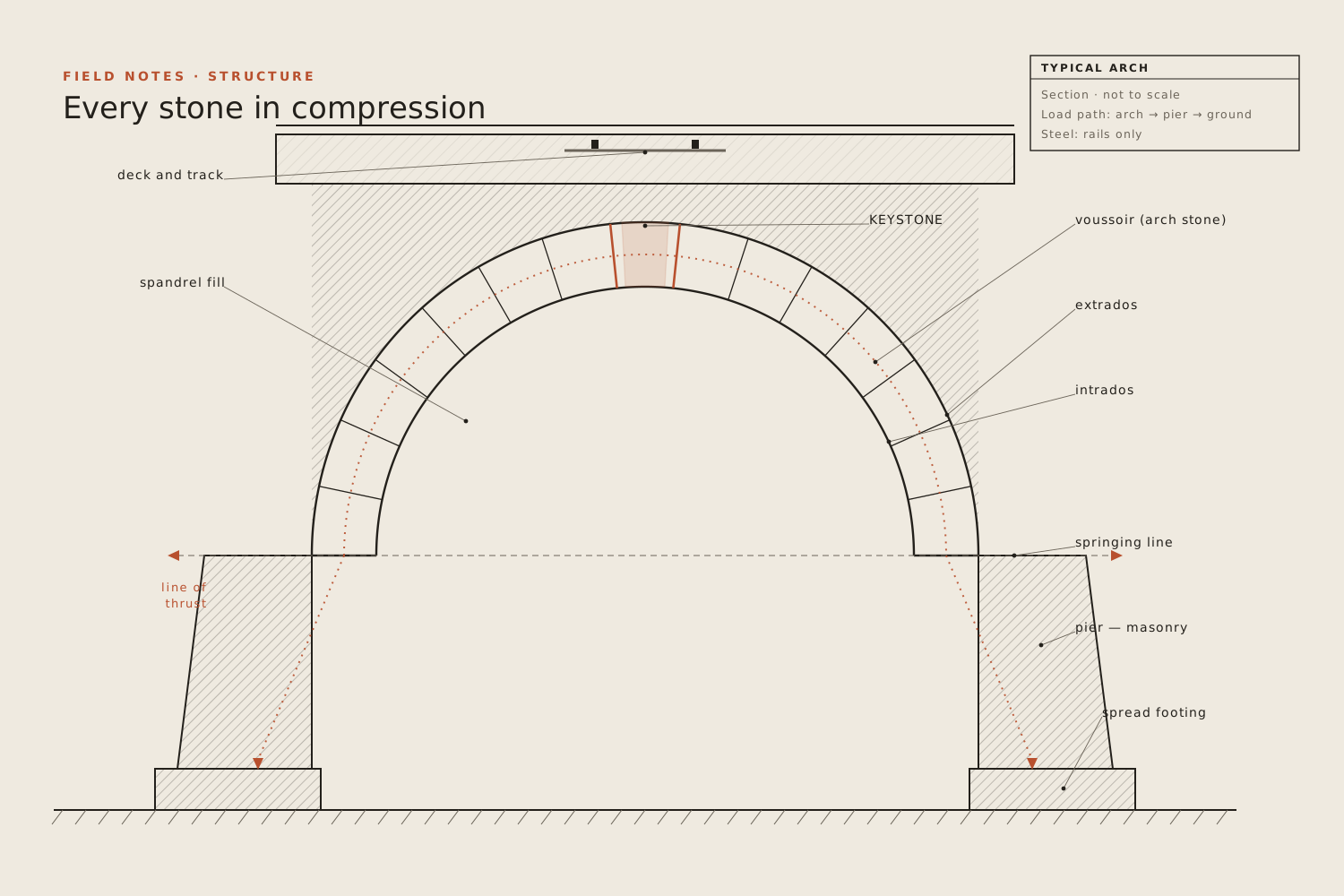
The reason is in the section drawing above. In a true arch, every stone is in compression — squeezed, never stretched. The weight of the train, and the arch's own considerable mass, travels down through the curve of each arch as a line of thrust, into the piers, and on into the rock. Each arch also pushes sideways against its neighbours, so the whole nine-arch run braces itself, pier against pier, until the thrust finally earths itself in the heavy abutments at either end. Stone is extraordinarily good at being squeezed. Kept dry and drained, and never asked to do anything it dislikes, it can go on doing it for centuries.
This is the deep lesson of the masonry arch, and it is older than any engineering code: give the load a path it wants to follow, and the structure barely has to try. The bridge is not fighting gravity. It is agreeing with it.
The bridge is not fighting gravity. It is agreeing with it.
What an architect carries home
I sat on the slope opposite for a long while, waiting — as everyone does — for the little blue train to cross, and wondering what the editor of a Kitchen issue was doing writing at such length about a railway bridge. This, I decided, is the connection, if one is wanted: the Nine Arch Bridge is a room that works, in exactly the sense this issue has been chasing. It was built for a single, honest use — to carry a train across a gorge — and every decision in it serves that use without disguise or apology.
There is no false ceiling here, no applied finish pretending to be structure, no imported material standing in for local skill. A good kitchen and a good bridge, it turns out, want the same virtues: clarity about what the thing is for, honesty about how it is made, and materials used for what they are genuinely good at. The counter that is stone because stone survives heat and water; the arch that is stone because stone survives being squeezed. It is the same discipline, at wildly different scales.
The other thing I carried home was about the two stories — the report and the legend — and the responsibility of choosing to hold both. As designers, we are forever tempted to flatten a building into one tidy caption. The Nine Arch Bridge refuses. It is a colonial railway work and a village triumph and a wartime improvisation and a hundred-year-old masterpiece of ordinary masonry, all at once, and it is the more interesting for being every one of them.
A good kitchen and a good bridge want the same virtues: clarity about what a thing is for, and honesty about how it is made.
The train came, in the end — small, unhurried and absurdly photogenic — and the whole hillside lifted its phones. I put mine down for a moment and simply watched it cross: a hundred years of stone carrying the morning as though it were nothing at all. Then I picked the phone back up, because I am, after all, the Digital Editor, and some of those photographs will find their way onto this very page once I am home.
Understand the structure before you photograph it. That is very nearly the whole of what the Bridge in the Sky taught me — and it is, I think, very nearly the whole of what we try to do here.