
Why we stopped fearing the rain
A note on designing with the monsoon, not against it.

There is a particular sound every Indian knows. The first fat drops of the year hitting dry earth, and then that smell — petrichor, though we had a word for it long before the scientists did. For a few seconds, the whole subcontinent exhales. And then, almost immediately, we begin to worry. Will the terrace leak again? Did we clear the drains? Why is there a damp patch blooming on the bedroom wall like a slow bruise?
We have been taught to meet the monsoon as a siege. Seal the building. Caulk the gaps. Pile sandbags of waterproofing chemicals against an enemy at the gate. And every year, the enemy finds a way in anyway — through a hairline crack, a badly sloped sunshade, a chajja that throws water onto the wall instead of away from it. We fight the rain, and the rain, patient and ancient, usually wins.
This issue is about a quieter idea: that we have been fighting the wrong war.
Go to Kerala, or to a Goan balcão, or to the stepped tanks of Gujarat, and you find buildings that were never afraid of water. The sloped tiled roof does not resist the downpour; it choreographs it, sending it sheeting cleanly to a courtyard that was designed to receive it. The traditional nalukettu gathers rain into its open heart and lets it cool the rooms around it. The temple tank does not drain water away as waste — it keeps it, reveres it, returns it to the ground. Our ancestors did not waterproof against the monsoon. They made an arrangement with it.
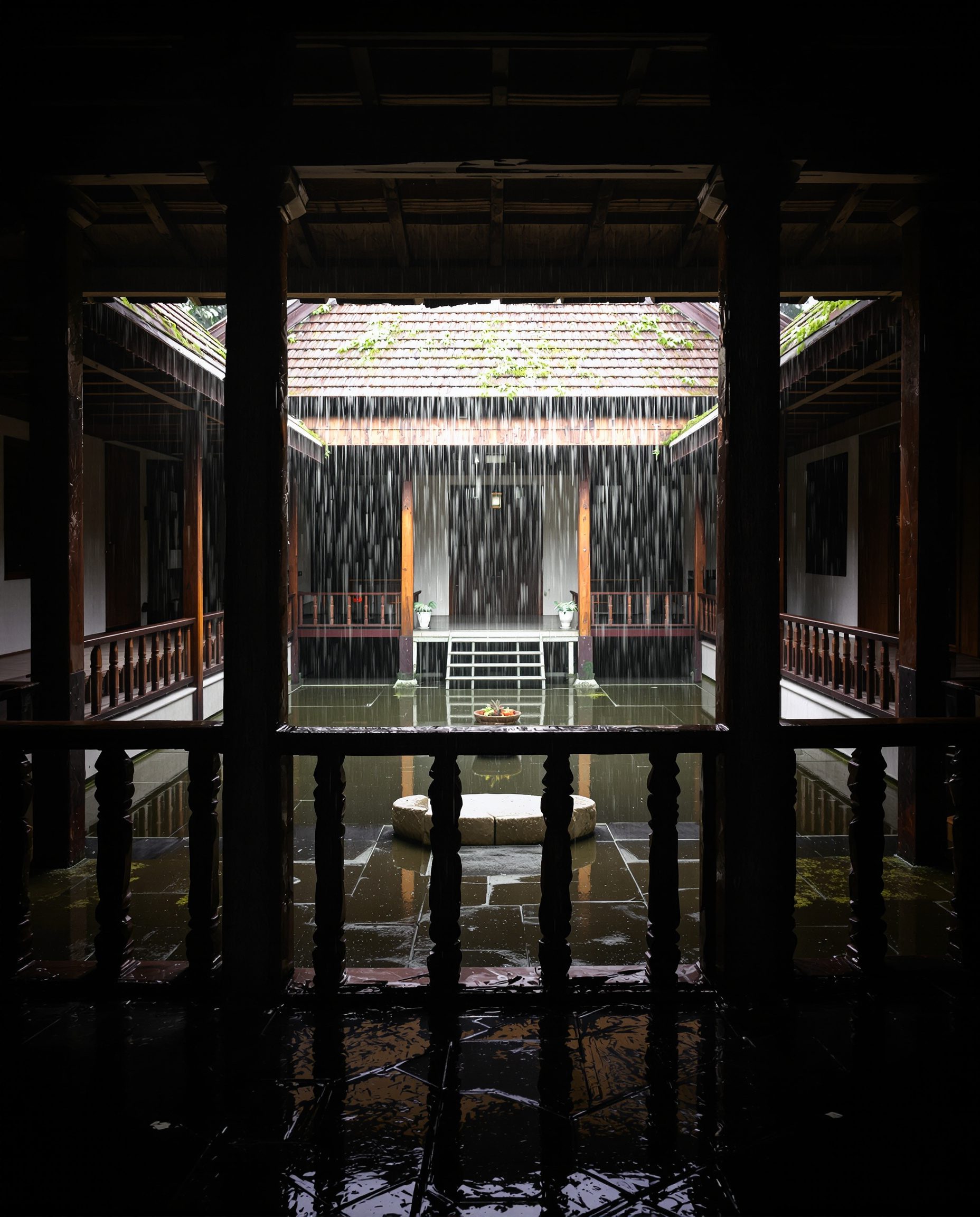
Somewhere in the rush to build faster and cheaper, we forgot the arrangement. We poured flat slabs in a land of cloudbursts. We sealed homes that needed to breathe, and then ran dehumidifiers to undo the damage. We treated water as a problem to be repelled rather than a force to be guided. The bill for that forgetting arrives every June, in leaks and seepage and the slow rot of buildings that were never on speaking terms with their own climate.
At Studio Matrx, this is the heart of how we think about design — not just for rain, but for everything. The Indian way of building, at its best, was never about conquering conditions. It was about reading them. The sun, the wind, the festival crowd, the joint family, the monsoon — good design does not wall these out. It listens, and then it makes room. A house that works with the heat needs less air-conditioning. A home that works with the family needs fewer apologies. And a building that works with the rain needs far less waterproofing, because it was never picking a fight in the first place.
This is not nostalgia. We are not asking you to abandon RCC for laterite, or to romanticise a leaking ancestral home. The architects in these pages use modern materials, modern tools, modern budgets. What they have recovered is older — an attitude. They have stopped treating the monsoon as an intruder and started treating it as a guest the house was built to welcome.
So this month, before the next cloudburst, we offer a small reorientation. Walk your terrace and ask not “how do I keep the water out?” but “where does the water want to go, and have I made it a path?” Stand in the first rain and watch how your building behaves. It is trying to tell you something.
We stopped fearing the rain the day we started listening to it. We hope, after this issue, you might too.
- MBBS (JJMMC), MS (PGIMER, Chandigarh)
- MBA in Hospital & Healthcare Management (BITS, Pilani)
- Postgraduate Certificate in Technology Leadership and Innovation (MIT, USA)
- Executive Programme in Strategic Management (IIM, Lucknow)
- Senior Management Programme in Healthcare Management (IIM, Kozhikode)
- Advanced Certificate in AI for Digital Health and Imaging Program (IISc, Bengaluru)