
Working on a Project
The furniture side of a real job — from brief and drawings to specification, the FF&E schedule, procurement and designing for long life.
Everything so far becomes useful here. On a live project, furniture has to be briefed, planned, drawn, specified, scheduled, bought or made, delivered and installed — on budget and on programme. This is the professional discipline that turns good taste into a delivered interior: the drawings a maker can build from, the specification a supplier is held to, and the one document — the FF&E schedule — that keeps the whole thing under control.
What you'll be able to do
By the end of this module you will be able to — mapped to the course outcomes for Furniture for Interior Design:
Describe the end-to-end furniture workflow on a project — brief, plan, drawings, specification, schedule, procurement and installation.
Produce the key furniture deliverables — layout drawings, a clear specification, and an FF&E schedule.
Control furniture on a project against budget, programme and quality.
Design furniture choices for sustainability and long life, not just first appearance.
The workflow
Furniture work runs a clear sequence, and each step feeds the next: start from the brief and plan, draw it so it can be built or bought, specify it so it can be held to, and control it all through the FF&E schedule.[1, 2]
Start with the job, not the chair
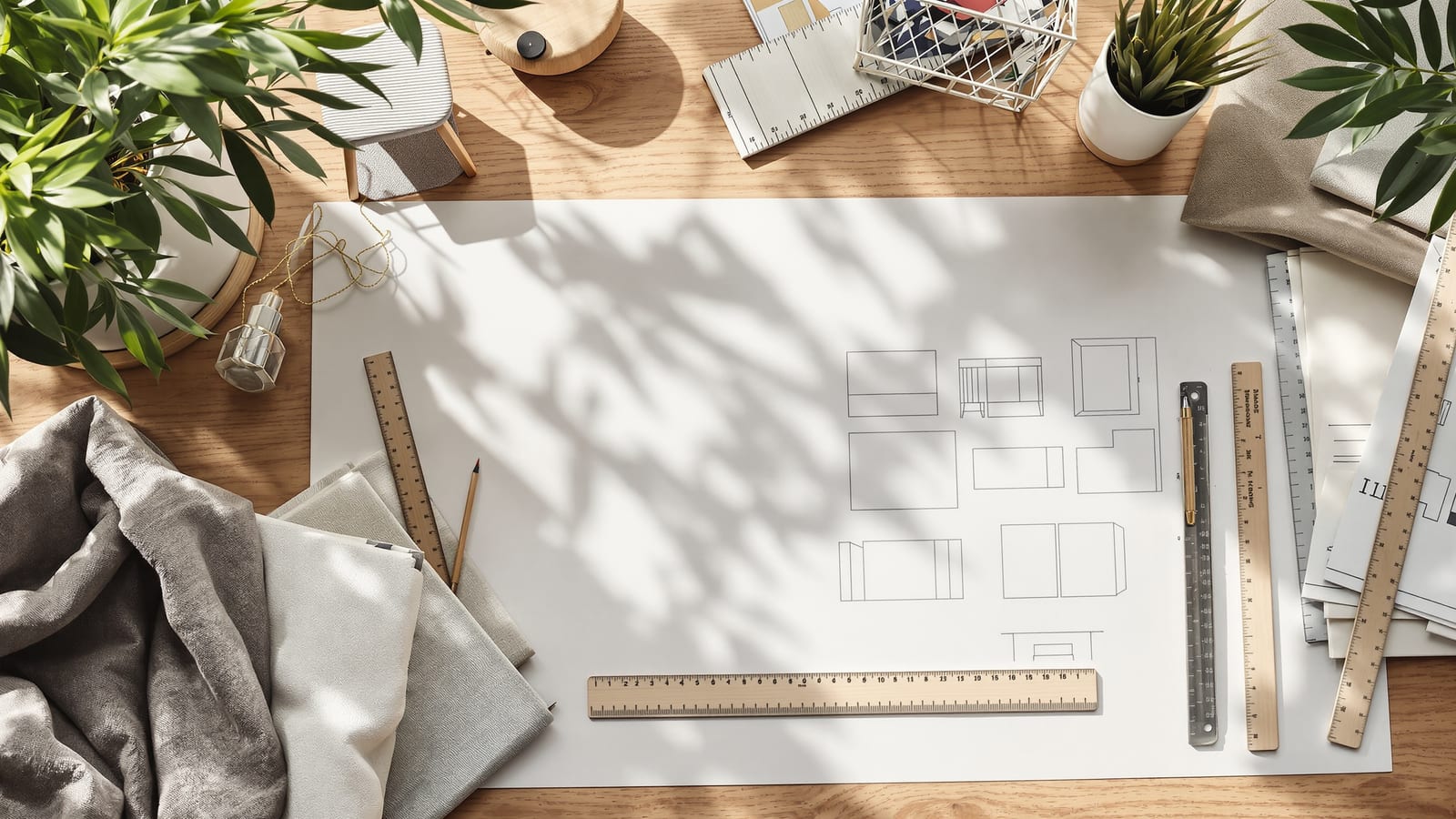
Furniture work begins with the BRIEF — what the space is for, who uses it, the budget, the programme, and the image the client wants. From it you produce the FURNITURE LAYOUT (Modules I–II): zones, circulation and every piece placed and sized to the body. The plan is the foundation of everything downstream — the schedule, the budget, the order of works — so it is worth getting right and signed off before you draw a single detail.[1, 2]
Delivering it
With the paperwork set, the job gets delivered — procured to programme, controlled against budget, designed for long life, and handed over clean.[1, 4]
Getting it bought, made and delivered
With drawings, specs and schedule set, PROCUREMENT executes: raising orders, agreeing lead times, commissioning makers, tracking deliveries, and coordinating the installation sequence (heavy and fitted items first, loose last). Prototypes and SAMPLES are approved before bulk orders. The schedule drives it, flagging long-lead and bespoke items early — because the piece that scuppers an opening is almost always the one with the longest, least-watched lead time.[1, 4]


The professional's decisions
| Aspect | One | The other |
|---|---|---|
| Where a project starts | The brief and the furniture plan | Not the chair you like — that comes later |
| Off-the-shelf vs bespoke drawings | Off-the-shelf — layout plan + model reference | Bespoke — full workshop plan/elevation/section/details |
| The controlling document | The FF&E schedule — budget, tracker, programme in one | Not the mood board — that's the start, not the control |
| Protecting the programme | Order long-lead & bespoke items first | Loose, in-stock items last |
| Sustainability | Buy less, better, keep longer; design for repair & end of life | Not a finish added at the end |
Key terms
The statement of what the project must do — function, users, budget, programme and image — that furniture work starts from.
Layout plans plus, for bespoke, workshop plan/elevation/section/details good enough to build from.
The written instruction fixing each item's maker/model or design, dimensions, material, finish and standards.
The master list of every Furniture, Fixture & Equipment item — qty, supplier, spec, cost, lead time and status; budget, tracker and programme in one.
Ordering, commissioning, tracking and delivering the furniture per the schedule.
Order-to-delivery time; long-lead and bespoke items are ordered first to protect the programme.
Deliberately deciding where to spend and where to save — money on pieces that show and take hard use.
What happens to a piece when it's done — can it be re-covered, disassembled and recycled? A design decision, not an afterthought.
Practice task
Build a mini FF&E schedule for one room. List each furniture item with its quantity, the route (off-the-shelf / reuse / bespoke), a rough cost and lead time, and a status. Then flag the longest lead-time item — the one you would order first — and one item where you would spend more, and one where you would save.
Self-check
1. What is the single document that controls furniture cost, procurement and programme on a project?
2. Why must bespoke furniture be fully drawn (plan, elevation, section, details)?
3. The most sustainable furniture strategy is usually to —
Recap
References & further reading
- [1]Drew Plunkett & Sam Booth, Furniture for Interior Design. London: Laurence King Publishing, 2015.
- [2]Francis D.K. Ching & Corky Binggeli, Interior Design Illustrated (3rd ed.). Hoboken: John Wiley & Sons, 2012.
- [3]Chris Grimley & Mimi Love, The Interior Design Reference & Specification Book. Beverly, MA: Rockport, 2018.
- [4]FF&E schedules and specification writing — professional interior-design practice references.
- [5]Circular-economy and sustainable furniture design guidance (industry references).
Further reading
- Chris Grimley & Mimi Love, The Interior Design Reference & Specification Book. Rockport.
- Drew Plunkett & Sam Booth, Furniture for Interior Design. Laurence King.
- Christine M. Piotrowski, Professional Practice for Interior Designers. Wiley.
Sources gathered and fact-checked June 2026. Published values vary by source, sample and method — treat as indicative and confirm against the cited standard before structural use.
You've completed the course
From reading the context, sizing to the body and knowing the classics, to sourcing, materials and the FF&E schedule — that is furniture for interior design, the professional way. Carry one habit into practice: specify furniture that is comfortable, appropriate to its context, honestly made and built to last — and let the schedule prove it.