
 Lesson 2.3
Lesson 2.3 · Air, Water & Monsoon
The Kitchen in the Southeast
The fire corner was sound engineering for a smoky wood fire — then the chimney hood arrived and quietly cancelled the reason.
The smartest rule in the house — for a kitchen that no longer exists
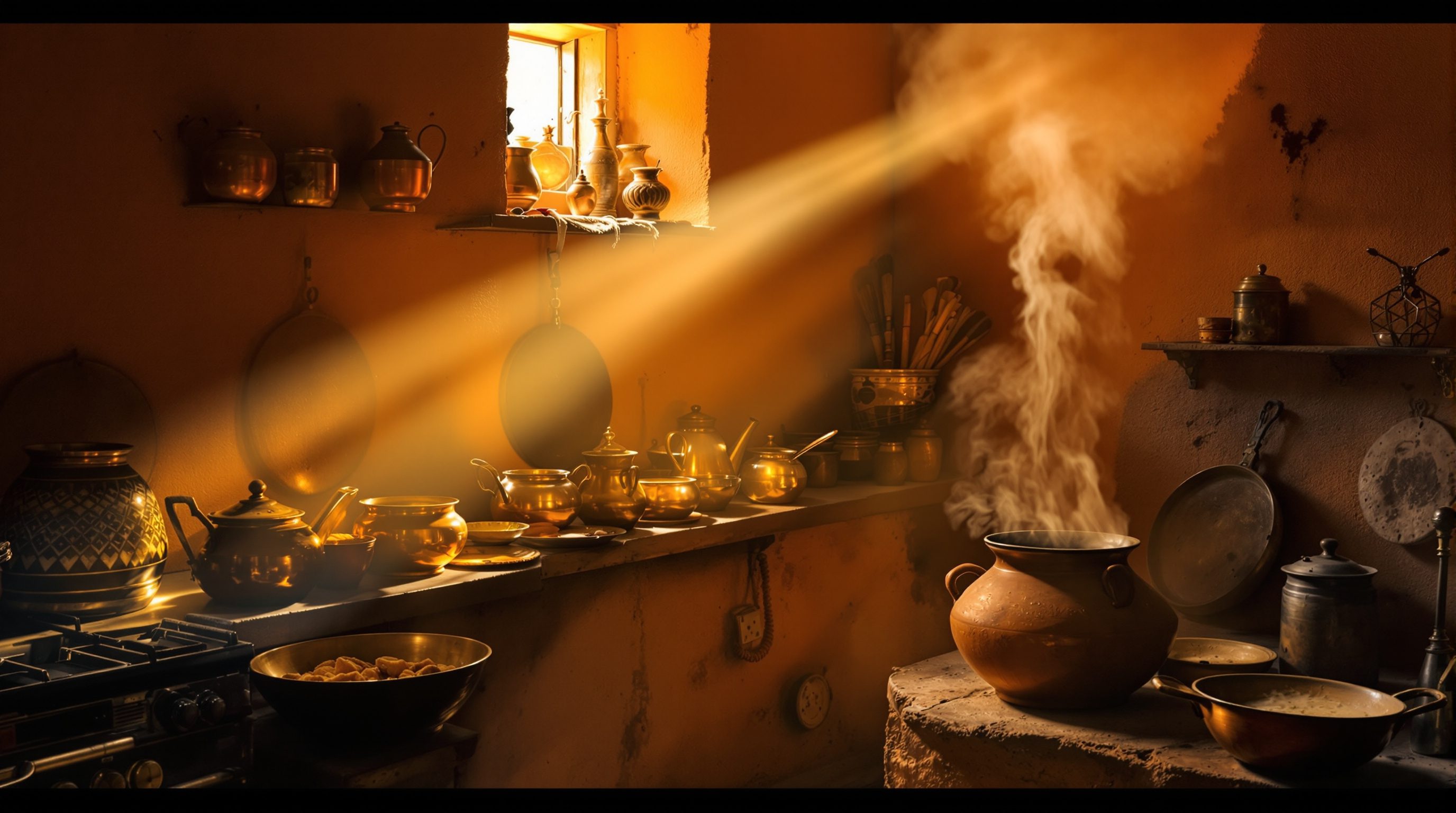
Picture a single-room kitchen at dawn: a clay chulha, dung cakes and firewood, no chimney, smoke looking for a way out. The grandmother who built her cooking corner in the south-east was not obeying superstition — she was doing fluid dynamics with her eyes closed. The trouble is that her kitchen had no hood, and yours does.
The rule, and the corner it names
Vastu assigns the south-east of a home to Agni, the fire element, and prescribes the kitchen there — ideally with the cook facing east. It is one of the most consistently repeated rules in Indian residential Vastu, and one of the most confidently defended.
It is also, in this course, our flagship example of a 🟡 plausible-but-contingent rule. That means it is neither folklore to be mocked nor physics to be obeyed forever. It is something rarer and more interesting: good design whose foundation has shifted under it. To judge it fairly we have to do two separate things — recover the logic it genuinely had, and then check whether that logic still holds in your kitchen. Most arguments about this rule fail because they only do one or the other.
Why it was genuinely clever
Reset your mental image. The kitchen this rule was written for had an open wood or dung fire, no chimney or exhaust hood, and often no separate flue at all — just a smoky room and a doorway. Under those constraints, the south-east does three sensible things at once.
First, morning sun. The SE catches gentle early light, which dried out a perpetually damp, soot-laden space, helped keep it hygienic, and lit the fire-lighting hour before lamps were lit. Second, and most elegantly: across much of India the prevailing summer wind blows from the south-west. Put the fire in the SE and that breeze pushes the smoke diagonally away — toward the NW corner and out — rather than dragging it across the living and sleeping rooms. Third, it keeps an open flame away from the cool, light north-east and the heavy south-west sleeping zone, both of which the house wanted kept calm.
That is not a coincidence dressed up as wisdom. That is a thoughtful, working solution to a real ventilation problem — smoke management without machinery.
Notice the move: the rule never says "manage your smoke." It says "south-east." The reason got compressed into a compass bearing — which is exactly how a good idea survives long enough to outlive its reason.
Why modern technology dated it
Now put a LPG or induction hob and an exhaust hood / chimney in that same corner. The smoke is now captured and ducted mechanically, the instant it rises. The entire smoke-clearance argument — the cleverest part of the original logic — simply evaporates. You no longer need the SW wind to carry anything anywhere; the hood does it in seconds, regardless of which way the house faces.
Worse, the rule may now work against you. A kitchen is already one of the hottest rooms in the house — appliances, hob, bodies, steam. The south-east collects both morning and a share of midday solar gain. So the literal rule adds solar heat to a room that is fighting heat anyway. A thermally-minded designer in a hot Indian city might actively prefer a cooler face for the kitchen and let the hood handle the air.
So the verdict is honest and a little poignant: the placement was right for its technology and is weak for yours. Nothing was ever wrong with the thinking. The kitchen changed underneath it.
This is the whole course in one corner: a 🟡 rule is a frozen answer to a question that has since been re-asked. Re-ask the question — how do I handle heat and smoke? — and the corner is just one possible answer, no longer the answer.
The honest move — and the cousin rule next door
The move (straight from Lesson 1.4) is to keep the intent and drop the literalism. The intent of the SE rule is excellent: a cooking space that handles its own heat and smoke and stays apart from the cool and sleeping zones. Meet that intent with today's tools — a properly sized extraction hood, cross-ventilation, and a thermally sensible orientation — instead of obeying the compass bearing as if it were the engineering. If the SE also happens to suit your plan, lovely; place it there with a clear conscience. Just don't pay a thermal penalty to hit a bearing.
There's a related rule worth a quick, separate verdict: "never put the kitchen in the cool north-east." This one has mild, living logic — the NE is the corner most homes want kept light, open and cool, and a hot, busy, cabinet-heavy kitchen squanders exactly that. So it earns a 🟡 for sensible layout reasons, not for fire-element ones. And finally, flag the assignment itself — "the SE belongs to the fire god Agni" — for what it is: a symbolic, cultural mapping. Respect it as belief. Just remember the physics rode alongside the symbol; it was never caused by it.
How each rule sorts
The fire corner, sorted honestly — including the cousin rule and the symbol.
Sound for a chimney-less wood fire: SE morning sun dried and lit the space, and the SW summer wind swept smoke diagonally out to the NW. Once you have an induction hob and an exhaust hood the smoke reason vanishes and the SE only adds solar heat — the rule outlived its reason.
Mild but real layout logic: most homes want the NE kept light, open and cool, and a hot, busy kitchen squanders that corner. It's a planning preference, not a fire-element law.
A symbolic, cultural assignment, not a physical cause. The genuine physics of sun and smoke once coincided with the symbol but was never produced by it — respect it as belief, don't dress it as engineering.
What to carry from the fire corner
- The SE kitchen was real, working smoke-and-sun engineering for an open, chimney-less wood fire — not superstition.
- An exhaust hood plus induction handles smoke mechanically, so the cleverest part of the logic simply evaporates.
- A kitchen is already hot; the SE adds solar gain, so the literal rule can now cost you the thing it once saved.
- Keep the intent — heat and smoke handled, apart from cool and sleeping zones — and meet it with extraction and orientation, not a compass bearing.
If fire taught us to read a rule by the technology it was written for, water and waste will test it: next, in 2.4, we tackle toilets, drains and the long-running SW/NW debate — where old soil-and-slope logic meets modern sealed plumbing.
The author
Amogh N P
Architect, interior designer, and creative polymath. Studio Matrx began in his notebooks — his vision of design made honest, useful, and open to everyone. Its Academy is written and taught in his memory, and free, forever.
More about Amogh →